





 Portuguese
  English
  Spanish
  4 min of reading
  0 comments


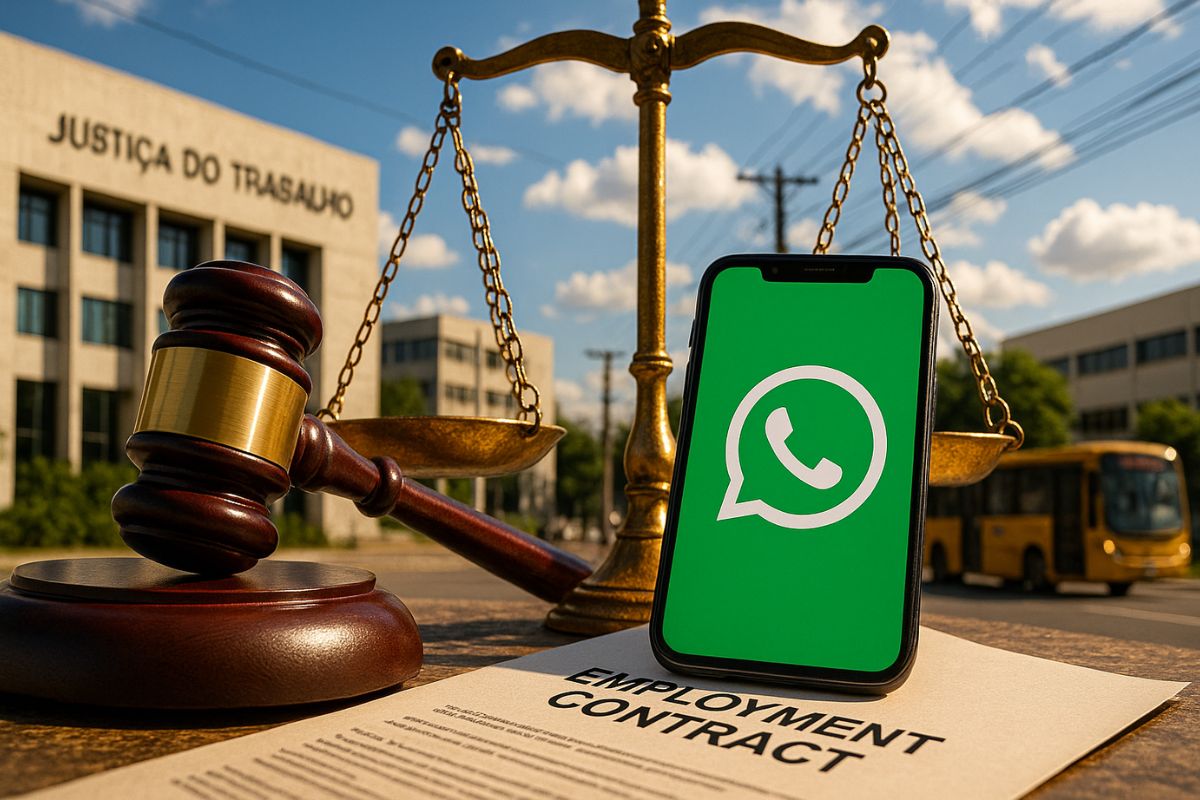
Recent Decisions Confirm That Messages Exchanged Via WhatsApp Have Legal Validity and Can Prove Employment Relationship, Ensuring That the Worker Has All the Labor Rights Foreseen by Law.
The Labor Court has begun to recognize that a job offer made and accepted via WhatsApp constitutes a valid employment contract, with all corresponding labor rights. The interpretation is based on the principle that the employment relationship depends on evidence of the work relationship and not on the existence of a formally signed contract.
In practice, messages sent through the application can serve as evidence of the agreement between the parties, demonstrating the position, salary, start of activities, and other essential elements of the employment relationship. According to the JusBrasil portal, courts have considered WhatsApp a legitimate means for establishing labor agreements, provided that the conversations reveal mutual consent and clarity in the terms of hire.
Screenshots and Messages Are Valid as Judicial Evidence
The courts have accepted screenshot and records of WhatsApp conversations as valid evidence in labor actions.
-
End of the 1-hour lunch break in the CLT? Current labor law maintains the break, allows for negotiated reductions, and defines rules for working hours and home office in Brazil.

-
Employee Fired After Accumulating 114 Days of Medical Leave in One Year, Labor Court Upholds Company’s Decision

-
Employee Fired While Treating Depression Wins in Court and Vale Is Required to Rehire Him Following Decision Based on the CLT and INSS Benefits

-
Workers Should Be Aware! March 6 Will Be The Fifth Business Day Of March And The Final Deadline For Companies To Pay Salaries According To The CLT


This includes exchanges of messages regarding the job offer, the start of activities, salary amounts, and working conditions.
Regional Labor Courts have already recognized employment relationships based solely on these conversations, as long as there is consistency and authenticity in the evidence presented.
A notable example occurred in the 18th Region Labor Court (Goiás), where a waitress proved her employment relationship with a restaurant using only WhatsApp messages.
The decision ensured the payment of overtime, night shift premium, and severance pay, recognizing that the contract, although informal, met all requirements of the Consolidation of Labor Laws (CLT).
Unfulfilled Job Offer Can Lead to Compensation
In addition to recognizing the employment relationship, companies that make job offers via WhatsApp and do not fulfill them can be ordered to pay compensation for moral and material damages.
This occurs when the candidate proves that they relied on the offer and suffered concrete losses, for example, by resigning from another job or declining other opportunities.
In such cases, the messages are interpreted as an agreement of wills, even if informal.
If the company withdraws from hiring without reasonable justification, the candidate may be compensated for frustrated legitimate expectation, according to the understanding of various labor courts.
Precautions to Ensure Validity and Legal Safety
For WhatsApp messages to serve as evidence of a valid employment contract, it is essential that they contain clear and objective information.
The main elements that must be included are:
- Function or position to be held;
- Salary amount or payment method;
- Work hours and contract conditions;
- Start date of activities.
Keeping complete conversations with visible identification of the parties is essential.
In more complex cases, the record can be formalized through a notarial deed at a notary’s office, which grants public faith to the messages and reduces the chances of judicial contestation.
The Use of WhatsApp After Hiring
The application is also widely used for internal communications, but excessive use outside of working hours can generate discussions about the right to disconnection.
Work messages sent after hours may qualify as overtime, if they prove that the employee was available to the company.
Moreover, the employee cannot be required to participate in corporate WhatsApp groups, unless this is explicitly stated in the employment contract.
Case law understands that the worker has the right to privacy and that professional communication should respect reasonable limits.
Risks and Responsibilities of Companies
For companies, using WhatsApp in hiring processes and work communications requires extra attention.
Messages exchanged in the application can turn against the employer in cases of legal disputes, serving as evidence of harassment, undue pressure, or unfulfilled hiring promises.
Another point of risk is the protection of personal data, as the use of the application must comply with the General Data Protection Law (LGPD).
Information from candidates and employees shared via WhatsApp must be handled with confidentiality and explicit consent.
Limits of Dismissal and Formalization of Links
Although WhatsApp can be used to establish an employment relationship, dismissing via message is a controversial practice.
Some courts accept digital communication as long as there is clarity and respect, while others consider the act inappropriate if it causes embarrassment or humiliation to the employee.
Even if the conversations prove the start of the relationship, subsequent formalization is still recommended, with registration in a work book and contract signing.
The absence of registration does not prevent the recognition of the link, but exposes the company to fines and sanctions.
Do you agree that a job offer made via WhatsApp should carry the same legal weight as a formal contract? Does this type of digital link reinforce the modernization of labor relations or bring more risks to employees and employers? Leave your opinion in the comments; we want to hear from those who have experienced something similar in practice.










Seja o primeiro a reagir!