





 Portuguese
  English
  Spanish
  5 min of reading
  16 comments


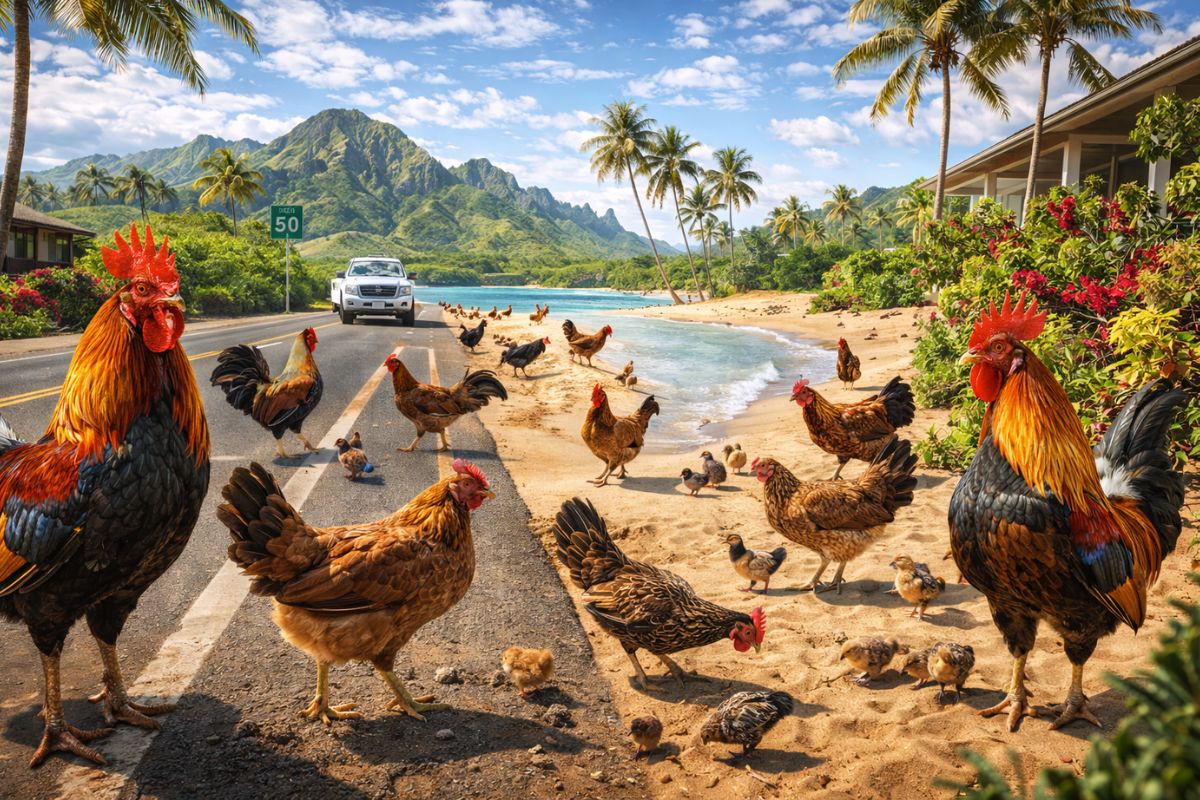


Kauai, Hawaii, Has Become a True Chicken Island, Where Tens of Thousands of Abandoned Birds Dominate Streets, Beaches, Gardens, and Parking Lots, Enchanting Tourists and Irritating Residents.
Among tropical storms that destroyed chicken coops, escaped domestic chickens, and the ancestral wild Red Junglefowl, Kauai has transformed into a living laboratory of ecology, tourism, and conflict, raising a difficult debate: how to control the population without destroying the charm of the chicken island?
How Kauai Became Known as Chicken Island
To understand why Kauai became known as Chicken Island, one must go back centuries in time. The first chickens arrived around 1200 AD, brought by the Polynesian colonizers who migrated to Hawaii.
They brought the Red Junglefowl, a bird native to Southeast Asia, considered the ancestor of nearly all modern domestic chickens.
-
A British startup creates tires that generate electricity in electric vehicles when passing over potholes, speed bumps, and cracks.

-
Scientists have created robots made with living cells that have their own nervous system, swim on their own, explore the environment, and self-organize without any genetic engineering, and now they want to do the same with human cells.

-
Students create a solar-powered ambulance that operates without a plug, without fuel, and still keeps medical equipment running in remote areas.

-
French “ghost” submarine lost in World War II reappears after more than 80 years on the seabed near the coast of Spain.


This wild lineage established itself on the island, coexisting for a long time relatively harmoniously with the local ecosystem.
Centuries later, by the end of the 17th century, the arrival of European colonization changed the game. New domestic chickens were introduced, further mixing the genetics of the birds on Kauai.
At the same time, dogs and cats began to prey on the Red Junglefowl, significantly reducing the original presence of this species in the wild.
In 1939, in an attempt to reinforce the naturalized population, 857 birds were intentionally released.
The idea was to strengthen the group of Red Junglefowl on the island, but the scenario that would form decades later would be far more chaotic than anyone imagined.
Storms, Destroyed Chicken Coops, and an Explosion of Wild Chickens
The turning point that solidified Kauai as Chicken Island came much later. In the 1980s and 1990s, two major tropical storms hit the island, destroying chicken coops and releasing a huge number of domestic chickens into the wild.
These escaped birds began to reproduce freely and mix with the remaining populations of Red Junglefowl, giving rise to a gigantic hybrid population of wild chickens, with characteristics of both the wild ancestor and domestic chickens.
Genetic studies indicate that this hybridization created birds perfectly adapted to the Kauai environment. Today, the chicken island is home to resilient, opportunistic, and highly reproductive birds, occupying practically all available environments.
The result is visible on any outing. Chickens appear in forests, urban areas, parking lots, beaches, squares, and commercial areas.
It is not uncommon to see tourists filming, taking pictures, or even trying to catch a chicken in the street, as if they were “nobody’s” animals available for anyone daring enough to hold them.
Amidst tens of thousands of birds scattered across the chicken island, no one notices the absence of one more or less individual.
When the Chicken Island Stops Being Cute and Becomes a Nuisance
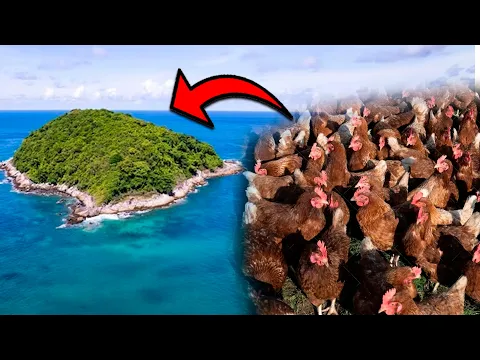

From a tourism perspective, Kauai’s image as Chicken Island has become a postcard.
Many visitors find it curious and even charming to see chickens roaming freely on paradise beaches, scratching the ground in parking lots, or crossing the street as if they owned the place.
For many residents, however, the chicken island is more of a problem than an attraction. The birds scratch in gardens, knock over plants, make noise at dawn, and can harm small crops and urban areas.
In addition to the direct nuisance, there is a more serious side:
the chickens can carry diseases that affect other birds, native species, and even humans. The accumulation of droppings in public areas increases health risks, encourages pests, and can contaminate food and water.
In practice, the chicken island lives in constant tension between the “cute” side of the free-roaming birds and the real impact of an uncontrolled population in a relatively small environment.
Management Challenge: How to Control the Chicken Island

Given the current scenario, Kauai is forced to discuss the future of the chicken island. The challenge is to find management methods that work in practice, without causing ecological collapse or destroying a symbol that has already become part of the local identity.
Some ideas have emerged over the years:
capturing and removing the birds, sterilization programs, and even introducing natural predators to reduce the population. But none of these solutions are simple.
Large-scale capture and removal is costly and difficult to execute on an island where chickens are literally everywhere.
Sterilizing birds requires individual capture, which is impractical for such a large population. Moreover, introducing new predators could further disrupt the ecosystem, threatening native species and creating larger problems than the current ones.
Therefore, many experts point to a combined approach, less spectacular but more realistic. Public education campaigns to discourage residents and tourists from feeding the chickens can reduce the availability of easy food, limiting population growth.
At the same time, restoring natural habitats and strengthening native species helps to reduce the impact of the chicken island on the ecosystem, creating a healthier balance in the long run.
The Chicken Island and Other Animal-Dominated Islands
Kauai is not the only place that has gained a nickname because of animals taking over the territory. The story of the chicken island connects to a broader phenomenon: small islands where a single species multiplies until it dominates the landscape.
A famous example is Pig Island, Big Major Cay, in the Bahamas. There, pigs live on white sandy beaches and crystal-clear waters, swimming alongside tourists and have become one of the Caribbean’s most curious attractions.
The exact origin is uncertain, but theories range from sailors leaving the animals as a food reserve to tourism-related initiatives.
Another case is Horse Island near Nova Scotia, Canada, where herds of horses descended from abandoned ponies roam freely across the dunes and pastures, drinking from freshwater ponds.
In all these places, including the chicken island, the same question always arises:
where does the charm of seeing free animals end and the problem of living with uncontrolled populations in delicate environments begin?
In the end, Kauai as Chicken Island is a mirror of a larger dilemma: how far are we willing to accept the chaos of nature in exchange for the beauty and curiosity it offers us?
And you, after learning about the story of the chicken island, do you think Kauai should strictly control the population of wild chickens or accept these birds as a permanent part of the island’s identity?





Eu me coloco a disposição para ajudar no projeto de captura com os galinheiros móveis, eu acredito que espalhando esses galinheiros móveis mais próximo dos centros e praças, já vai aliviar bastante em médio prazo. Sou Domingues de Magé no Rio de Janeiro, 2198837-7390 só me contratar que eu vou com todo prazer.
Olá!!! Eu acredito que o melhor seria encontrar uma maneira de controlar essas aves soltas, não é muito saudável uma superpopulação de galinhas defecando por todos os lados, se continuar desta forma, em poucos anos vai ficar difícil de residir e muito menos o turismo, acredito que fazer galinheiro moveis para captura seria uma das muitas alternativas para conter o crescimento, essas aves capturadas pedem ser doadas para pessoas da ilha que queira cria-las em galinheiros.
Manda umas 1000
Pra cá pra ver se eu n sumo em uma semana com elas.
Fritas, cozidas, marinadas,assadas, salgados, vivas vendidas e ainda acho pouco kkk
😂😂😂😂😂😂😂