





 Portuguese
  English
  Spanish
  5 min of reading
  0 comments


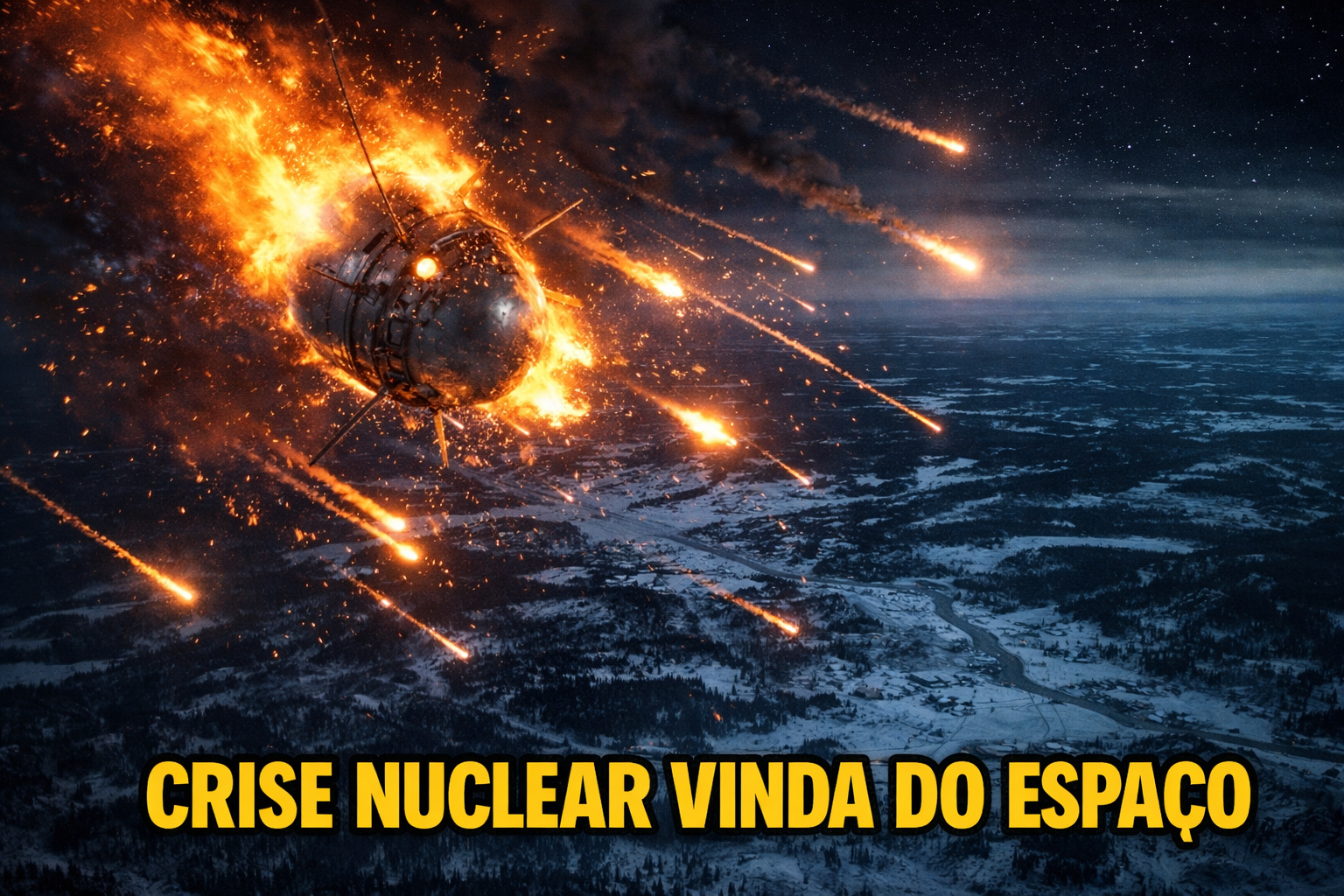
In 1978, The Soviet Satellite Kosmos 954 Fell in Canada with an Active Nuclear Reactor, Spread Radioactive Material and Exposed the Real Risks of the Military Space Race.
The episode occurred on January 24, 1978, when the Soviet military satellite Kosmos 954 re-entered the Earth’s atmosphere uncontrollably and disintegrated over northern Canada, spreading radioactive debris over an estimated area of more than 124,000 km², covering parts of the Northwest Territories, Alberta, and Saskatchewan.
The accident was officially confirmed by the Government of Canada, the United States Department of Defense, and later by the Soviet Union, after intense diplomatic pressure. The cleanup operation was conducted by the Canadian Armed Forces in partnership with the U.S., under the name Operation Morning Light.
What Was Kosmos 954 and Why Did It Carry a Nuclear Reactor
Kosmos 954 was part of a class of Soviet satellites known as RORSAT (Radar Ocean Reconnaissance Satellite). These satellites had a clear strategic mission: to locate and track enemy naval fleets, especially United States aircraft carriers, at any point in the oceans.
-
Friends have been building a small “town” for 30 years to grow old together, with compact houses, a common area, nature surrounding it, and a collective life project designed for friendship, coexistence, and simplicity.

-
This small town in Germany created its own currency 24 years ago, today it circulates millions per year, is accepted in over 300 stores, and the German government allowed all of this to happen under one condition.

-
Curitiba is shrinking and is expected to lose 97,000 residents by 2050, while inland cities in Paraná such as Sarandi, Araucária, and Toledo are experiencing accelerated growth that is changing the entire state’s map.

-
Tourists were poisoned on Everest in a million-dollar fraud scheme involving helicopters that diverted over $19 million and shocked international authorities.



To operate powerful radars hundreds of kilometers from Earth, the satellite required a power source far beyond the solar panels of the time. The Soviet solution was extreme:
an onboard nuclear fission reactor, of the BES-5 “Buk” type, using highly enriched uranium.
The original plan was that, by the end of the mission, the reactor would be ejected into a disposal orbit, over 900 km in altitude, where it would remain for centuries. That did not happen.
The Technical Failure That Turned the Satellite Into a Global Threat
Just a few months after launch, on September 18, 1977, the control system of Kosmos 954 began to display serious failures. The satellite lost orbital stability and began to descend slowly, something immediately detected by radar from the U.S. and Canada.
The worst-case scenario was confirmed: the reactor ejection mechanism failed, preventing the nuclear core from being separated before atmospheric re-entry.
As a result, the entire satellite — including the reactor — entered the atmosphere at over 7.5 km/s, violently fragmenting and spreading radioactive particles over thousands of kilometers.
The Invisible Cloud: How Radioactivity Spread Across Canada
Unlike a nuclear explosion, there was no detonation. The danger came from the dispersion of contaminated fragments, many the size of small screws, but with dangerous levels of gamma radiation. Search teams found:
- Fragments with radiation up to 500 times above background levels
- Parts partially buried in snow and soil
- Metal components still hot weeks after the fall
The affected area included remote regions with very low population density, which prevented immediate deaths. Still, the environmental and human risk was considered severe.
Operation Morning Light: The Largest Radioactive Hunt in Canadian History
Shortly after the fall, Operation Morning Light was initiated, one of the most complex nuclear cleanup operations ever conducted outside of war zones. Between January and October 1978:
- More than 400 military personnel and scientists participated
- Planes with radiological sensors mapped the territory
- Ground teams traversed frozen areas and remote forests
- Only about 10% of the radioactive material was recovered
The Canadian government concluded that it would be impossible to locate all the fragments, and part of the contamination remains diluted in the environment to this day.
The Diplomatic Conflict: When Canada Billed the Soviet Union
Backed by the UN Convention on International Liability for Damage Caused by Space Objects, Canada presented an official invoice to the Soviet Union.
- Charged amount: 6 million Canadian dollars
- Amount paid by the Soviets: 3 million Canadian dollars


The agreement was finalized in 1981, after years of tense negotiations, and became the only case in history where a country was formally compensated for damages caused by nuclear space debris.
The Real Impact of Kosmos 954 on the Military Space Race
The accident exposed something that had until then been treated in secrecy: the extreme militarization of space during the Cold War had surpassed acceptable safety limits. After the Kosmos 954 incident:
- The U.S. and USSR began to review projects involving nuclear reactors in low orbit
- The use of nuclear energy in space began to require more stringent disposal plans
- The UN intensified debates on space debris and orbital nuclear risks
Nonetheless, similar programs continued for a few years. It is estimated that the Soviet Union launched more than 30 nuclear satellites by the end of the 1980s.
Why This Accident Still Worries Experts Today
The Kosmos 954 case is not just a historical episode. It is a permanent alert. Today, with:
- Exponential growth of satellites
- Return of projects with space nuclear reactors for lunar and interplanetary missions
- Ever-increasingly congested orbits
Space security experts cite Kosmos 954 as the clearest example that orbital failures can turn into real global crises, not just technical problems.
The Silent Legacy of a Satellite That Fell with an Active Reactor
More than four decades later, Kosmos 954 remains the only confirmed case of a satellite with an active nuclear reactor that fell over inhabited territory, contaminated a vast region, and generated real diplomatic, environmental, and strategic consequences.
It symbolizes the point at which the technological race of the Cold War surpassed the Earth’s orbit — and came crashing down hard enough to remind everyone that space, when militarized without limits, can also become a risk field down here. A disaster that did not explode, did not make immediate noise, but left an invisible trail that still redefines how the world views the use of nuclear energy beyond the planet.










-

-

-

-

-

54 pessoas reagiram a isso.