





 Portuguese
  English
  Spanish
  4 min of reading
  0 comments


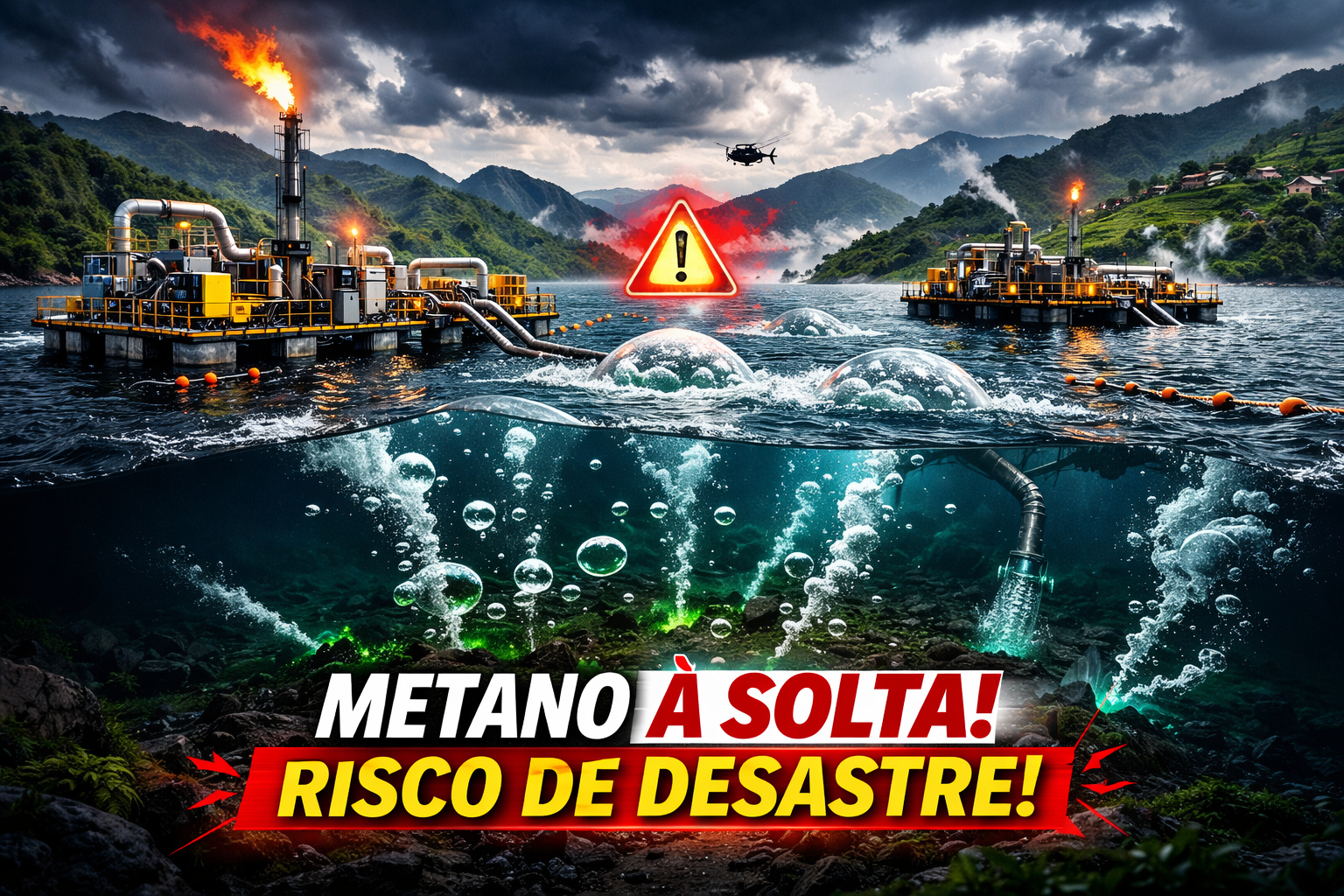
Lake Kivu Stores Billions of m³ of Methane and CO₂ Under High Pressure. Rwanda Extracts the Gas to Generate Energy and Reduce Lake Eruption Risk.
In the heart of Central Africa, on the border between Rwanda and the Democratic Republic of Congo, Lake Kivu hosts one of the planet’s most unusual and potentially dangerous natural systems. Hundreds of meters deep, billions of cubic meters of methane and carbon dioxide remain dissolved under high pressure. Scientific studies estimate that the lake contains approximately 60 billion cubic meters of methane and about 300 billion cubic meters of CO₂ accumulated in its deep layers.
The threat is not theoretical. Stratified volcanic lakes can experience a phenomenon known as limnic eruption, when a disturbance abruptly releases dissolved gases, forming suffocating clouds. In 1986, at Lake Nyos in Cameroon, a sudden release of CO₂ killed more than 1,700 people. Lake Kivu presents similar characteristics, but on a much larger scale, with about 2 million people living along its shores. In light of this scenario, Rwanda decided to transform geological risk into energy infrastructure.
The Geology of Lake Kivu and the Accumulation of Methane
Lake Kivu is located in the East African Rift Valley, a tectonically active region marked by faults, volcanism, and geothermal activity. The stratification of the lake prevents complete mixing of its waters. The deep layers remain stable, dense, and rich in dissolved gases.
-
Friends have been building a small “town” for 30 years to grow old together, with compact houses, a common area, nature surrounding it, and a collective life project designed for friendship, coexistence, and simplicity.

-
This small town in Germany created its own currency 24 years ago, today it circulates millions per year, is accepted in over 300 stores, and the German government allowed all of this to happen under one condition.

-
Curitiba is shrinking and is expected to lose 97,000 residents by 2050, while inland cities in Paraná such as Sarandi, Araucária, and Toledo are experiencing accelerated growth that is changing the entire state’s map.

-
Tourists were poisoned on Everest in a million-dollar fraud scheme involving helicopters that diverted over $19 million and shocked international authorities.


Methane is primarily generated by bacterial activity that decomposes organic matter in an anoxic environment. Part of the carbon dioxide is of volcanic origin, released by geothermal activity underground.


The great depth, which exceeds 480 meters at some points, allows these gases to remain dissolved under pressure. Any significant disturbance—such as earthquakes or volcanic activity—could trigger an abrupt release.
How Methane Extraction Works in Lake Kivu
The extraction project involves floating platforms equipped with vertical pumping systems. Pipelines descend to depths that can exceed 300 meters. The methane-rich water is pumped to the surface under controlled pressure.
By reducing pressure during the ascent, the gas naturally separates from the water, in a process similar to opening a soda bottle. The methane is then captured, treated, and directed for electricity generation.
The partially degassed water is returned to specific depths, maintaining the stratified balance of the lake to avoid instability.
This control is essential. The project’s engineering must ensure that extraction does not cause excessive mixing of the layers, which could trigger uncontrolled release.
Energy Capacity and Impact on Rwanda’s Energy Matrix
Rwanda has limited energy resources and has historically relied on imports and conventional thermal generation. The exploration of methane from Lake Kivu has become a strategic pillar of the national energy matrix.
Projects like KivuWatt, operated by a private company in partnership with the Rwandan government, have already delivered tens of megawatts to the national power system. The long-term goal is to expand capacity to hundreds of megawatts, gradually tapping into the dissolved stock.
In addition to electricity generation, extraction reduces the concentration of methane in the deep layers, decreasing the potential for instability. This is a dual strategy: energy production and geological risk mitigation.
Technical Challenges and Delicate Balance
The operation requires rigorous hydrodynamic control. Lake Kivu is considered a meromictic lake, where layers do not fully mix. Stability depends on gradients of temperature, salinity, and density.
Excessive or poorly distributed withdrawal can alter this structure. Therefore, mathematical models and constant monitoring are used to ensure that the reinjection of treated water occurs at appropriate depths.
Another challenge is the corrosion and maintenance of equipment operating in a deep aquatic environment rich in gases.
Real Risk or Exaggerated Threat?
Scientific research indicates that Lake Kivu is stable in the short term but has significant accumulated potential. The volume of gas stored is much greater than that observed at Lake Nyos before the 1986 tragedy.
The difference lies in the population scale. Millions live in the cities of Gisenyi, Kibuye, and Goma. An abrupt release would have regional consequences.
The Rwandan strategy not only addresses the exploration of energy resources but also involves managing geological liabilities accumulated over centuries.
Transforming Invisible Threat into Energy Infrastructure
Lake Kivu represents a unique case where geology, biogeochemistry, and engineering converge. What could have been merely a natural risk has become the foundation of energy policy.
Controlled extraction of methane demonstrates how applied science can reduce structural vulnerability while simultaneously generating economic development.
The operation continues to be monitored by international experts, universities, and scientific institutions.
From Invisible Risk to Energy Source
Billions of cubic meters of gas dissolved under the waters of Lake Kivu are neither a myth nor an exaggeration. The geological system is real, as is the potential risk of limnic eruption. Rwanda’s response is also concrete: floating platforms, deep pumping, and methane-based electricity generation.
By transforming invisible risk into a strategic energy source, the country has created one of the most unusual energy projects on the planet. Lake Kivu remains under constant surveillance. Between geological threat and energy opportunity, it symbolizes how engineering can intervene in extreme natural processes to prevent tragedies and sustain growth.










-

Uma pessoa reagiu a isso.