





 Portuguese
  English
  Spanish
  6 min of reading
  0 comments


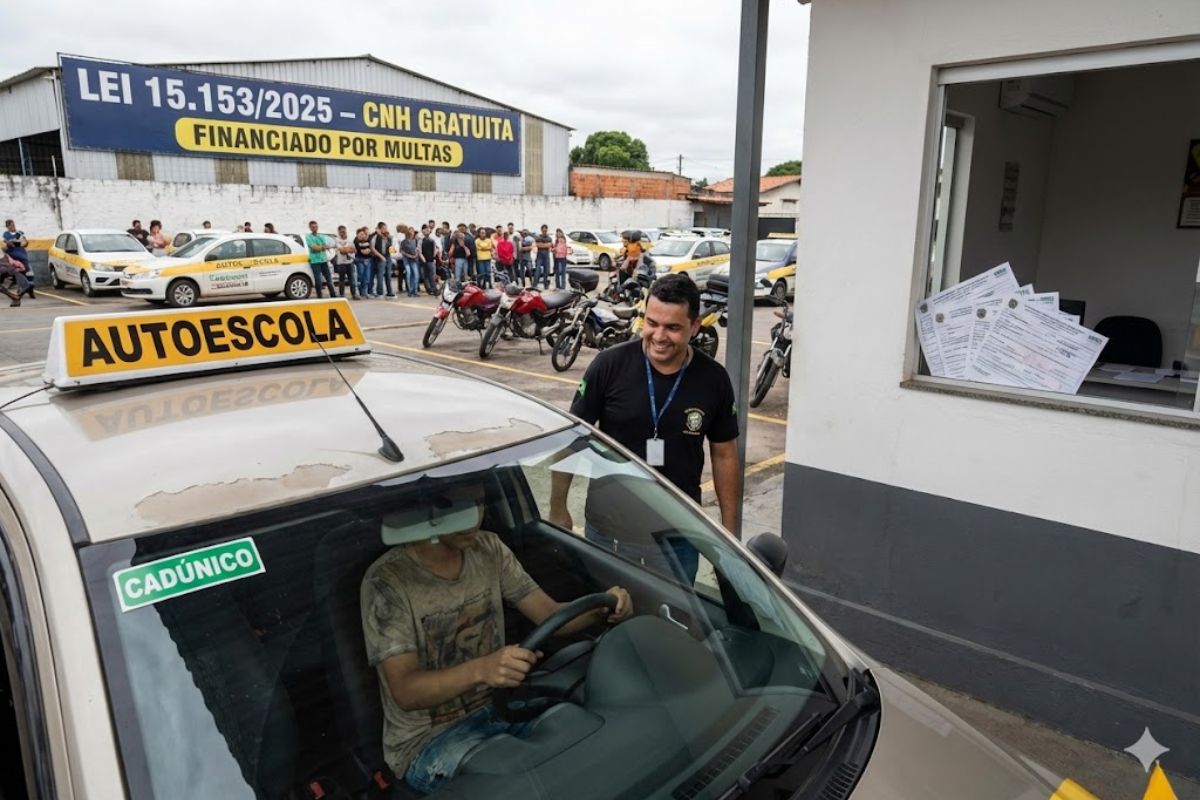
With the Free CNH through CadÚnico Officially Established by Law 15.153/2025, Traffic Fines Will Fund Exams, Fees, and Driving School Classes, While Detrans and CRAS Organize Selections for Low-Income Individuals to Compete for Jobs Requiring Licenses in Logistics, App-Based Transport, and Delivery, Increasing Opportunities in the Job Market.
The Free CNH through CadÚnico has ceased to be a promise and has gained legal backing in 2025, with the enactment of Law No. 15.153/2025, which transforms social licensing into a structured public policy. On December 10, 2025, the program’s design was detailed to the public, clearly stating that the initial focus is on categories A and B, which are precisely the most required for operational and logistics positions.
In practice, the Free CNH through CadÚnico connects two sensitive ends of the country in 2025: on one side, low-income families who cannot afford driving school; on the other, a job market that requires a driver’s license for a large part of the available positions in transportation, delivery, and services. By redirecting resources from fines to cover exams, fees, and classes, the program attempts to transform traffic violations into productive inclusion and formalization of new drivers.
How the Free CNH through CadÚnico Was Structured in Law
Law No. 15.153/2025 establishes that the Free CNH through CadÚnico should no longer rely solely on state-specific programs and must follow national guidelines. The legislation specifies that:
-
The Senate approves a bill that criminalizes misogyny, hatred, or aversion towards women, and includes the crime in the Racism Law with a penalty of up to 5 years.

-
Chamber Approves Bill That Allows Pepper Spray for Women Over 16 and Imposes Strict Rules for Purchase, Possession, and Use as Self-Defense

-
Chamber Approves Law to Combat Leucaena, Fast-Growing Plant That Dominates Land and Threatens Native Species in Various Regions of the Country

-
Asset Division: Know What Cannot Be Divided in Case of Divorce


the benefit is aimed at the first license
the initial focus is on categories A (motorcycle) and B (car)
the process must be free for the beneficiary, covering fees and training
One of the pillars of the law is the funding source. The text provides that part of the fund created from traffic fines should be used to finance:
medical and psychological exams
administrative fees with the Detran
theoretical and practical classes in accredited driving schools
Thus, the Free CNH program through CadÚnico distances itself from temporary initiatives and becomes part of a continuous policy, supported by a recurring revenue source.
The central idea is that drivers who commit violations help, indirectly, to form new qualified drivers who could not afford the process.
Who Can Compete for the Free CNH through CadÚnico
The law defines general guidelines and leaves implementation to state Detrans, but some basic requirements are explicitly stated as a guideline for notices.
Among the central criteria for accessing the Free CNH through CadÚnico are:
be over 18 years old
be able to read and write
have an active and updated registration in CadÚnico
not have any record of a previous license
prove residency in the state where you are applying for the benefit
Priority is given to people in social vulnerability, primarily measured by family per capita income and other indicators from the Cadastro Único.
Unemployment weighs in the analysis, but the law makes it clear that the focus is broader than just those without a formal job.
In practice, the selection for the Free CNH through CadÚnico tends to favor families with lower income, a strong dependency on social programs, and a low capacity to pay the full cost of driving school.
Role of CadÚnico, CRAS, and Detrans in Social Licensing
The machinery of the Free CNH through CadÚnico depends on the interaction of three fronts: CadÚnico, CRAS, and Detrans.
Each has a specific function to ensure that the benefit reaches the target audience without fraud or distortions.
The CadÚnico is the official basis that records income, family composition, and social situation of the beneficiaries of public policies.
It is from this that the information is obtained to identify who fits the low-income profile defined by Law No. 15.153/2025.
The CRAS (Social Assistance Reference Centers) are the territorial entry point for families. These units are responsible for:
providing guidance on the Free CNH through CadÚnico
keeping the registration always updated
registering changes in income, address, or family composition
The state Detrans are responsible for technical execution:
publishing notices with the number of vacancies, deadlines, and local criteria
contracting or accrediting participating driving schools
organizing schedules for theoretical and practical exams
validating compliance with the steps until the issuance of the CNH
There is no automatic enrollment. Those wishing to obtain the Free CNH through CadÚnico need to first ensure that their social registration is regular and then monitor the publication of notices by the Detran in their state.
What Costs Does the Free CNH through CadÚnico Cover in Practice
The objective of Law No. 15.153/2025 is to minimize the financial barrier for those trying to obtain their first CNH through the program. In the proposed design, the Free CNH through CadÚnico should include:
opening fees for the process with the Detran
mandatory medical and psychological exams
theoretical course with the required workload established by legislation
sufficient practical classes to prepare the candidate for the road test
By assuming these costs with funds from fines, the program aims to prevent the beneficiary from needing to supplement amounts to complete the process.
The logic is that access to licensing should not depend on the ability to pay, but rather on social classification and compliance with formal steps.
Free CNH through CadÚnico and Its Impact on Employment and Income
The law was conceived with an explicit objective: to use the Free CNH through CadÚnico as a tool for inclusion in the labor market.
Various job openings in 2025 require a driver’s license in categories A or B, especially in:
- app-based deliveries
- transport of small loads
- general services requiring travel between clients
- logistical and operational support roles
Without the CNH, low-income candidates are automatically excluded from selection processes, even when they have experience in other areas.
By funding the process, the program aims to allow thousands of Brazilians to compete for these positions on minimally equal documentary terms.
Moreover, the Free CNH through CadÚnico can serve as a gateway to longer professional trajectories, where the already licensed worker subsequently seeks higher categories or specializations.
Essential Steps to Not Miss the Opportunity
For those who see the Free CNH through CadÚnico as a concrete chance to increase income, some practical steps are essential, even before the opening of state notices:
Check if CadÚnico is active and updated with the CRAS, with correct income, address, and family composition.
Verify the status of the CPF, avoiding registration issues that may hinder the benefit.
Follow the official channels of the Detran in your state, where the notices for Law No. 15.153/2025 will be published.
Organize basic documents in advance, such as proof of residence, identification document, and proof of registration in CadÚnico.
The more organized the documentation, the lower the risk of missing deadlines or having the application rejected due to formal errors, and the greater the chance of turning the Free CNH through CadÚnico into an effective gateway to the formal job market.
For you, what should be the main priority criterion in the queue for the Free CNH through CadÚnico: young people seeking their first job or heads of families already responsible for the household income?










-

-

-

-

13 pessoas reagiram a isso.