





 Portuguese
  English
  Spanish
  4 min of reading
  0 comments


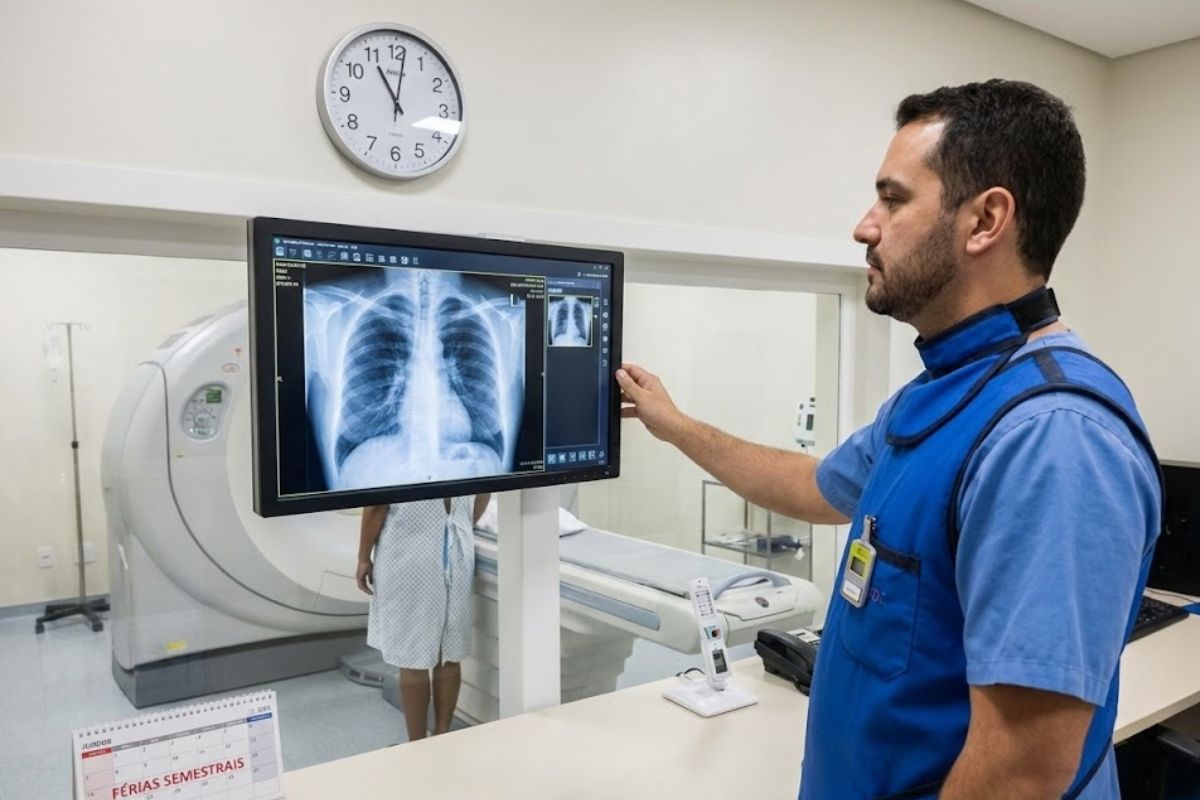
In Effect Since 1985, Law 7.394/85 Provides for a Maximum Workweek of 24 Hours, a Daily Limit of 4 Hours in Areas with Ionizing Radiation, and 20 Days of Vacation Every Six Months, Ensuring Physical Recovery, Prevention of Occupational Diseases, and Better Working Conditions for Radiology Technicians and Technologists.
Since 1985, when Law 7.394/85 was created, radiology technicians and technologists have gained specific protection: a maximum workweek of 24 hours, with only 4 hours of work per day in areas with ionizing radiation. The rule recognizes the daily risk faced by those operating ray-emitting equipment.
Almost four decades later, thousands of professionals continue to be supported by this special legislation, which also guarantees 20 days of vacation every six months, totaling 40 days of rest per year, to reduce the cumulative effects of radiation exposure and preserve physical and mental health throughout their careers.
Who Is Protected by Law 7.394/85
Law 7.394/85 regulates the professions of radiology technician and technologist, defining specific rules for those who work directly with examinations and procedures involving ionizing radiation.
-
The Senate approves a bill that criminalizes misogyny, hatred, or aversion towards women, and includes the crime in the Racism Law with a penalty of up to 5 years.

-
Chamber Approves Bill That Allows Pepper Spray for Women Over 16 and Imposes Strict Rules for Purchase, Possession, and Use as Self-Defense

-
Chamber Approves Law to Combat Leucaena, Fast-Growing Plant That Dominates Land and Threatens Native Species in Various Regions of the Country

-
Asset Division: Know What Cannot Be Divided in Case of Divorce


These professionals are part of teams in hospitals, clinics, laboratories, and imaging diagnostic services across the country.
According to the legislation, the maximum working hours are 24 hours per week, averaged out to 4 hours of daily work in areas with radiation exposure.
Schedules that exceed this limit violate the original intent of Law 7.394/85, which is to reduce the time of contact with radiation sources and avoid excessive doses over the years of service.
Why the Workweek Is Shorter for Those Who Deal with Ionizing Radiation
Unlike other areas of health, radiology professionals face invisible risks linked to ionizing radiation.
Even following safety protocols and using personal protective equipment, frequent exposure can lead to cumulative effects on the body, which often do not appear immediately.
Among the most cited impacts are skin problems, decreased immunity, genetic changes, and, in more severe cases, an increased risk of developing cancer.
Therefore, the reduced workweek outlined in Law 7.394/85 is treated as a preventive measure rather than a privilege, in line with safety recommendations from health organizations.
By limiting the daily time spent in areas with radiation, the regulation aims to decrease the total dose absorbed throughout their careers, preserving health and reducing the likelihood of absenteeism due to occupational diseases.
20 Days of Vacation Every Six Months and 40 Days per Year
In addition to the shortened workweek, Law 7.394/85 guarantees a vacation regime different from the standard applied to most workers.
Instead of 30 annual days concentrated in a single period, radiology professionals are entitled to 20 days of vacation every six months, totaling 40 days of rest throughout the year.
This semiannual division is designed to offer more frequent breaks, which are essential for those dealing with ionizing radiation every day.
With regular breaks, the body has a better chance to recover from exposure effects and the stress of the hospital routine, contributing to quality of life and safety in patient care.
In practice, this vacation model functions as part of the overall protection of the category, complementing the limitation of a 24-hour workweek and reinforcing the idea that rest is also a tool for occupational health.
Protection, Quality of Life, and Employer Responsibility
The set of rights outlined in Law 7.394/85, with reduced hours, semiannual vacations, and specific rules for working in radiation areas, forms a minimum security package for radiology technicians and technologists.
This is not just a labor advantage, but a mechanism to prevent serious and irreversible illnesses.
Occupational health experts emphasize that these guarantees help reduce absenteeism, preserve work capacity, and improve the work environment, benefiting both health services and patients.
When the law is respected, the trend is less overload, more attention to protocols, and a lower risk of errors in procedures that depend on technical precision.
It is up to employers to organize schedules, shifts, and days off in a manner compatible with the 24-hour weekly limit and the right to semiannual vacations.
And you, in the service where you work or are attended, are the special work hours and semiannual vacations of Law 7.394/85 really being respected?









-

Uma pessoa reagiu a isso.