





 Portuguese
  English
  Spanish
  5 min of reading
  2 comments


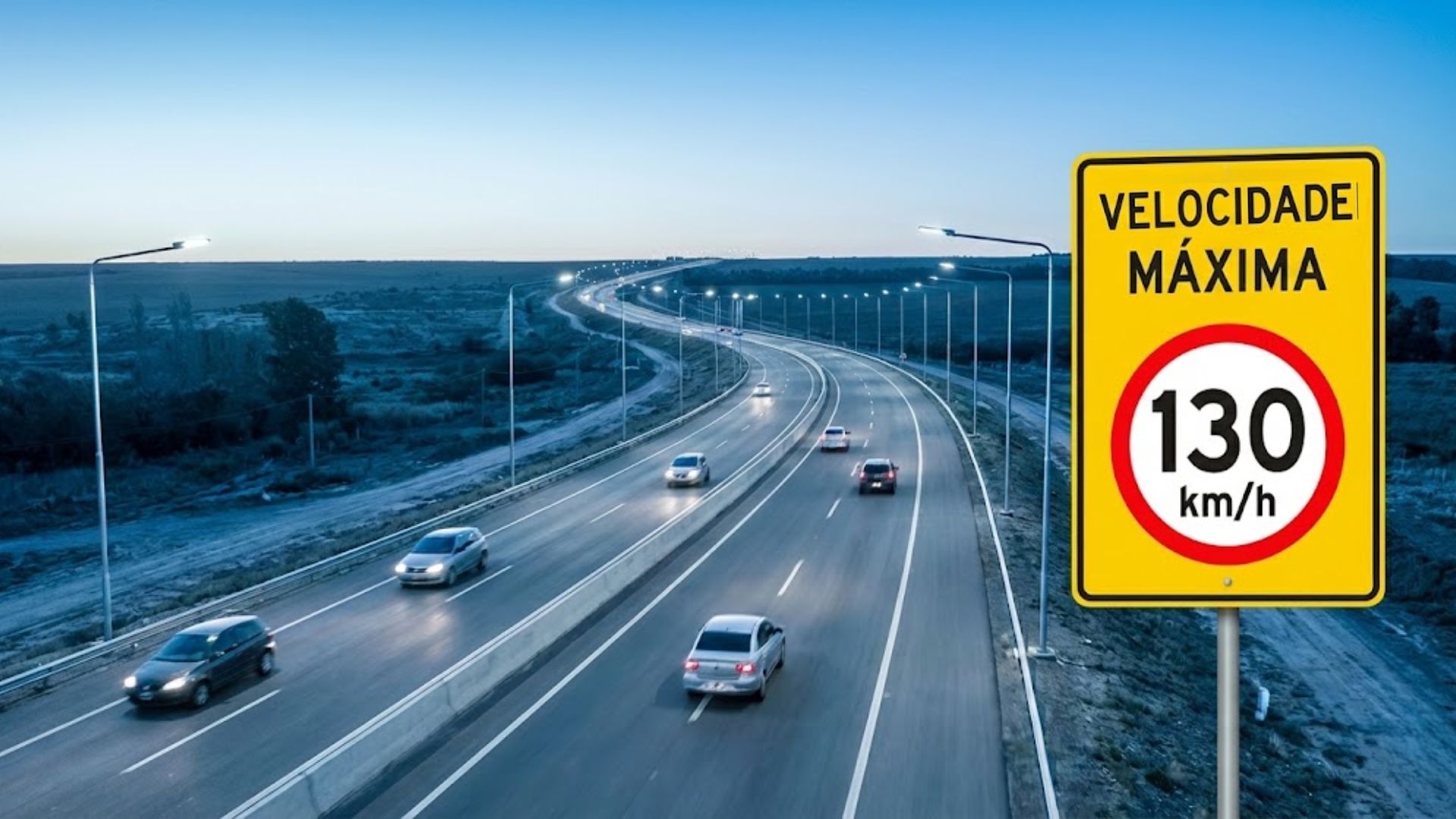


Argentinian Regulation Draws Attention for Allowing High Speed Limits on Dual Carriageways, Bringing the Country Closer to Standards Adopted on Major European Roads.
Argentina currently has one of the highest speed limits in South America on dual carriageways: up to 130 km/h for cars and motorcycles on highways and expressways, as provided for in the National Traffic Law 24.449, in effect throughout the country.
This level, associated with roads that have better infrastructure and physical separation between directions, attracts the attention of Brazilian drivers who are used to lower limits on roads.
Although the 130 km/h limit is not a new feature of Argentine legislation, the topic has gained prominence again when compared to traffic rules in other countries in the region, such as Brazil, and European nations that follow similar or even more flexible parameters.
-
The Argentine government celebrates the lowest poverty rate in 7 years, but experts warn that the methodology has changed, real wages have fallen, unemployment has risen, and the number of people on the streets of Buenos Aires has increased by 57% since Milei took office.

-
7.8 magnitude earthquake in Indonesia frightens the population, triggers tsunami alert, and hits an island with over 200,000 inhabitants this Thursday.

-
Google will finally let you change that embarrassing Gmail address you created in your teenage years without losing any accounts, logins, or old emails: the feature is already available in the United States.

-
Heading to Brazil in a Bonanza F33 single-engine aircraft: a couple departs from Florida on a visual flight, makes technical stops in the Caribbean to refuel and organize paperwork, and begins the staged crossing until they reach the country.

The combination of higher speeds on dual carriageways and more restrictive limits in urban areas constitutes the strategy of the country to try to balance traffic flow and road safety.
Limit of 130 km/h on Argentine Highways
The Argentine traffic regulatory framework establishes differentiated limits based on the type of road and the environment in which the vehicle operates.
On highways, which are multi-lane roads with controlled access and no at-level crossings, the general rule allows cars and motorcycles to travel up to 130 km/h, while heavy vehicles, such as buses and trucks, follow lower limits, aligned with rural zone parameters.
On semi-highways, which have an intermediate standard and still include some at-level crossings, the legislation sets a limit of up to 120 km/h for cars and motorcycles, with reductions for other types of vehicles.
On rural single-lane segments, the national rule generally establishes 110 km/h for cars, motorcycles, and pickups, with lower values for larger vehicles.
However, in many segments, specific signage may establish lower speeds, depending on the layout, terrain, and accident history.

This arrangement places Argentine highways in the group of roads that operate with high maximum speeds, provided that design requirements are met, such as separation barriers between directions, adequate shoulders, and access control.
In some accesses to major centers, local authorities have even discussed or applied reductions from 130 km/h to 110 km/h, arguing that this would reduce the risk of collisions in high-traffic sections with tolls.
Speeds in Urban Areas of Argentina
If on higher-standard highways the maximum speed reaches 130 km/h, the scenario is quite different in urban areas.
The legislation establishes that, in general, streets have a limit of 40 km/h and avenues of 60 km/h, with exceptions only where signage permits higher speeds, such as on some urban expressways.
Additionally, there are special limits at points considered critical for safety.
In the vicinity of schools, sports centers, or places of large gatherings, the speed is often reduced to about 20 km/h during operating hours.
At urban intersections without traffic lights, the guideline is for more cautious driving, with speeds not exceeding 30 km/h.
The legislation also provides for specific limits at at-level crossings without barriers, urban crossing segments on routes, and areas with higher conflict between vehicles and pedestrians.
This design reinforces the logic that most of the fluidity gain occurs on well-structured highways, while the urban environment continues to be treated as a space of greater vulnerability.
Comparison with Brazil
In Brazil, the Brazilian Traffic Code also defines speed limits by type of road, but with generally lower thresholds on highways.
On urban roads without specific signage, the CTB establishes, as a rule, 80 km/h for high-speed roads, 60 km/h for arterial roads, 40 km/h for collectors, and 30 km/h for local roads.

On rural highways, when there are no signs indicating another limit, the law provides for 110 km/h for cars, pickups, and motorcycles on dual lanes and 100 km/h on single lanes.
For heavy vehicles, such as trucks and buses, the general limit is 90 km/h, both on single and dual lanes.
In practice, this means that while some Argentine highways allow up to 130 km/h for light vehicles, Brazilian dual highways tend to limit to 110 km/h, even in sections with a modern construction standard.
In addition to the legal ceiling, each section may have its own rules, set by road agencies and regulatory bodies, based on technical studies about routing, visibility, traffic flow, and accident records.
How Argentina Compares to Europe
When compared to European countries, Argentina is closer to nations that allow higher speeds on high-standard highways.
Italy adopts, as a general rule, up to 130 km/h on autostradas, with reductions on rainy days or in specific sections.
In Germany, some Autobahnen have no mandatory maximum limit, although there is an official recommendation of 130 km/h.
The existence of different models shows how each country combines factors such as infrastructure quality, traffic culture, fleet renewal, enforcement, and goals for reducing traffic fatalities.
In Argentina, the limit of 130 km/h coexists with discussions about serious accidents in high traffic areas and with specific proposals for reductions in corridors that access major cities.
At the same time, road safety experts often emphasize that the legal limit is just one of the elements influencing risk on the roads.
Pavement conditions, signage, speeding, fatigue of professional drivers, and insufficient enforcement remain among the factors associated with serious collisions on high-standard highways.
Balancing Fluidity and Safety
The adoption of 130 km/h on Argentine dual carriageway roads is part of a strategy that aims to concentrate higher speeds in sections with physical separation between directions and highway standards.
Meanwhile, stricter rules remain in effect in urban areas and on single or more complex geometry roads.
In regional comparison, the country stands out for allowing a higher limit than Brazil on dual roads, operating within the range observed on some of the main European motorways.
Considering this scenario, a question arises that divides specialists and drivers: is it better to prioritize higher speed on high-capacity roads or maintain conservative limits to reduce the severity of accidents?








AQUI NO BRASIL 🇧🇷 , AS RODOVIAS DUPLICADAS DEVERIAM ADOTAR AS VELOCIDADES MÁXIMAS DE 120 KILOMETROS , E AS RODOVIAS NÃO DUPLICADAS DE VIAS SIMPLES DE 90 KILOMETROS !!! , AS RÁPIDAS DE 80 KILOMETROS , AS RURAIS DE 70 KILOMETROS ! .
Aqui as polícias rodoviária de estado vivem de multar seus cidadãos as escondidas . Tem que mudar a velocidade dos atuais ,80 km para pelos 90 km. É absurdamente baixa e numa ultrapassagem você é tbm multado como fui , da última vez. Tenho uma dezenas de multa em 40 anos de carteira nenhuma dem estrada Federal…. A última velocidade medida acertada de 86km, tinha acabado de ultrapassar e estavam escondido numa sombra …isto não é preocupação com o usuário é arrecadação na cara dura