





 Portuguese
  English
  Spanish
  4 min of reading
  1 comment


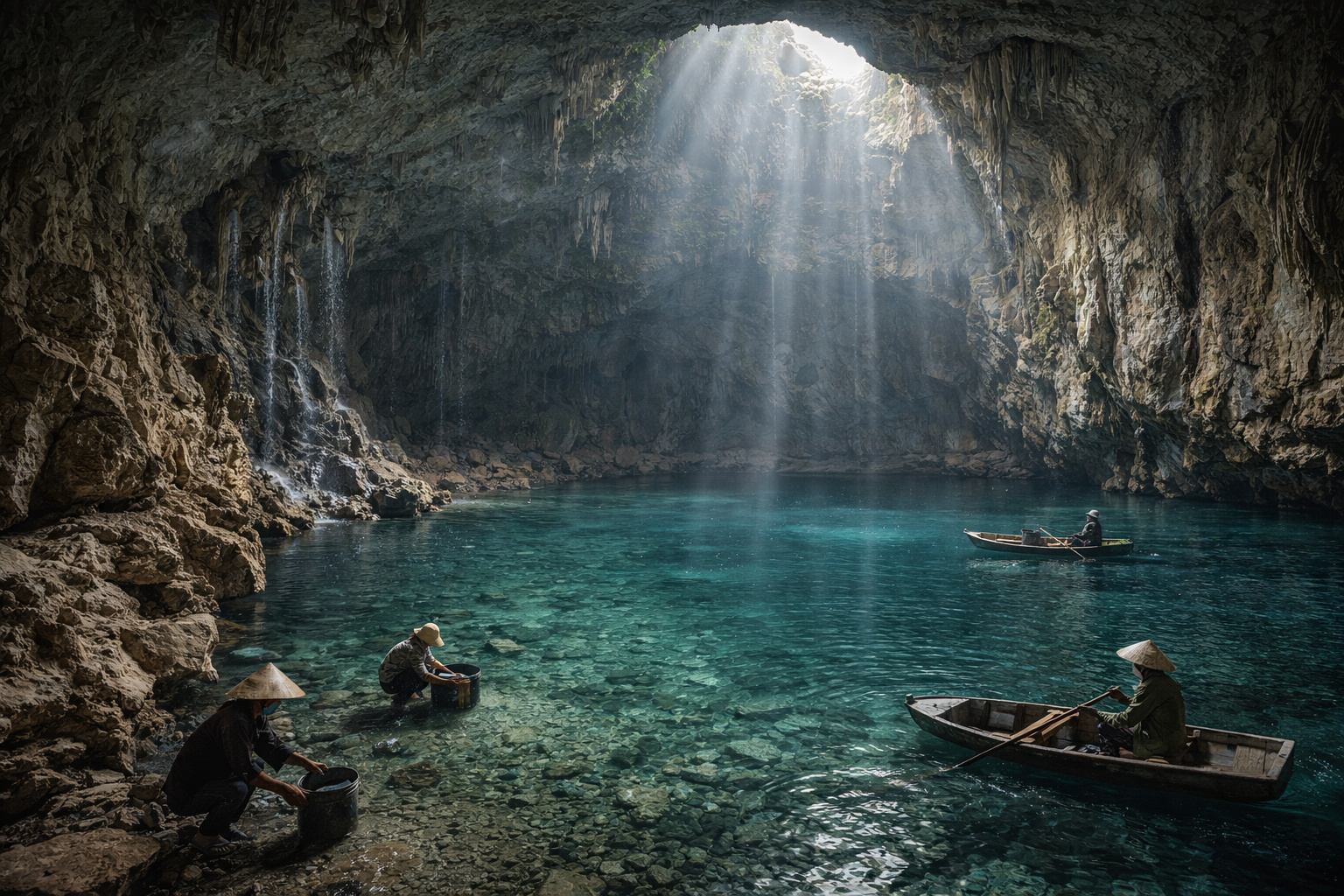


In Vietnam, Limestone Caves Stretching Dozens of Kilometers Serve as Underground Reservoirs and Natural Water Tanks Used for Centuries.
Vietnam is one of the richest countries in the world in karst formations — landscapes formed by the dissolution of limestone over millions of years. These structures are marked by deep caves, underground rivers, siphons, sinkholes, and galleries that can extend for dozens of kilometers.
In the region of Phong Nha – Kẻ Bàng, in the center of the country, this phenomenon reaches its peak. There, limestone has been dissolved by water since the Paleozoic, creating a continental-scale underground water system. What is an adventure destination for tourists has been, for local communities, a solution for infrastructure for centuries: a natural reservoir of fresh water stored within the earth.
Unlike the modern logic of building reservoirs, dams, or water tanks, nature has been performing this service long before urbanization. The relationship between geology and water supply is a rare example of how a natural phenomenon can take on a hydraulic function.
-
Friends have been building a small “town” for 30 years to grow old together, with compact houses, a common area, nature surrounding it, and a collective life project designed for friendship, coexistence, and simplicity.

-
This small town in Germany created its own currency 24 years ago, today it circulates millions per year, is accepted in over 300 stores, and the German government allowed all of this to happen under one condition.

-
Curitiba is shrinking and is expected to lose 97,000 residents by 2050, while inland cities in Paraná such as Sarandi, Araucária, and Toledo are experiencing accelerated growth that is changing the entire state’s map.

-
Tourists were poisoned on Everest in a million-dollar fraud scheme involving helicopters that diverted over $19 million and shocked international authorities.


How Limestone Caves Are Able to Store Water
In karst regions, rain and humidity infiltrate through the limestone rock via joints and fractures. This process creates galleries and internal chambers that capture and channel water into the rock mass. Over time, a natural network of interconnected reservoirs forms. Three characteristics make the system efficient:
- First, limestone is permeable and soluble, allowing water to travel both vertically and horizontally, supplying large internal volumes;
- Second, caves can store water at different levels, functioning as pressurized chambers and independent reservoirs;
- Third, the internal temperature is stable, reducing evaporation and surface contamination.

While an artificial lagoon loses water to the atmosphere, a cave retains the liquid in a protected, cool environment away from the sun. This makes karst a kind of geological hydraulic infrastructure, predating modern engineering.
Millenary Use: From Rural Peoples to Field Supply
In the Phong Nha – Kẻ Bàng region and in other karst areas of central Vietnam, rural communities have been using caves for water supply for centuries. The practice consists of collecting water from internal springs or underground rivers that periodically emerge at the surface through sinkholes and spring caves.
This water, having been filtered through the limestone mass, usually exhibits lower turbidity and less organic contamination than surface waters. For agricultural regions, this makes a difference especially in the dry season, when rivers and external reservoirs disappear.
The system has worked as an ancestral form of water regulation: the rain from wet months is stored inside the mountain and released slowly during drought. There are no pumps, no concrete walls, no valves — just gravity and geology.
Integrating Ancient Solutions with Modern Demands
Although traditional use has deep roots, scientific interest in the subject intensified in the 20th century when geologists and hydrologists began to study the behavior of karst aquifers.
Today, caves and karst systems are analyzed as natural reservoirs, complementing conventional reservoirs and supplying smaller cities. In Vietnam, researchers are mapping deep galleries, identifying connections between underground rivers, and developing collection systems that do not disrupt the water balance.
The transition draws attention because it reveals a rare encounter between technology and tradition: modern monitoring methods, such as chemical tracers and hydrogeological modeling, coexist with usage forms that date back to the pre-colonial period.
In recent decades, projects have emerged utilizing caves as regulatory water deposits for agriculture, tourism, small communities, and, in some cases, seasonal drought mitigation.
Dimensions and Scale: When the Natural Cavity Becomes Mega-Infrastructure
Phong Nha – Kẻ Bàng contains some of the largest caves on the planet, including chambers over 200 meters high and galleries extending for dozens of kilometers. Inside them are rivers, lakes, and siphons that store millions of cubic meters of water, forming a natural capacity greater than many small dams.

A notable example is the connected cave system that functions as true underground water tanks. During the rainy season, the infiltration volume increases and internal levels rise. In the dry season, the system releases water gradually through springs that irrigate fields and supply families.
The exact amount varies by season, but the principle is always the same: what enters through the rain is stored by the rock and returned slowly to the environment.
Why Is This Solution So Little Known?
There are three main reasons:
- The first is that the infrastructure is hidden. Unlike a dam or aqueduct, there is no visible monument;
- The second is that the scale is geological, not human. To understand the dimension, it is necessary to view the entire set of caves and aquifers as a single hydraulic body, something that is not always intuitive;
- The third is that modern engineering tends to favor artificial structures, even when nature provides ready alternatives.
The result is that millions of people drink, irrigate, and survive thanks to systems they did not build — but that function as if they were man-made.










Que importante sería poseer esas cualidades, que sirvieron en la guerra para esconder tropas, y otros.