





 Portuguese
  English
  Spanish
  6 min of reading
  0 comments


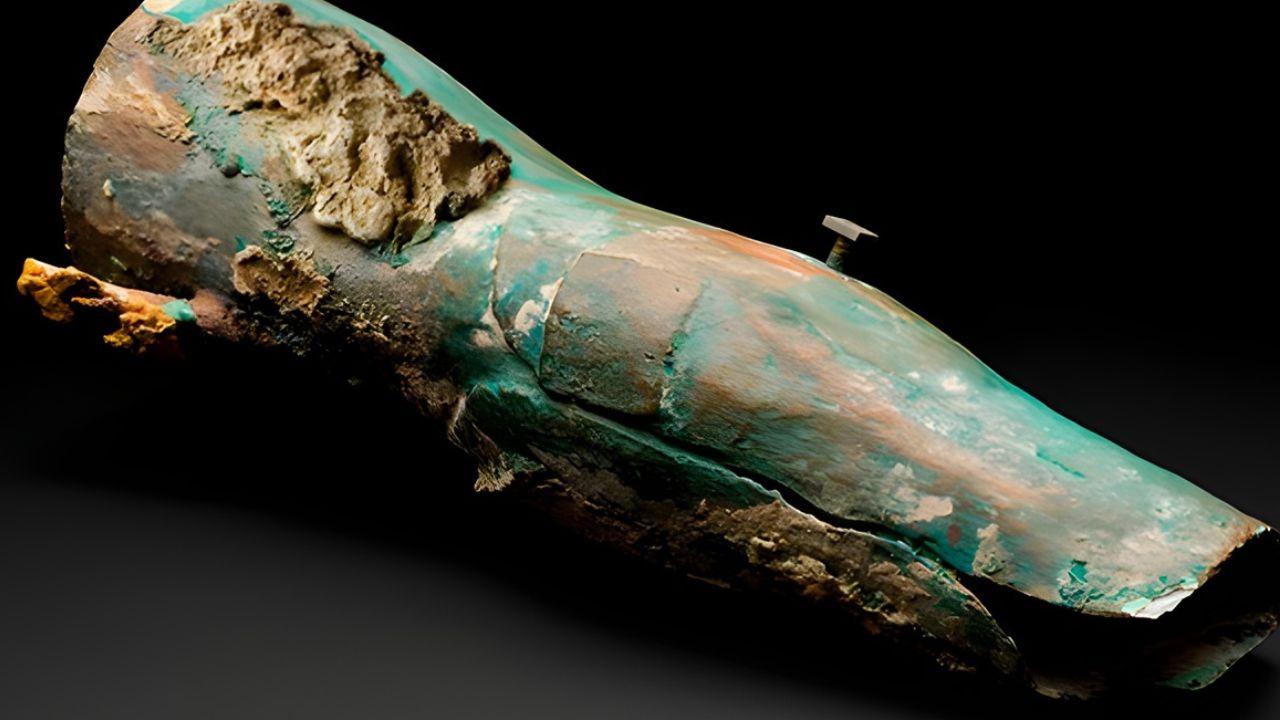
Discovery in Italy reveals leg prosthesis from 300 BC made of bronze and wood, showing advanced level of medicine in ancient times.
Around 300 BC, in the region of Capua, in southern present-day Italy, an artifact was identified that helped redefine the understanding of ancient medicine: a leg prosthesis with a wooden core and bronze covering, associated with an individual who had suffered amputation. The piece, known as the Capua Leg, was excavated from a grave in the region and is described by the Science Museum Group as an example dated to around 300 BC, widely recognized as one of the oldest recorded limb prostheses.
Subsequently studied in recent academic reconstructions, such as the one published in the journal Clinical Orthopaedics and Related Research, the piece shows that, long before modern medicine, there was already sufficient technical knowledge to produce devices capable of partially replacing a human limb for practical purposes. More than an archaeological symbol, the Capua Leg remains one of the most important pieces of evidence that engineering applied to the human body was already mastered to some degree in the ancient world.
Structure of the Capua Leg combined internal wood and molded bronze covering
The found prosthesis featured a construction composed of a wooden core, responsible for providing lightness and shape, externally covered by carefully molded bronze plates.
-
German reactor of 16 meters with twisted magnetic fields reaches a historic milestone in nuclear fusion by generating high-energy helium ions that simulate alpha particles from the Sun; progress in Wendelstein 7-X could unlock plasma control and explain phenomena observed in our star.

-
Scientists identify a unique cell that appears only during pregnancy and acts in the connection between the placenta and blood flow, revealing an essential mechanism for fetal development and possible causes of gestational complications.

-
It took just two days of walking in the jungles of New Guinea to find the plane that historians had been searching for for 80 years: the legendary Marge still had its original red paint and the face of the woman who named the most feared fighter of World War II.

-
On a rocky stretch of just 40 meters in South Africa, scientists found dozens of footprints that are 132 million years old hidden beneath the tide, revealing the youngest record ever identified in the southern part of the African continent.

This metallic covering not only reinforced the structure but also indicated concern for durability and adaptation to continuous use.
Historical accounts and analyses indicate that the piece included fastening systems, possibly with straps, that allowed the prosthesis to be secured to the user’s body.
The engineering involved in the construction suggests a level of anatomical and mechanical knowledge much more advanced than what is normally associated with antiquity. The combination of materials reveals a clear attempt to balance strength, weight, and functionality.
Prosthesis was not just symbolic and indicated functional use in life
Unlike purely symbolic funerary objects, the Capua Leg is widely interpreted as a functional prosthesis, used by the individual while still alive.
The analysis of the piece suggests that it was designed to allow mobility, albeit limited, enabling the user to walk with assistance.

This type of application indicates that amputation did not necessarily mean the end of physical autonomy, even in ancient times.
The prosthesis represents a concrete attempt at functional reintegration of the human body after limb loss. This aspect reinforces the idea that ancient medicine was already seeking practical solutions for rehabilitation.
Historical context indicates presence of specialized medical and craft knowledge
The existence of a prosthesis of this technical level suggests the involvement of specialized professionals, both in the medical field and in metallurgy and carpentry.
In antiquity, especially in regions under Roman and Etruscan influence, there was a tradition of technological development in various fields, including engineering and medicine.
Although written records are limited, archaeological evidence such as the Capua Leg indicates that there was a practical understanding of the human body and its needs after severe injuries.
The production of a functional prosthesis required integration between different areas of knowledge, something that is not always recognized when analyzing ancient societies. This includes everything from wound treatment to adapting the device to the body.
Destruction of the original artifact did not prevent preservation of historical knowledge
The original example of the Capua Leg was destroyed during World War II, which represents a significant loss for archaeology. However, molds, replicas, and detailed records have allowed the artifact to continue being studied.
These records were fundamental in keeping alive the evidence that complex prostheses existed over two thousand years ago.

Even without the original object, the preserved documentation ensures that the knowledge associated with the discovery does not get lost. This type of situation reinforces the importance of detailed scientific records.
Comparison with other ancient prostheses shows gradual evolution of technology
The Capua Leg is not an isolated case, but stands out for its complexity. Other ancient prostheses, such as artificial fingers and dental devices, have also been identified in different regions. However, few exhibit the same level of structural sophistication.
The comparison between these findings indicates a gradual evolution of medical and craft techniques over the centuries.
The Capua Leg represents an advanced point within this evolution, evidencing that certain solutions were already well developed in ancient periods. This suggests that knowledge may have been more widespread than is commonly believed.
Amputations in antiquity required practical solutions for survival
The need for prostheses is directly linked to the occurrence of amputations, which could result from wars, accidents, or diseases. Without adequate solutions, amputated individuals faced extreme difficulties in surviving.
The existence of devices like the Capua Leg indicates that there was concern to ensure some level of mobility and independence.
This shows that ancient medicine was not limited to immediate treatment but also sought ways for rehabilitation. This aspect broadens the understanding of patient care in antiquity.
Ancient engineering applied to the human body reveals surprising approach
The construction of the Capua Leg can be seen as an example of engineering applied to the human body. The choice of materials, the shape of the piece, and the fastening system indicate a process of trial and error, refined over time.
This type of approach demonstrates that technological solutions were not restricted to buildings or tools but were also directed towards the body itself.
The prosthesis reveals an intersection between medicine, engineering, and craftsmanship that challenges the simplified view of ancient technology. This type of integration is one of the most impressive aspects of the finding.
Capua Leg challenges the idea that advanced medical technology is recent
The discovery of the Capua Leg contributes to questioning the idea that complex medical technologies are exclusive to modern periods.
Although the available resources were limited, creativity and practical knowledge allowed for the development of efficient solutions.
This suggests that the human capacity to innovate in response to physical challenges is much older than is commonly recognized. The history of medicine may be richer and more complex than traditional records indicate.
The Capua Leg is just one among several examples that have been discovered or reinterpreted by modern studies. With the advancement of analysis techniques, such as tomography and digital reconstruction, new details can be identified in ancient artifacts.
These discoveries have the potential to rewrite parts of the history of technology and medicine. Archaeology continues to reveal that ancient societies possessed technical solutions that were much more advanced than previously imagined.
This field of study still holds many surprises.
What the Capua Leg reveals about human capacity for adaptation throughout history
The existence of a functional prosthesis over two thousand years ago highlights a fundamental characteristic of humanity: the capacity for adaptation. Faced with physical limitations, ancient societies sought solutions that allowed for the continuity of life and activity.
This type of innovation shows that the pursuit of quality of life and functionality is not exclusive to the modern world. The Capua Leg symbolizes this historical continuity of the human attempt to overcome limitations.
The analysis of artifacts like the Capua Leg raises an important question: how many other advanced technologies may have existed in the past and have yet to be discovered or understood?
The limitation of historical records may obscure a significant part of this knowledge. Archaeology suggests that the past may have been more technologically sophisticated than traditional views allow us to see.
In light of this, an inevitable reflection arises: how many solutions considered modern today may have been partially developed thousands of years ago but have been lost over time?








Seja o primeiro a reagir!