





 Portuguese
  English
  Spanish
  5 min of reading
  0 comments


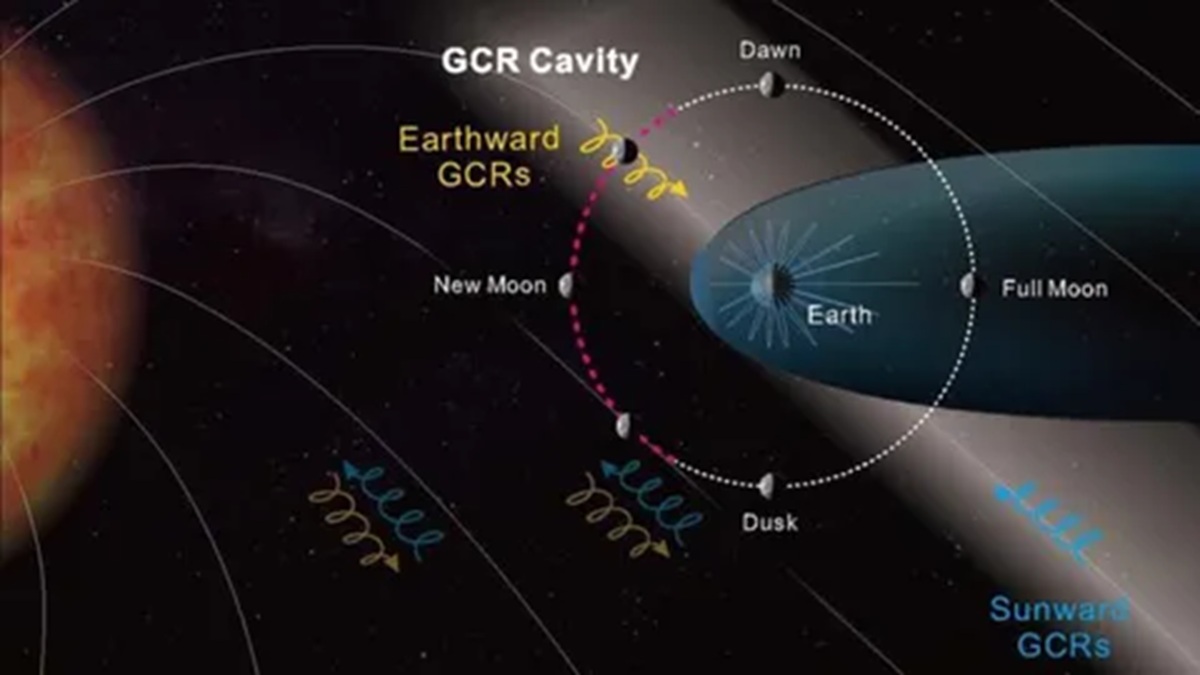
Data collected by the Chinese Chang’e-4 module revealed a reduced cosmic radiation band between Earth and the Moon, a discovery that could redefine operational schedules, reduce astronaut exposure by up to 20%, and directly influence the future of lunar exploration
A discovery made from data from the Chinese Chang’e-4 lander identified a region of reduced cosmic radiation between Earth and the Moon, a result that could alter the planning of lunar exploration and help reduce astronaut exposure to radiation in future missions.
According to researchers, the area acts as a kind of “cavity” that appears in the early morning hours of the Moon’s local time. The observation indicates that Earth’s magnetic field may influence the space between the two bodies at greater distances than previously thought.
The study was published on Wednesday, March 25, in the journal Science Advances. The analysis was based on measurements from the Lunar Lander Neutron and Dosimetry experiment, installed aboard Chang’e-4, which indicated a reduction in galactic cosmic rays a few hours after the lunar sunrise.
-
Artemis 2 sends four astronauts on a historic mission to the Moon after 50 years, with a launch on April 1 and a record flight to the far side of the Earth’s natural satellite.
-
Scientists drilled 523 meters of ice in Antarctica with water at 75 degrees and found 218 meters of sediments that prove that where there is now half a kilometer of ice, there was once an open ocean millions of years ago.

-
Scientists create a new propulsion system that allows satellites to use the air from Earth’s atmosphere as fuel to operate in space with lower costs and longer operational time.
-
Student creates revolutionary filter that removes up to 96% of microplastics from water using cheap magnetic technology and could change the future of drinking water in homes.


Discovery may influence the timing of future missions
Cosmic rays are among the main risks for astronauts traveling beyond low Earth orbit. These high-energy particles can penetrate spacecraft and human tissues, which can cause DNA damage and increase the risk of cancer.
In light of the advancement of new crewed missions, researchers state that a more precise mapping of radiation intensity could help reduce astronaut exposure during activities on the lunar surface.
The study mentions that more crewed trips are planned to the Moon, starting with NASA’s Artemis II mission, scheduled for launch on April 1.
Robert Wimmer-Schweingruber, a professor at the Institute of Experimental and Applied Physics at the University of Kiel in Germany, and one of the corresponding authors of the study, said in an email to Live Science that the next landings will likely occur in polar regions. According to him, these areas may remain permanently illuminated by the Sun, and the lunar morning seems to be the best time for surface missions.
According to Wimmer-Schweingruber, conducting operations during this period could reduce the amount of radiation received by astronauts’ skin by about 20% compared to the average levels measured on the Moon. The observation, he said, provides a practical reference to enhance safety in future lunar exploration activities.
How scientists identified the radiation cavity
To locate this region of lower cosmic ray incidence, researchers analyzed data collected over 31 lunar cycles. The survey covered the period from January 2019 to January 2022 and focused on phases of low solar activity.
Under these conditions, the measured space radiation was predominantly from galactic cosmic rays. The team looked for repeated changes in the count of protons detected by Chang’e-4 as the Moon moved through different parts of its orbit around Earth.
The neutron and dosimetry instrument of the module recorded protons in two energy ranges. Then, scientists organized this data according to lunar local time to check for recurring variations throughout the cycle.
The main reduction appeared in lower-energy protons, in the range between 9.18 and 34.14 mega-electron-volts. During the Moon’s local morning, in the waxing gibbous phase, between new moon and full moon, the count dropped about 20% compared to later times.
As this decrease appeared repeatedly at a specific stage of the waxing phase, and not throughout all the analyzed periods, the team concluded that the Moon was crossing a real region of reduced cosmic radiation.
The hypothesis raised was that Earth’s magnetic field was blocking some of the high-energy protons.
Simulations reinforced the result observed by Chang’e-4
To test this interpretation, researchers conducted simulations of proton movement along the lunar orbit. The models reproduced the same radiation cavity observed in the measurements, reinforcing the consistency of the result.
Wimmer-Schweingruber stated that he did not expect to find this “shadow” or cavity. According to him, the finding made sense after the analysis, but initially provoked skepticism within the team itself, leading to several tests before the final conclusion.
The repetition of the pattern over many lunar cycles was also important to support the discovery. Instead of a one-time fluctuation, the data showed a reduction linked to a specific position of the Moon in its trajectory around Earth.
Effect amplifies the known influence of Earth’s magnetic field
The conclusions point to a different scenario than what had been considered regarding the behavior of cosmic radiation in the space between Earth and the Moon. Until now, scientists generally assumed that, after crossing Earth’s magnetosphere, galactic cosmic rays were distributed approximately uniformly in this region.
According to Wimmer-Schweingruber, the result shows that Earth’s magnetosphere influences space even beyond its own extent. The team expected some effect on the Moon in the magnetotail, the long stretch of the magnetic field that projects away from the Sun on the nighttime side of Earth, but did not anticipate a similar phenomenon in front of the magnetosphere, facing the Sun.
The researcher stated that future studies, with larger datasets, could better define the size and behavior of this cavity.
For him, this could help pave the way for a more practical phase of lunar exploration, with operational decisions based on more detailed measurements of radiation.
As initial guidance, Wimmer-Schweingruber summarized that the best time for astronauts to go to the lunar surface would be in the early morning hours, local time.
The assessment combines, in a single recommendation, the scientific data observed by Chang’e-4 and a possible direct application in the planning of upcoming crewed missions.
This article was based on a study published in the journal Science Advances.








Seja o primeiro a reagir!