





 Portuguese
  English
  Spanish
  6 min of reading
  0 comments


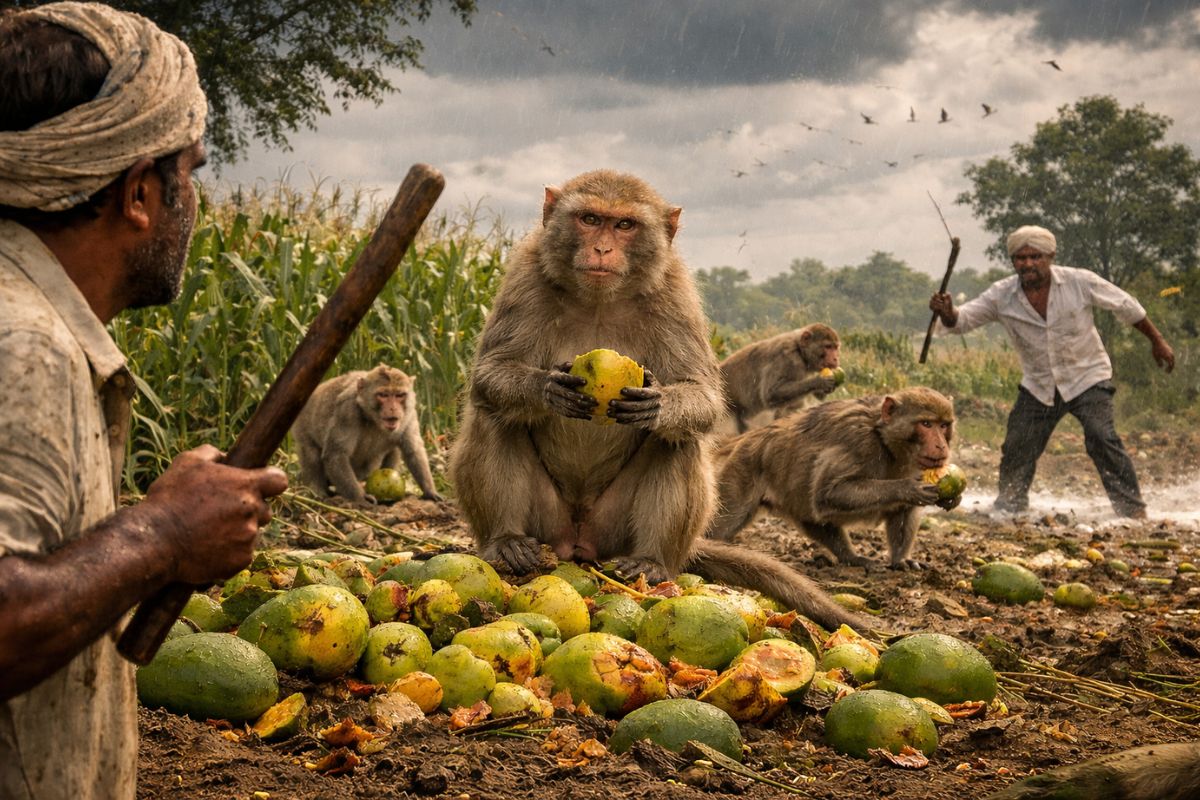
In Indian Farms, Monkeys Invade Crops, Attack Orchards, and Challenge Farmers Already Suffering from Irregular Rains. To Protect Production, Producers Use Artificial Roars, Fake Shots, Strobe Lights, Water Sprayers, Solar Sensors, and Extreme Technologies, Trying to Drive Away Intelligent Animals Without Compromising Their Own Livelihood.
In rural areas of India, monkeys have ceased to be just part of the landscape and have become a daily risk for farmers who rely on their harvests for survival. In regions near forests, these animals invade farms in increasingly larger groups, destroy crops, and cause damages that add to the losses already caused by climate change.
Amid irregular rains, excessive out-of-season water, and reduced natural food supply for wildlife, producers are turning to increasingly creative and technological solutions. Roars of lions, gunshot sounds, flashing lights, motion sensors, and jets of water emerge as improvised weapons in the attempt to save crops from the constant monkey attacks.
Where the Crisis with Monkeys has Intensified in Indian Farms

One of the most emblematic cases occurs in the outskirts of Bengaluru, in southern India, a region known as the country’s tech hub, but also surrounded by forested areas.
-
Italian researchers have detected what appears to be a second Sphinx buried under the sands of Egypt, and satellite scans reveal a gigantic underground megastructure hidden beneath the Giza Plateau for over 3,000 years.

-
There are 4,223 drums and 1,343 metal boxes concreted with 50-centimeter walls that store the radioactive waste from Cesium-137 in the worst radiological accident in Brazil, just 23 kilometers from Goiânia, with environmental monitoring every three months.

-
Giant Roman treasure found at the bottom of Lake Neuchâtel in Switzerland reveals an advanced trade system, circulation of goods, and armed escort in the Roman Empire about two thousand years ago.

-
He buried 1,200 old tires in the walls to build his own self-sufficient house in the mountains with glass bottles, rainwater, and an integrated greenhouse.


There, farmer Raghavendra Bhat manages a six-hectare organic farm, daily living with the pressure of wildlife.
When he switched from working with computers to farming in 2014, Bhat did not imagine that monkeys would become his most problematic visitors.
At first, the presence of the animals seemed harmless, but the situation worsened over time, turning into frequent and increasingly aggressive invasions.
From Occasional Visitors to Organized Invaders
As the years went by, the attacks intensified. According to Bhat, hundreds of monkeys began invading his banana plantation, advancing towards the house, jumping on people, and spreading fear within the property.
The farmer started to recognize the animals individually, which shows the level of recurrence of the invasions.
He even identifies a leader among the monkeys, a tailless individual who returns every year with larger groups.
The organization of the attacks made it clear that these were no longer isolated incidents, but a difficult pattern to contain.
Climate Changes Broaden the Conflict Between Humans and Monkeys
Indian farmers have always lived with pests, but the current scenario is different.
Climate change and human encroachment on natural habitats have reduced food supply for wildlife, pushing animals like monkeys into agricultural areas.
Unseasonable rains have already caused severe losses in the crops.
In Bhat’s case, nearly 90% of a recent pigeon pea harvest spoiled due to excessive rain.
For small producers, this type of loss can be definitive, especially when loans need to be paid even after the crop failure.
When Monkeys Attack What Is Left of the Harvest
After losses caused by the weather, the invasion of monkeys becomes the final blow.
Bhat questions how small farmers can survive when animals destroy the few remaining percentages of production.
The impact is not only economic but psychological.
Constant uncertainty, combined with climatic unpredictability and wildlife attacks, creates an environment of extreme pressure in Indian agriculture, where most producers have very small areas and few income alternatives.
Extreme Methods Already Used Against Monkeys on Farms
In desperation, some farmers resort to fireworks, electric fences, and even poison to ward off wild animals.
These solutions, besides being dangerous, raise ethical and environmental questions, and do not always solve the problem in a lasting way.
Bhat reported losing at least 20% of his annual income due to invasions by monkeys and elephants.
To avoid even greater losses, he adopted a drastic measure: capturing monkeys when the attacks became unbearable.
Capture, Transport, and Release Miles Away

About five years ago, Bhat began to attract and cage monkeys, transporting up to 25 animals at a time in his tractor.
Afterward, he would release them in a forest located about 100 kilometers from the farm.
Even so, the farmer reports that monkeys waste much more than they consume.
They bite fruits like bananas, guavas, mangoes, and sapotes, damaging dozens to eat just one or none at all, disproportionately increasing the losses.
The Search for More Humane Technological Solutions
Tired of aggressive methods, Bhat decided to invest in technology.
In December 2021, a guest at the farm reported an unpleasant experience with monkeys and recommended a bioacoustic device being tested in northern India.
The equipment, powered by solar energy and activated by motion sensors, reproduces sounds of lion roars, tigers, and leopards, as well as fake shots, with the aim to target monkeys’ senses without harming them.
How Sound Devices Work Against Monkeys
The device was developed by a technology company focused on wildlife.
The logic behind the equipment is simple and straightforward: change the animal’s behavior without causing physical harm, exploiting the instinctive fear of predators and threatening noises.
Before arriving at sound, the team tested sprinklers with sensors that sprayed water on the monkeys.
At first, the animals were startled, but within a few days they started to play with the system, nullifying the effect.
Varied Sounds to Deceive Monkeys’ Intelligence
Faced with quick adaptation, developers began programming the speaker to emit different sounds each week.
The idea was to prevent monkeys from recognizing the pattern and getting used to the trick, which is common when dealing with highly intelligent animals.
Even so, results vary. In some cases, monkeys flee upon hearing the sound. In others, they only change their invasion route, accessing the farm from different directions.
The Cost of Technology and the Exclusion of Small Farmers
The sound device costs about US$ 130, an amount considered high for the reality of most Indian farmers.
More than half of the country’s workforce depends on agriculture, and many producers have properties smaller than two acres, roughly the size of a football field.
For these farmers, investing in technology to deter monkeys may be unfeasible, even when losses threaten their very survival.
When Technology Saves an Entire Harvest

In another region of India, in the state of Maharashtra, farmer Malan Raut faced a similar situation.
After losing crops in a flood, she suffered losses again, this time caused by deer that destroyed her garden.
With the help of a women’s agricultural cooperative, Raut received a different device: a scarecrow equipped with a flashing light powered by solar energy, which stays on all night.
The result was positive, and the fenugreek crop was able to survive.
Lights and Sounds Also Have Side Effects
Although they help some producers, these systems bring problems.
Neighbors complain about the constant noise, which disrupts the tranquility of rural areas.
Additionally, researchers warn that it is only a matter of time before animals become accustomed to the stimuli.
Experts studying the conflict between humans and wildlife say that, in the case of monkeys, acoustic devices lose effectiveness over time.
Animals learn to ignore the sounds and continue invading farms without fear.
Monkeys Learn Quickly and Change Strategy
Bhat noticed this adaptation on his own farm.
He observed monkeys reacting to the sound, initially fleeing but then returning through other points of the property.
The intelligence of monkeys turns every solution into a temporary challenge, requiring constant adjustments.
Currently, the farmer keeps the device installed on a three-meter electrical pole, far enough from his house not to disturb.
Even so, he admits that the monkeys continue to adapt.
A Problem Without a Simple Solution in Indian Agriculture
The scenario reveals a complex conflict, where monkeys, farmers, technology, and climate change intersect.
There is no definitive solution, only successive attempts to minimize losses and buy time.
Meanwhile, producers continue to improvise, testing equipment and hoping that the next harvest can withstand another round of daily attacks from these increasingly bold visitors.
Do you think technology will be able to outsmart the intelligence of monkeys on Indian farms, or will farmers always be one step behind?










-

Uma pessoa reagiu a isso.