





 Português
  Inglês
  Espanhol
  5 min de leitura
  1 comentário


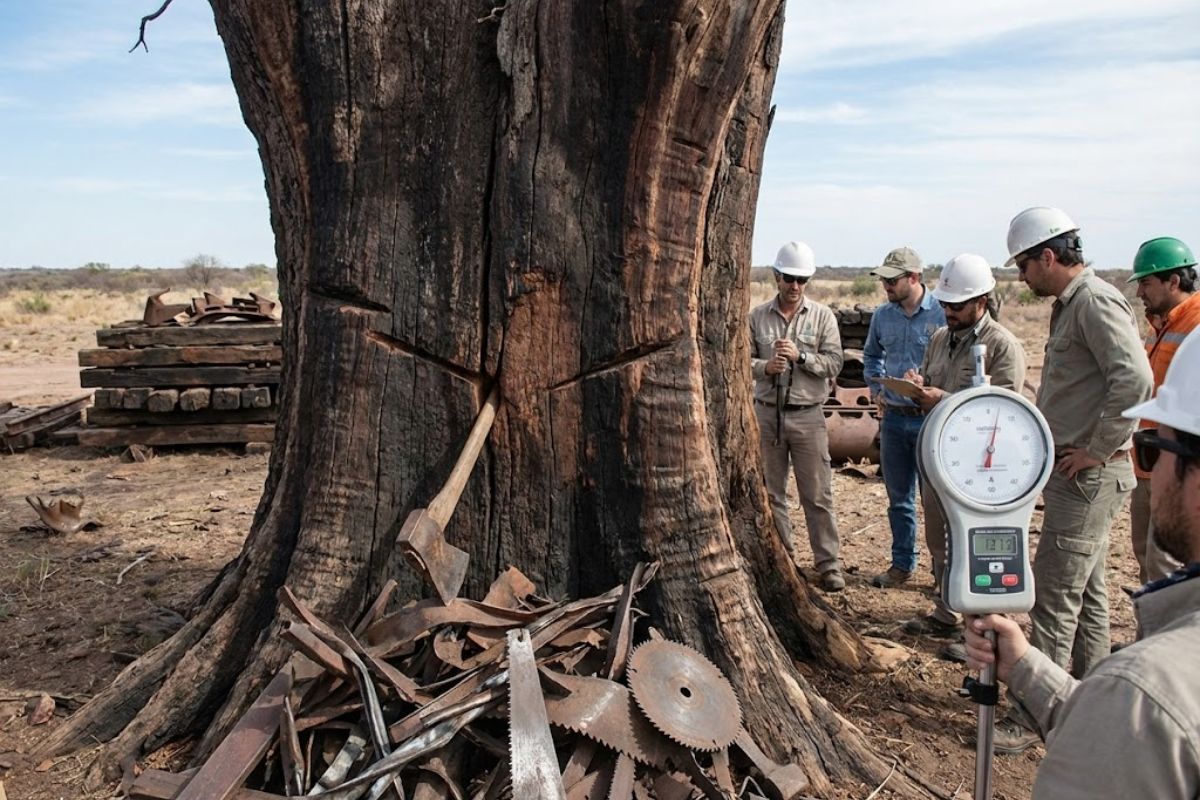


The South American Wood Quebracho, Native to Argentina and Paraguay, Became a Benchmark for Hardness in the Janka Test, Reaching 4,570 Pounds-Force, About 20,340 N. Dense and Wear-Resistant, It Has Been Used in Railroad Ties and Naval Structures, but Experts Remind Us That Hardness Is Not Total Resistance
The South American wood that earned the nickname “axe breaker” is the quebracho, a tree native mainly to Argentina and Paraguay that ranks at the top when the criterion is extreme hardness. The highlight comes from the Janka test, a global reference in forest engineering, in which this species reaches about 4,570 pounds-force, equivalent to 20,340 N.
This South American wood has become synonymous with difficulty in cutting and durability in heavy applications, traditionally used in railroad ties, naval structures, and industrial sectors. At the same time, the technical discussion makes it clear that hardness does not summarize total performance: for engineers and designers, different stresses require different properties, and what is “almost unbreakable” in cutting may have limits in other types of loads.
What Does the Janka Test Measure and Why Did It Become a Reference?

The Janka test is the most cited method when discussing wood hardness. It calculates the force needed to press a steel sphere halfway into the material’s diameter. This criterion primarily assesses the resistance to surface deformation, which influences wear, marking, and performance in surface friction and impact.
-
With more than 635,000 doctors, Brazil sees competition increasing in large cities, and recent graduates are competing for shifts at an accelerated pace while the countryside still faces shortages.

-
The world’s first octopus farm wants to open in the Canary Islands and is already provoking an international reaction: the plan aims to produce 3,000 tons per year.

-
Drought may be creating stronger superbugs in the soil and helping antibiotic resistance reach hospitals, warns a study highlighting a problem that could grow alongside extreme weather.

-
The biggest scam in history: Napoleon’s France deceived the United States by selling them a territory that was Spanish.


In the case of quebracho, the number stands out because it places the species among the hardest ever measured: about 4,570 pounds-force, equivalent to 20,340 N. For comparison within the same ranking, well-known tropical woods also appear at the top but fall short in the specific criterion of surface hardness.
Quebracho: The South American Wood That Became “Axe Breaker”

The popular name quebracho is explained by its origin in the Spanish ‘quebrar hacha’, literally meaning “to break the axe”. The expression did not arise as a marketing exaggeration but as a practical label, associated with the extreme difficulty of cutting and the resilient behavior of the material against tools.
Quebracho is identified as Schinopsis spp., with a native occurrence mainly in Argentina and Paraguay. The wood is described as highly dense and wear-resistant, two attributes that tend to push a species toward applications requiring constant contact, repetitive load, and aggressive environments.
Why Did Railroads and Ships Adopt This South American Wood?

The classic application cited for quebracho is its use in railroad ties. Railroad ties work under compression, friction, vibration, and environmental exposure, and wood with high hardness and wear resistance gains an advantage in lifespan.
Another highlighted traditional use is in naval structures, where durability and density aid components that suffer abrasion, stress, and frequent contact with wet environments and temperature variations. In heavy industrial applications, the material fits as a robust option for parts subjected to wear and surface impact.
Ipê and Lignum Vitae Enter the Top but Fall Below in Janka

Experts cite other tropical woods known for hardness and durability, such as lignum vitae (Guaiacum officinale) and ipê, but assert that none surpasses quebracho in the specific criterion of the Janka surface hardness test.
Lignum vitae is noted with 4,390 lbf and is flagged as being currently classified as a threatened species. The fact that very hard woods have environmental restrictions is an important point to avoid the simplistic interpretation that “harder” is always synonymous with “better” or “permitted for any use.”
Hardness Is Not Total Resistance: What Engineering Looks at Beyond Janka
The technical discussion itself insists that hardness is not synonymous with absolute resistance. Laboratories that assess wood analyze various properties beyond Janka, including resistance to compression, bending, twisting, shearing, impact, and fatigue.
In practice, an extremely hard wood may not be the most efficient in efforts such as twisting or continuous bending. Conversely, species less hard on the Janka scale may perform structurally better in beams, roofs, or furniture, depending on how they distribute stresses and respond to repeated loads.
This point explains why there is no single “most resistant wood in the world” in all scenarios. Each application demands a set of physical and mechanical properties, and the engineer decides based on the dominant stress, environment, expected lifespan, and maintenance.
Other Very Hard Woods and What Each Indicates
Besides quebracho, the cited ranking lists species with high numbers in the Janka test and notable characteristics:
Guaiacum officinale, lignum vitae, with 4,390 lbf, noted as threatened.
Acacia cambagei, from Australia, with 4,270 lbf, known for its violet aroma when cut.
Snakewood (Brosimum guianensis), with 3,800 lbf, described as rare and highly valued.
Verawood (Bulnesia arborea), with 3,710 lbf, noted for green tones and high durability.
African blackwood (Dalbergia melanoxylon), with 3,670 lbf, used in high-precision musical instruments.
The presence of threatened or rare species at the top reinforces a warning: when the metric is extreme hardness, market pressure can grow and demand care in management and use, especially in scenarios of excessive exploitation.
Sustainability and the Pressure on “Legendary” Woods
The fame of quebracho as “practically unbreakable” wood is used to illustrate the potential of South American forests, but also to reinforce the need for responsible and sustainable use. The text points out that many of the hardest woods in the world already face environmental restrictions due to excessive exploitation.
This context is especially relevant when a species becomes a symbol of engineering and is sought after to “solve everything.” Extreme hardness is a technical attribute, not an automatic license for exploitation, and the supply chain must be compatible with conservation and environmental rules.
The South American wood quebracho, native mainly to Argentina and Paraguay, leads the Janka test with around 4,570 pounds-force, equivalent to 20,340 N, and earned the nickname “axe breaker” for resisting cuts and wear. The history of use in railways and naval structures explains the reputation, but engineering itself reminds us that hardness does not summarize total resistance, as compression, bending, twisting, impact, and fatigue can alter performance depending on the application.
In your opinion, should the hardest South American wood be reserved only for critical industrial uses, or would it make sense to expand to common applications even with the risk of environmental pressure and future restrictions?







O que deve determinar a legalidade ou não do uso de qualquer espécie nativa, independentemente de sua espécie, é a extração autorizada por projeto de manejo florestal sustentado.