





 English
  Francês
  Alemão
  Italiano
  Japonês
  Norueguês
  Portuguese
  Spanish
  3 min of reading


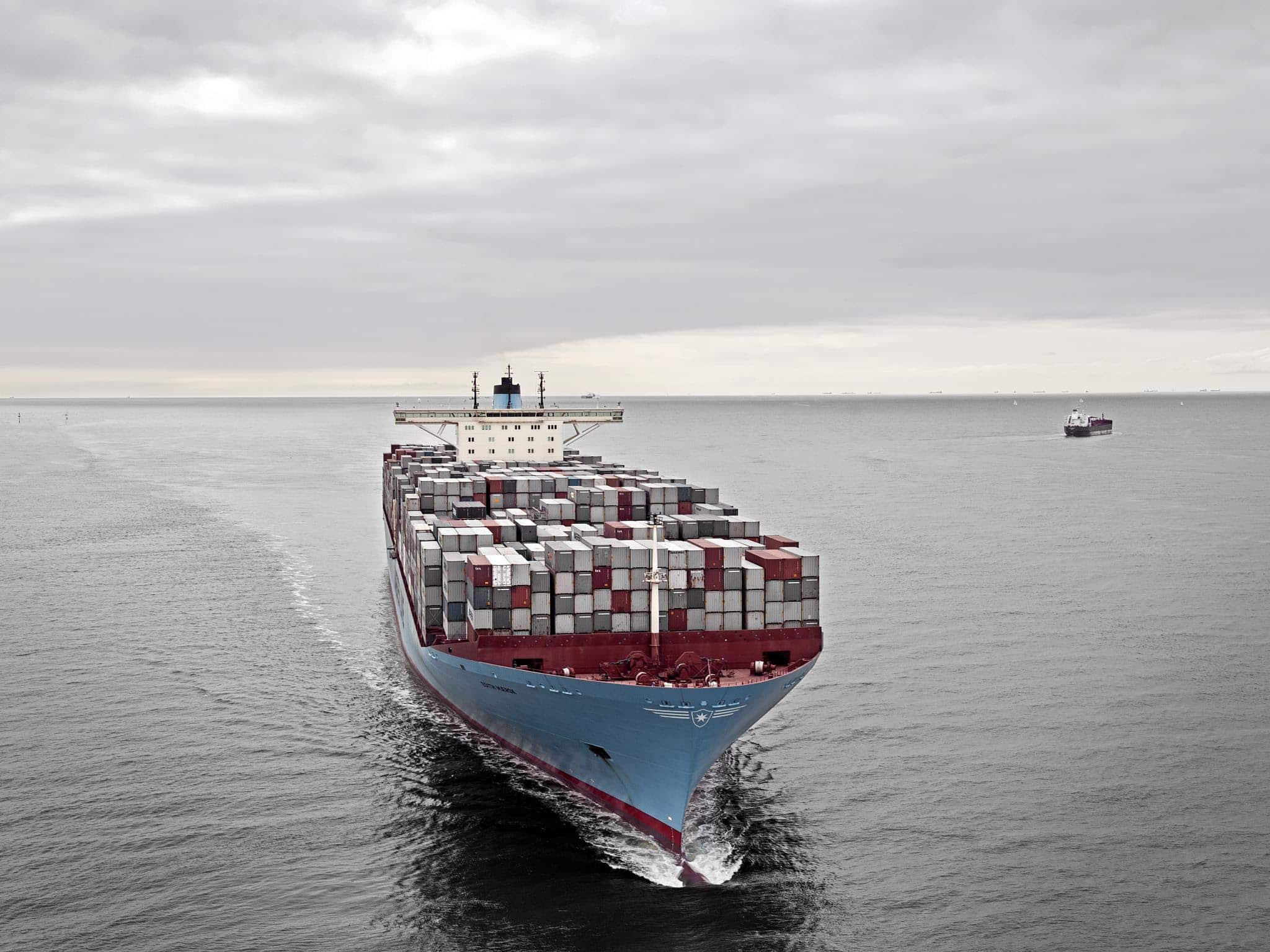
Vessels With Green Methanol Engines Will Replace Old Ships, Thus Reducing Pollutant Gas Emissions
Following a decarbonization roadmap, while aiming to maintain operational excellence and seize business opportunities related to sustainability, Maersk, the world’s largest shipping company, is awaiting the arrival of 19 container ships with engines that can operate on green methanol biofuel.
The maritime vessels were ordered from Hyundai Heavy Industries, with delivery expected to begin in 2023. Of the total container ships expected by Maersk, 12 will have a capacity of 16,000 TEU, powered by MAN G95 biofuel engines (main engine) and 16,000 m3 methanol tanks, to be delivered from 2024 to mid-2025; 6 will have a capacity of 17,000 TEU under the Danish flag (the country of origin of Maersk), with delivery expected in 2025; and 1 feeder ship with a capacity of 1,900 TEU is set to be delivered and operated as early as next year.
According to the company, when all these new maritime vessels are deployed and have replaced the older ships, there will be an annual CO2 emissions savings of about 2.3 million tons. In the view of Maersk’s Fleet &
Strategic Brands CEO, Henriette Hallberg, this fleet modernization favors business efforts involving sustainability.
-
New shoe factory in Ceará is expected to create 400 jobs and strengthen the local economy.

-
No one imagined it, but a mixture of sawdust with a mineral that fights fires surprises scientists with a result that changes the course of fire-resistant construction.

-
From empty land to a high-end house, wooden construction uses a lightweight system, metal structure for the foundation, ventilated ceramic cladding, and special windows to create an efficient and comfortable living space throughout the year.

-
From vacant land to a high-end house, wooden construction uses a lightweight system, a metal structure for support, ventilated ceramic cladding, and special windows to create an efficient and comfortable living space throughout the year.


“Our customers are looking to us to decarbonize their supply chains, and these six vessels capable of operating on green methanol will further accelerate efforts to provide our customers with carbon-neutral transportation. A global action is needed this decade to meet the Paris Agreement goal of limiting global warming to a temperature increase of 1.5°C.”
.Henriette Hallberg Thygesen – CEO of Fleet & Strategic Brands at Maersk
Partnerships With Other Companies Will Favor Biofuel Generation for the New Fleet
With the intention of producing what is necessary to supply a good part of the new ships to come, Maersk has partnered with other global giants around the world. The companies involved in the agreement are CIMC ENRIC, European Energy, Green Technology Bank, Orsted, Proman, and WasteFuel.
The forecast is to produce 730,000 tons of e-methanol, which is a biofuel also called methyl alcohol and methyl hydrate, produced from natural gas through what is called value reforming or coal gasification, with synthesis gas obtained, composed mainly of CO, CO2, and H2.
“Green methanol is the only ready-to-market and scalable solution available today for shipping. Production must be scaled up through collaboration across the ecosystem and throughout the world. That is why these partnerships represent an important milestone in initiating the transition to green energy,” says Henriette Hallberg Thygesen.
According to the executive, this strategy will allow the company to have biofuel to supply ships in various parts of the globe. “Once fully developed, the project to produce green fuel at scale will allow Maersk to obtain fuel from various parts of the world. Collaboration and investments in innovative projects are the main ways to achieve a net-zero supply chain,” she concludes.
Decarbonization Will Be the Focus of Maersk’s New CEO
Maersk has announced Swiss Vincent Clerc as the new CEO. The executive takes on the company’s top role, assuring that he will continue the work of digitalization and decarbonization, maintaining operational excellence and seizing business opportunities related to sustainability.
The company has set targets to eliminate pollutant emissions by 2040. The first step is to reduce its carbon intensity in ocean products by 50% by 2030, with 25% of all cargo transported using green fuel.
It is also estimated that terminals will achieve a 70% reduction in greenhouse gas emissions, and a minimum of 30% of cargo transported by air will be sustainable aviation fuel. Additionally, warehouses and distribution centers are expected to have a minimum of 90% green operations. By following this path, the goal is to reduce carbon emissions to zero by 2040.










Seja o primeiro a reagir!