





 Portuguese
  English
  Spanish
  5 min of reading
  0 comments


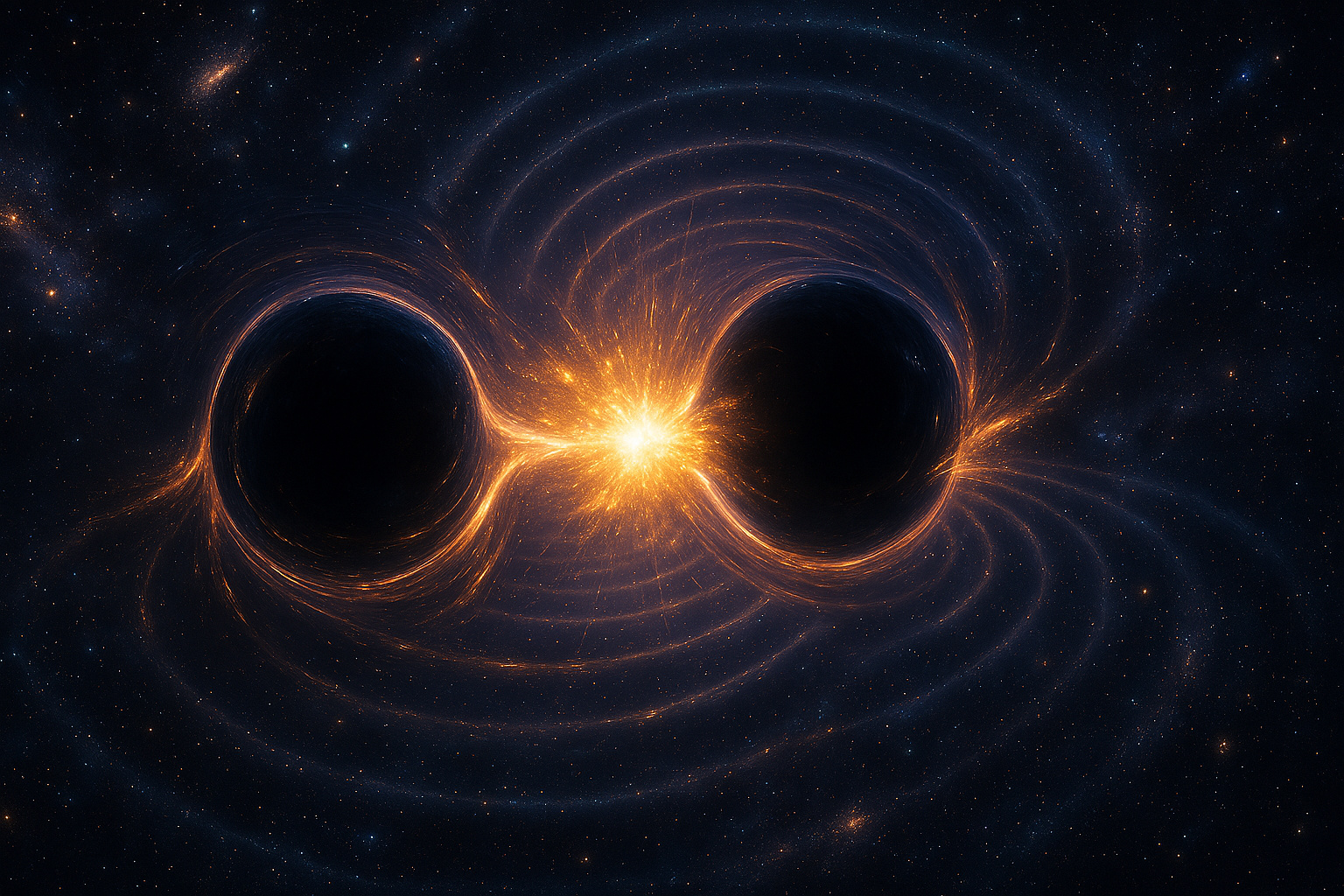
Gravitational Waves Detected by LIGO and Virgo Confirm Collisions of Black Holes Above 60 Solar Masses and Reveal the Most Energetic Events Ever Observed in the Universe.
The almost imperceptible ripples in the fabric of space-time, predicted by Albert Einstein in 1916, have ceased to be just a theoretical concept and have become one of the most powerful tools of modern astrophysics. In recent years, observatories like LIGO, Virgo, and, more recently, KAGRA have begun to record increasingly extreme signals, culminating in the detection of gravitational waves generated by collisions of black holes with masses exceeding 60 times that of the Sun. These events not only confirm fundamental predictions of general relativity but also reveal cosmic processes that surpass any energy scale ever directly observed by humanity.
These detections represent a scientific leap comparable to the first observation of exoplanets or the direct image of a black hole. For the first time, science is able to “hear” the Universe at frequencies associated with colossal phenomena occurring billions of light-years from Earth, and accurately reconstruct, with mathematical precision, what happened in the final moments of these titanic collisions.
What Are Gravitational Waves and Why Are They So Important
Gravitational waves are distortions in space-time caused by the accelerated movements of extremely massive objects. Unlike light or particles, they traverse the cosmos practically without being absorbed or deflected, carrying direct information about their origin. This allows for the study of invisible events by traditional telescopes, such as mergers of black holes, neutron stars, and possible exotic objects.
-
Goodbye clothes with odors from use: Samsung’s device uses high-temperature steam, eliminating up to 99.9% of bacteria, removing dust mites, and neutralizing odors directly in the wardrobe without the need for washing.

-
Embraer arrives in Mexico with 7 new E190-E2s in 2026, after 5 jets have already been delivered, while Mexicana surpasses 1 million passengers, plans a fleet of 20 aircraft, and expands strategic routes across the country.

-
China is not joking around and is secretly expanding its nuclear weapons infrastructure: a giant dome the size of 13 city blocks, 600 warheads, destroyed villages, and a modernized military network in record time in China, says CNN.

-
Goodbye iron and wrinkled clothes: LG’s smart wardrobe uses TrueSteam vapor, hangers that vibrate up to 180 times per minute, and cycles of 20 to 30 minutes to remove odors and reduce wrinkles without washing.


When two black holes spiral in and collide, part of their mass is directly converted into energy, according to the famous equation E = mc².
This energy is released in the form of gravitational waves, capable of propagating for billions of years until being detected on Earth, altering the length of interferometric arms by fractions smaller than the diameter of a proton.
Collisions Above 60 Solar Masses: Why These Events Shocked Scientists
The first detections, announced in 2015, involved black holes with masses between 20 and 40 suns. However, more recent signals revealed much more massive systems, with individual objects exceeding 60 solar masses and, in some cases, producing final black holes with over 140 solar masses.
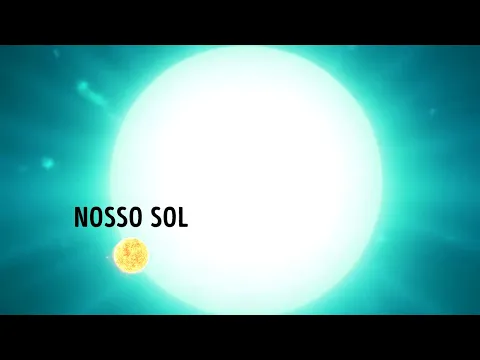
These values drew attention because they challenge classical models of stellar formation. Theories indicated that very massive stars should lose a significant part of their mass before collapsing or even completely destroying themselves in explosions known as supernovae due to pair instability, which would prevent the formation of black holes within that mass range.
“There are standard mechanisms by which black holes form — when stars run out of fuel, they die and then collapse,” said Hannam. “But there is a mass range where we think it’s not possible for black holes to form this way. And the black holes in GW231123 are exactly in the middle of that gap (in mass). So there’s a question about how they formed, which makes them very interesting.”
The direct observation of these collisions suggests alternative scenarios, such as hierarchical mergers, where smaller black holes repeatedly join in dense environments, such as star clusters.
Energy Released: Tens of Suns Converted into Waves
During these extreme events, the amount of energy released is hard to conceive. In fractions of a second, the equivalent mass of several suns is transformed into pure energy, surpassing, for a brief moment, the combined brightness of all the stars in the Observable Universe.
This energy does not manifest as light, but as gravitational waves that spread throughout the cosmos. Detectors can measure the “signature” of these waves, allowing the calculation of the involved masses, the distance of the event, the rotation of the black holes, and even the orientation of the system in space.
The Role of Observatories LIGO, Virgo, and KAGRA
The success of these discoveries is directly linked to the technological evolution of the detectors. LIGO, in the United States, and Virgo, in Europe, use gigantic interferometers with arms kilometers long, where laser beams reflect thousands of times to amplify minimal variations in length.
KAGRA, in Japan, adds an innovative approach by operating partially underground and with cryogenically cooled mirrors, reducing thermal noise.
The joint operation of these observatories allows for more precise localization of the origin of the signals and differentiation of real events from local noise. The more detectors come online, the greater the capacity to map the gravitational Universe.
What These Discoveries Reveal About the Evolution of the Universe
The collisions of supermassive black holes offer valuable clues about the formation and evolution of the first stars, the dynamics of star clusters, and the history of galaxies.
Many of these events occurred when the Universe was less than half its current age, serving as gravitational fossils of ancient times.
Moreover, gravitational waves allow us to test general relativity in extreme gravitational regimes, something impossible to reproduce in the laboratory. So far, all observations confirm Einstein’s predictions with high precision, even under conditions of intense gravitational fields and velocities close to light.
A New Era of Observational Astronomy
The detection of gravitational waves does not replace traditional astronomy but complements it. While optical, radio, and X-ray telescopes observe the light emitted by cosmic objects, gravitational detectors capture invisible motions and collisions, opening a new window on observation.
With improvements expected in the next decade and even more ambitious projects like the LISA space observatory, the expectation is to detect even more massive events, including mergers involving supermassive black holes at the centers of galaxies.
These discoveries show that the Universe is much more violent, dynamic, and energetic than previously thought. By recording collisions of black holes with more than 60 solar masses and energies equivalent to tens of suns, gravitational waves reveal not only cosmic records but also a new chapter in the understanding of the physical limits of space-time and the very nature of reality.








-

-

-

-

5 pessoas reagiram a isso.