





 Portuguese
  English
  Spanish
  3 min of reading
  0 comments


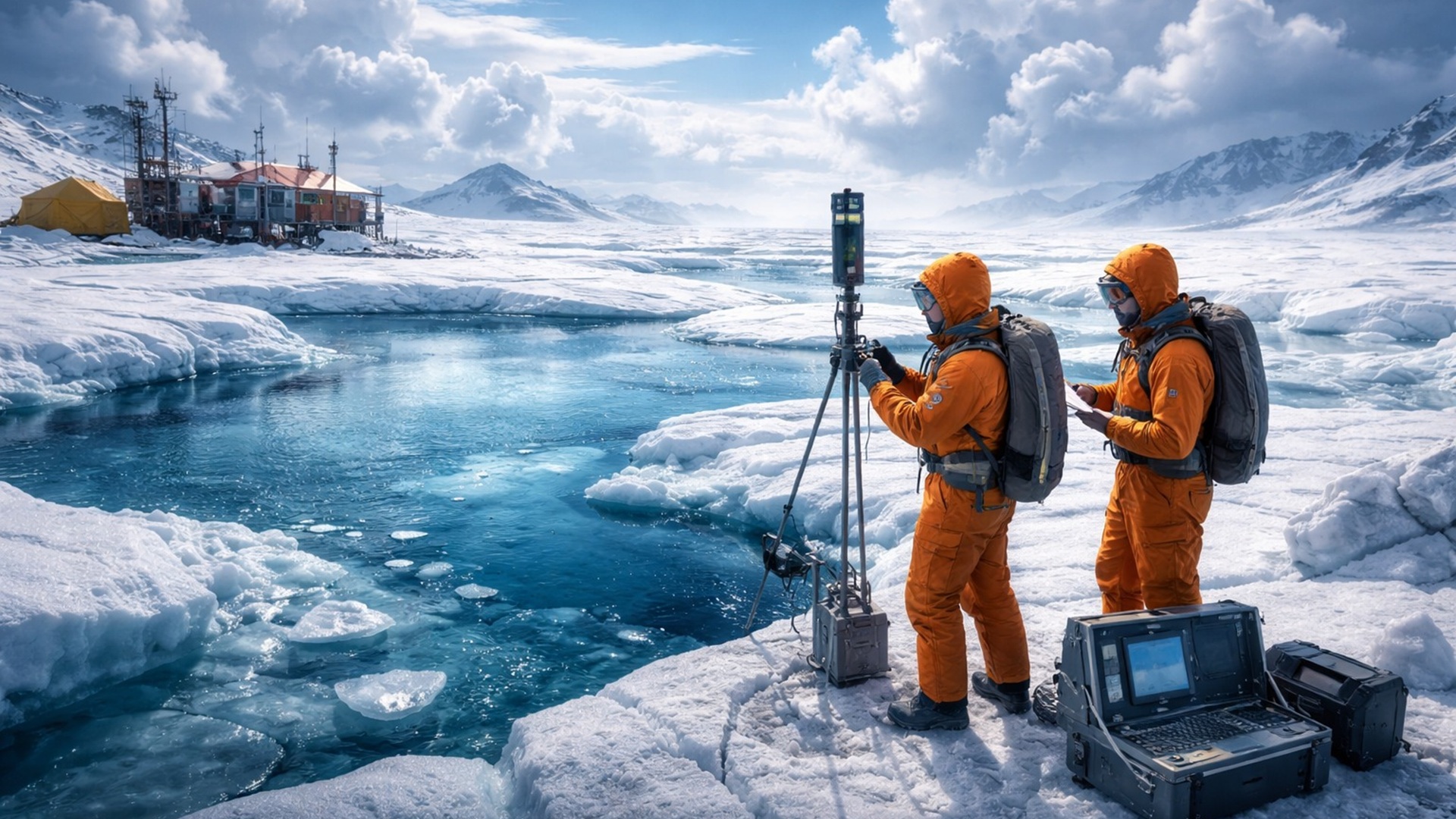
Study Based on Unpublished Time Series of Air Samples Collected at Stations in Antarctica Identifies Low Concentration of Ice Nucleating Particles in Clouds Over the Antarctic Ocean, Phenomenon That Influences the Solar Radiation Balance and the Climatic Role of the Largest Ice Desert on the Planet
Antarctica, recognized as the largest ice desert, features surprisingly low clouds in particles capable of forming ice crystals, according to analyses of air samples collected at outposts on the continent, a result that helps explain unique atmospheric characteristics of the region.
Scarcity of Nucleating Particles in the Largest Ice Desert
Recent research shows that, over the Antarctic Ocean and around Antarctica, the ice desert presents an unusual scarcity of ice nucleating particles, known as INPs. These particles are essential for the formation of ice crystals in clouds that do not reach sufficiently low temperatures.
INPs can include mineral dust, wind-blown soil, ash, sea salts, or proteins released by living organisms. In the Antarctic ice desert, however, scientists have identified surprisingly low concentrations of these elements in the atmosphere.
-
Motorola launched the Signature with a gold seal from DxOMark, tying with the iPhone 17 Pro in camera performance, Snapdragon 8 Gen 5 that surpassed 3 million in benchmarks, and a zoom that impresses even at night.

-
Satellites reveal beneath the Sahara a giant river buried for thousands of kilometers: study shows that the largest hot desert on the planet was once traversed by a river system comparable to the largest on Earth.

-
Scientists have captured something never seen in space: newly born stars are creating gigantic rings of light a thousand times larger than the distance between the Earth and the Sun, and this changes everything we knew about stellar birth.

-
Geologists find traces of a continent that disappeared 155 million years ago after separating from Australia and reveal that it did not sink, but broke into fragments scattered across Southeast Asia.

Sample Collection and Unprecedented Time Series
The researchers analyzed air filters collected over time at outposts in Antarctica. According to tropospheric scientist Heike Wex from the Leibniz Institute in Germany, a time series this long had never been conducted to determine ice nucleation levels on the Antarctic continent.
Wex states that the low abundance of INPs may be related to the absence of efficient biological sources, common in other regions of the globe, including the Arctic during summer. This pattern reinforces the unique character of the Antarctic ice desert compared to other polar areas.

Pre2grk/Wikimedia Commons,
CC BY-SA 4.0)
Extension of Results to Other Areas of the Continent
The air samples were collected near three stations in Antarctica. Despite the limited coverage, scientists believe that the low concentrations of ice nuclei observed at the two southernmost stations may extend to other parts of the ice desert continent.
The authors themselves emphasize that collecting more samples would be necessary to fill gaps and confirm the representativeness of the data on a continental scale, proceeding with caution in interpreting the results obtained thus far.
Impact of Clouds on the Climatic Balance of the Southern Hemisphere
The scarcity of ice nuclei in the ice desert directly influences cloud behavior. With fewer INPs available, more water remains in the liquid state, although supercooled, forming clouds that reflect more solar light back into space than clouds rich in ice.
This effect helps protect the Southern Hemisphere from some of the heat associated with climate change. However, according to tropospheric scientist Silvia Henning, also from the Leibniz Institute, this mechanism may be threatened.
Henning explains that global warming could increase the concentration of ice nuclei in Antarctica as glacial retreat exposes more land and makes the biosphere more active. This process could reduce the reflective power of clouds and intensify a warming cycle.
The research was published in the journal Geophysical Research Letters and highlights the importance of determining the current state of atmospheric conditions in the Antarctic ice desert to assess the impacts of future changes.








-

-

4 pessoas reagiram a isso.