





 Portuguese
  English
  Spanish
  4 min of reading
  0 comments


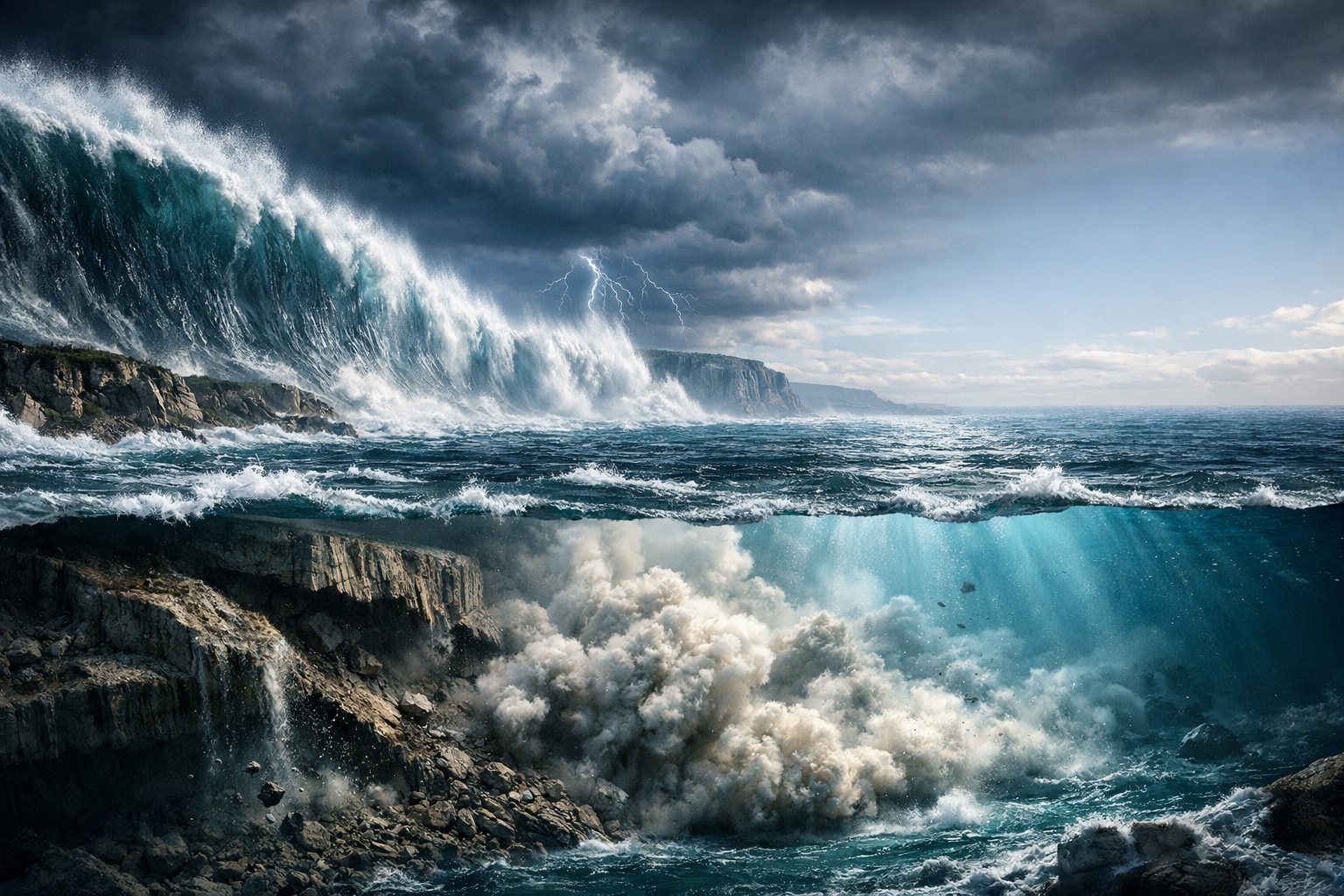
The Storegga Slide Submarine Landslide, Off the Coast of Norway, Displaced More Than 3,000 km³ of Sediment and Triggered a Tsunami That Hit Northern Europe About 8,000 Years Ago.
About 8,000 years ago, an extraordinary geological event occurred on the floor of the North Atlantic. Known as Storegga Slide, the largest submarine landslide ever documented displaced more than 3,000 cubic kilometers of sediment along the continental shelf of Norway. The mobilized volume is considered the largest ever recorded in a marine environment, with sufficient magnitude to drastically alter the underwater topography and trigger a tsunami that hit coastal areas of present-day Scotland and other regions of northern Europe.
The phenomenon was not just an isolated episode in geological prehistory. It remains a scientific benchmark when assessing risks associated with submarine slope instability, oceanic cables, and modern offshore infrastructure.
What Was the Storegga Slide and Where Did It Occur
The Storegga landslide occurred on the continental shelf off the coast of Norway, in a region characterized by steep submarine slopes and thick layers of sediment accumulated over thousands of years.
-
Motorola launched the Signature with a gold seal from DxOMark, tying with the iPhone 17 Pro in camera performance, Snapdragon 8 Gen 5 that surpassed 3 million in benchmarks, and a zoom that impresses even at night.

-
Satellites reveal beneath the Sahara a giant river buried for thousands of kilometers: study shows that the largest hot desert on the planet was once traversed by a river system comparable to the largest on Earth.

-
Scientists have captured something never seen in space: newly born stars are creating gigantic rings of light a thousand times larger than the distance between the Earth and the Sun, and this changes everything we knew about stellar birth.

-
Geologists find traces of a continent that disappeared 155 million years ago after separating from Australia and reveal that it did not sink, but broke into fragments scattered across Southeast Asia.


The word “Storegga” means “Great Edge” in Norwegian, referring to the submarine cliffs created by the collapse of the slope. The event involved the collapse of an extensive segment of the continental slope, generating a massive mass of sediment that slid downwards into the depths of the Atlantic.
Geological studies estimate that the volume displaced exceeded 3,000 km³ — an amount equivalent to dozens of times the volume of large contemporary landslides.
Scale of the Displaced Volume: Concrete Comparison
To understand the magnitude of the event, 3,000 km³ of sediment is equivalent to:
- 3 trillion cubic meters of material
- Enough volume to cover a major capital city with hundreds of meters of thickness
- A mass much greater than that moved in any contemporary land landslide
This scale makes the Storegga Slide a global reference for large-scale submarine instability events.
How the Landslide Generated a Tsunami in the North Atlantic
When the mass of sediment slid, it displaced a huge amount of ocean water. This sudden displacement generated a tsunami that propagated across the North Atlantic.
Geological evidence indicates that the tsunami reached:
- The coast of Norway
- The Faroe Islands
- Scotland
- Parts of present-day England

Sedimentary deposits found in coastal areas of Scotland show characteristic tsunami layers several meters thick, confirming the extent of the event.
Estimates suggest that the waves reached significant heights in regions near the underwater epicenter.
What Caused the Collapse of the Submarine Slope
Researchers point to a combination of factors as potential triggers:
- Excessive sediment accumulation after the last Ice Age
- Geotechnical instability in the deep layers
- Possible seismic activity in the region
- Release of methane gas trapped in hydrates
During the post-glacial period, accelerated melting increased sediment input into the oceans, creating thick potentially unstable layers. Small disturbances could have been sufficient to trigger the collapse.

The hypothesis involving methane hydrates suggests that changes in pressure or temperature may have reduced the cohesion of the sediment.
Modern Scientific Evidence
The Storegga Slide was identified through seismic and bathymetric surveys in the 20th century, which revealed large scars on the seabed off Norway.
Scientific drillings and sediment analyses allowed for the reconstruction of the event and estimation of its age at around 8,200 years before present.
Modern computational modeling helped simulate the propagation of the tsunami and estimate its height in the affected coastal regions.
Could the Event Repeat Itself Today?
The continental shelf of Norway continues to be monitored by scientists due to the presence of strategic infrastructure, including oil and gas platforms and submarine communication cables.
Although there is no evidence that an event of the same magnitude is imminent, the region still presents thick sedimentary layers and the presence of gas hydrates.
The Storegga Slide remains an example of how submarine slopes can be highly unstable under certain conditions.
Impact on Modern Infrastructure
Today, the seabed houses:
- Fiber optic cables that support global internet
- Submarine oil and gas pipelines
- Offshore platforms
A similar event to the Storegga Slide would have a significant impact on these structures.
Turbidity currents generated by submarine landslides can travel hundreds of kilometers, breaking cables and altering the underwater topography.
Storegga Slide as a Reference for Current Studies
The event is frequently cited in research regarding:
- Instability of continental slopes
- Risk of tsunamis generated by landslides
- Interaction between methane hydrates and geological stability
- Vulnerability of submarine infrastructure
It also serves as a comparative basis for studies on modern landslides detected in other oceanic regions.
The Storegga Slide remains the largest submarine landslide ever recorded in recent geological history. With over 3,000 km³ of sediment displaced, the event not only reshaped the floor of the North Atlantic but also generated a tsunami that hit parts of Europe about 8,000 years ago.
The colossal scale of the phenomenon reinforces the importance of continuous monitoring of submarine slopes, especially in an increasingly infrastructure-dependent world installed on the ocean floor.
The geological past demonstrates that the seabed, although invisible to most populations, can harbor natural processes capable of producing global impacts.







-

Uma pessoa reagiu a isso.