





 Portuguese
  English
  Spanish
  5 min of reading
  0 comments


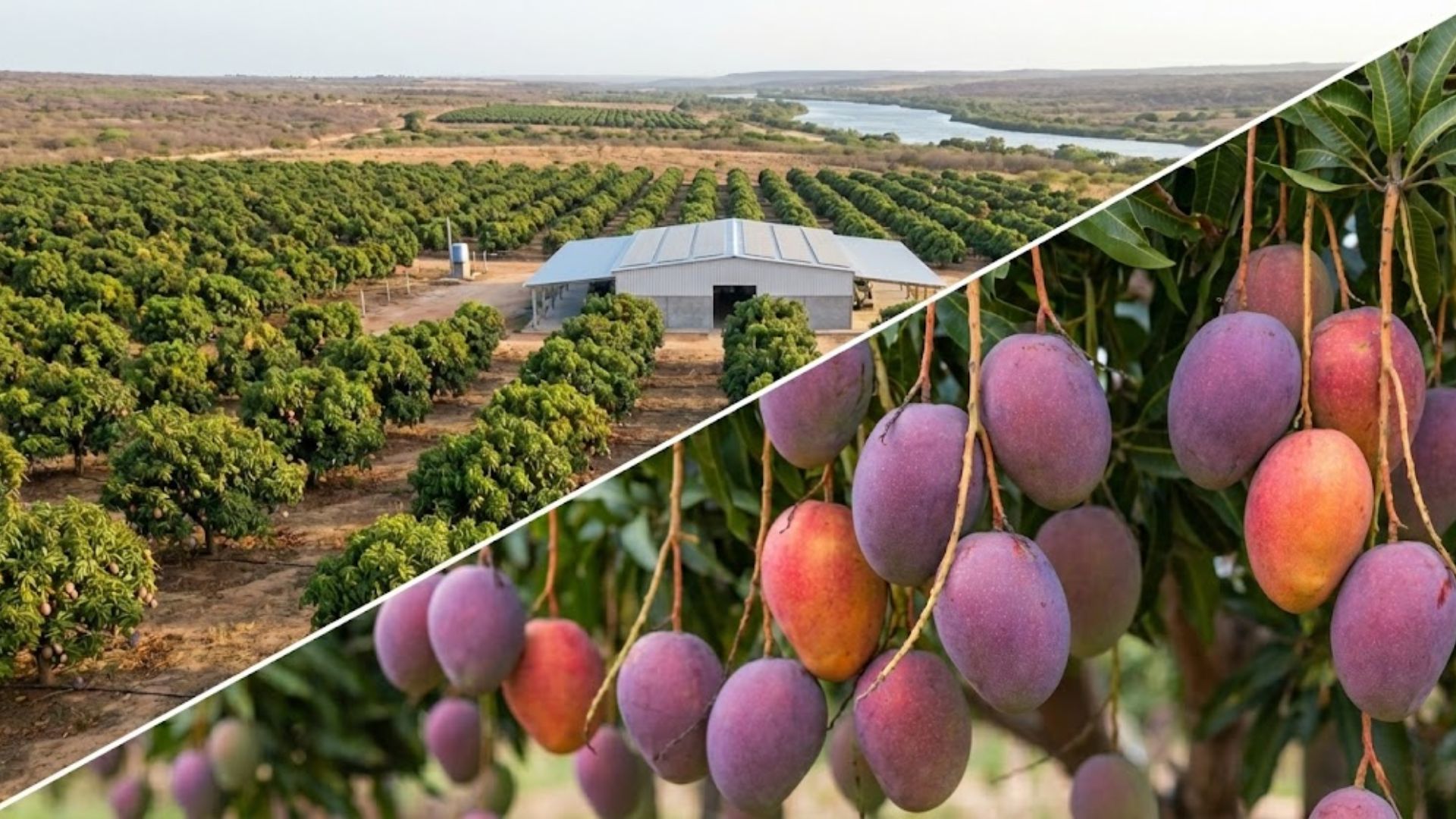
Transformation of The Semi-Arid Region with Irrigated Mangoes, Industrial Technology, Export to Europe, Job Creation, and Social Investments in Education, Health, and Solar Energy in the São Francisco Valley, a Strategic Region of Brazilian Agribusiness.
A mango farm situated in the semi-arid region and supplied with water from the São Francisco River has become one of the main economic engines of the São Francisco Valley, with about 1,400 jobs, annual production of around 30,000 tons, and an automated system that photographs each fruit dozens of times to determine export standards.
Behind the operation is Agrodan, a company that grew from a family investment started in the late 1980s and now accounts for a significant portion of Brazil’s mango exports, with Europe as the main destination.
The strategy combines large-scale irrigation, tracking and automated grading in post-harvest, and a set of social actions maintained in the rural area, including a dedicated school with robotics and music classes for children.
-
The water that almost everyone throws away after cooking potatoes carries nutrients released during the preparation and can be reused to help in the development of plants when used correctly at the base of gardens and pots, at no additional cost and without changing the routine.

-
The sea water temperature rose from 28 to 34 degrees in Santa Catarina and killed up to 90% of the oysters: producers who planted over 1 million seeds lost practically everything and say that if it happens again, production is doomed to end.

-
An Indian tree that grows in the Brazilian Northeast produces an oil capable of acting against more than 200 species of pests and interrupting the insect cycle, gaining ground as a natural alternative in soybean, cotton, and vegetable crops.

-
The rise in oil prices in the Middle East is already affecting Brazilian sugar: mills in the Central-South are seeing their margins shrink just as ethanol gains strength.


Origin of Agrodan and Start of Exports
The journey began in 1987, when the Dantas family decided to invest in irrigated agriculture in the São Francisco Valley, on the border between Pernambuco and Bahia, during a period marked by economic instability and hyperinflation.
The decision was guided by the local climate potential and, above all, by the proximity to the São Francisco River, which enabled production in an area historically associated with drought.
Initially, the farm grew different fruits, such as mango, banana, and grapes.
Still, mango quickly gained prominence in the business plan due to international demand and the possibility of export.

In 1991, the company made its first shipments abroad and began to structure a continuous process of expansion and standardization of production.
As time went by, the operation expanded and consolidated its presence in the region.
Today, Agrodan operates with seven farms and over 1,300 hectares planted, focusing on maintaining volume and regularity of supply to the external market, especially for European buyers.
Drip Irrigation and Water Control in the Sertão
If water defines the limit of what is possible in the sertão, it also became the turning point for large-scale production in the São Francisco Valley.
The company adopted drip irrigation in the productive areas, a system highlighted by Agrodan as a tool to reduce waste, improve nutrient delivery, and increase yield in the field.
In practice, the method directs water directly to the root zone, instead of wetting large soil areas.
This way, management tends to gain predictability, which is crucial in crops that need to meet schedules and quality standards for export.
While irrigation supports the most sensitive stage of cultivation, post-harvest logistics becomes another critical link to keep the fruit suitable for long journeys and sanitary requirements.
It is at this point that the company concentrates part of the automation of the process.
Technology in The Packing House and Automated Mango Selection

After harvest, the mangoes go to the packing house, where stages such as washing, sanitizing, and sorting occur.
Grading, according to information released about the operation, is performed with the support of sensors and high-resolution cameras capable of producing up to 40 images of each mango.
This visual record serves to identify criteria such as weight, color, and external defects.
The aim is to reduce losses, increase sorting accuracy, and separate, with greater safety, what will go to the domestic market and what will meet export requirements.
Automation, however, does not eliminate the need for standardized procedures and operational control throughout the chain.
In operations that sell abroad, small deviations in calibration, temperature, or handling can jeopardize entire batches.
Even with the increasing presence of equipment, human work remains central in the routine of the field and processing.
In addition to agricultural fronts, the demand for labor is distributed in maintenance, quality control, logistics, and production management.
Jobs in The Field, Profit Sharing, and Health Services
Agrodan attributes part of its management model to its integration with the local community, with policies focused on workers and the retention of families in the region.
Among the initiatives mentioned in materials about the company are profit sharing, education programs for youth and adults, and basic health services with telemedicine support.
Another data point associated with the profile of operations is the destination of the production.
In interviews and reports about the company, Agrodan appears as a strongly Europe-oriented exporter, with most of the volume shipped to the continent.

This focus reinforces the need for standardization, traceability, and strict compliance with international protocols.
Rural School with Robotics, Music, and Free Transportation
Since November 10, 2017, the inauguration date released by the social project linked to the company, Agrodan has maintained a dedicated school in the rural area, offering free education and operational support for students.
The structure provides transportation and meals, as well as complementary activities such as computer science, robotics, and music classes.
The aim is to serve children living in remote areas, where commuting to urban centers is often a real barrier to remaining in school.
By bringing the structure closer to families, the project seeks to reduce absences and increase learning time.
Investment in robotics stands out in a rural setting by bringing students closer to tools associated with technology.
Music classes serve as a cultural front that broadens repertoires and creates another relationship with the school environment.


Solar Energy, Reforestation, and Environmental Goals
In the environmental front, the farm operates with solar energy generation and reports projects on reforestation and monitoring of carbon-related indicators.
There are indications that the company aims to measure emissions and removals, seeking to demonstrate a favorable balance aligned with sustainability commitments.
In an institutional text about the environmental agenda, director Paulo Dantas stated that the goal is to improve processes and avoid regrets for not attempting to do better.
“What I don’t like is regretting not having tried to do things better,” he said when discussing water, waste, and carbon assessment initiatives.
The combination of irrigated production in semi-arid areas, automation in processing, and social projects in rural areas helps explain why the operation has become a symbol of economic transformation in the São Francisco Valley.
The question that remains is how this model can expand without losing quality control, sustainability, and the bond with the local community, and what other agriculture chains in the semi-arid region would need to change to replicate this result.







-

-

-

-

-

-

54 pessoas reagiram a isso.