





 Português
  Inglês
  Espanhol
  7 min de leitura
  0 comentários


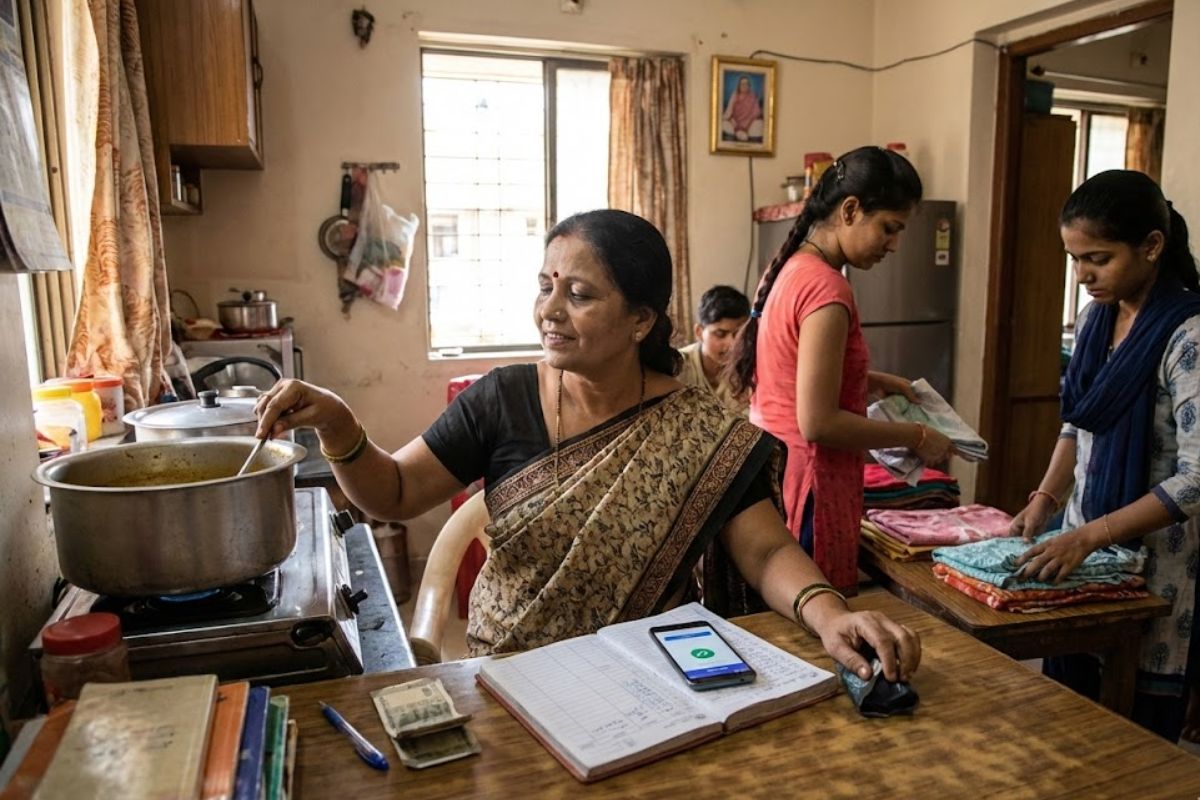
In 12 Indian States, More Than 118 Million Women Earn Money Every Month Unconditionally, In Small But Regular Amounts, In A Program That Recognizes Domestic Work, Empowers Female Autonomy, Pressures Public Budgets, And Is Already Deciding Local Electoral Results In A Strategic Patriarchal And Unequal Society.
In December 2025, the routine of a housewife in a village in Madhya Pradesh helps explain why so many women earn money every month in India simply by taking care of the home. Without formal employment, she receives 1,500 rupees from the government monthly, about 16 dollars, equivalent to approximately 86 reais, which she uses to buy medicine, vegetables, and pay her child’s school. The amount is modest, but predictable, goes directly into her bank account, and gives her a concrete sense of control and independence.
This same logic has spread in just a few years. Since the first state program in Goa in 2013, through its expansion in Assam shortly before the pandemic in 2020 and the campaign promises that marked the state elections of 2024 and 2025, India has transformed direct monthly payments into one of the largest social policy experiments in the world, as published by the BBC portal. Instead of subsidizing only cereal, fuel, or rural employment, the country started to compensate, even if partially, the invisible work that keeps houses functioning, which historically did not appear in any economic statistics.
How The Payment To Housewives In India Works

Today, in 12 states, 118 million adult women receive unconditional cash transfers every month.
-
The world’s first octopus farm wants to open in the Canary Islands and is already provoking an international reaction: the plan aims to produce 3,000 tons per year.

-
Drought may be creating stronger superbugs in the soil and helping antibiotic resistance reach hospitals, warns a study highlighting a problem that could grow alongside extreme weather.

-
The biggest scam in history: Napoleon’s France deceived the United States by selling them a territory that was Spanish.

-
Why is the Danakil Desert so dangerous? It has unstable terrain and how extreme temperatures and toxic gases turn the region into one of the most hostile environments on Earth.

The amounts vary from 1,000 to 2,500 rupees, somewhere between 12 and 30 dollars, about 65 to 162 reais, which represents approximately 5 to 12 percent of the household income.
There is no requirement to prove children’s school attendance or to demonstrate that the family is below the poverty line. The money simply enters the registered account, month after month.
The eligibility criteria change from state to state. In general, there are age limits, income brackets, and exclusions for families of public employees, wealthier taxpayers, car owners, or owners of large tracts of land.
Even with this filtering, the target audience is enormous. About 300 million Indian women now have bank accounts, which has simplified logistics and allowed the money to arrive more quickly and with fewer intermediaries.
In practice, beneficiaries often spend the resources on basic expenses: food, cooking gas, medicine, medical consultations, school fees, settling small debts, and occasionally on personal items, such as a better piece of clothing or simple jewelry.
The monthly amount is not enough to transform a family’s life, but the regularity of the payment creates a minimum safety net and opens a small margin for everyday decisions for women who until then depended almost entirely on their husbands’ salaries.
When Women Earn Money Every Month And Become A Decisive Political Force
The design of the programs varies, but one piece is constant: the explicit focus on female voters. Women earn money every month and become a voter base too large to be ignored, especially in poor states where a few extra dollars a month make a real difference in the budget.
Goa, in western India, was the first to launch an unconditional cash transfer program for women in 2013. The idea spread slowly until it gained momentum just before the pandemic in 2020, when Assam created a specific program for vulnerable women.
From then on, direct and unconditional transfers became a recurring promise in state campaigns.
In 2021, actor and politician Kamal Haasan, in Tamil Nadu, even proposed “salaries for housewives” as a central platform, but his party lost that election.
Three years later, in 2024, promises of monthly payments aimed at women helped parties win in states like Maharashtra, Jharkhand, Odisha, Haryana, and Andhra Pradesh.
The programs have ceased to be just social policy and have also become an explicit electoral strategy.
The most emblematic case occurred in Bihar, one of the poorest states in India. In the weeks leading up to the legislative elections of 2025, the local government transferred 10,000 rupees, about 112 dollars or 604 reais, to 7.5 million women’s accounts as part of a livelihood generation program.
Female voters showed up in greater numbers than men at the polls and were decisive for the overwhelming victory of the coalition led by the Bharatiya Janata Party.
Critics classified the maneuver as direct vote-buying, but the message from the polls was clear: monthly money in the account has become a powerful lever of political power.
What Changes In The Practical Life Of Beneficiaries
Behind the abstract numbers, there are subtle transformations in domestic life. Recent studies show that the vast majority of beneficiaries manage their own bank accounts and decide how to spend the money.
In West Bengal, a survey conducted in 2023 indicated that 90 percent of women personally manage their accounts, while 86 percent independently decide how to allocate the resources. The priorities are food, children’s education, and medical expenses.
In Maharashtra, a 2025 study revealed an important fact: about 30 percent of women eligible for the benefit did not even apply.
The reasons range from documentation issues to a feeling of self-sufficiency, but among those who joined, almost all maintain exclusive control over the money. This reinforces the perception that the monthly payment functions as a personal reserve, albeit small, for emergencies or decisions they previously could not make without consulting their husbands.
Surveys in Assam indicate that most women use the benefit to cover basic needs and value financial dignity more than the potential formal recognition of their domestic work.
Many still declare that they would prefer paid and stable employment if they had the option. In Tamil Nadu, beneficiaries report more tranquility at home, fewer marital conflicts, and increased personal confidence.
In Karnataka, women say they started eating better, having more input in household decisions, and wishing for larger amounts in the program.
In almost all these states, studies converge on two central points. First, women earn money every month without this reducing their desire to work outside or have formal employment, one of the main concerns of part of the feminist movement.
Second, the programs did not decrease the burden of unpaid domestic work but increased women’s negotiating power with relatives, husbands, and politicians.
Those receiving the money are able to demand more, make requirements, and face emergencies with less fear.
The Weight Of Invisible Work And The Billion-Dollar Fiscal Cost
The logic of these programs relies on a harsh statistical reality. The most recent Time Use Survey of India indicates that, in 2024, women dedicated nearly five hours a day to unpaid domestic and care work, more than 7.6 times the time spent by men.
This disproportionate burden helps explain the low female participation in the formal labor force, even in states experiencing rapid economic growth.
By transferring resources directly to those performing this work, state governments send a political message: caregiving and household management have economic value.
Indian feminists have argued for decades that this work should be recognized in national statistics, and monthly transfers appear as a kind of belated recognition, albeit partial and of low value.
From a fiscal standpoint, however, the experiment is heavy. Twelve Indian states project to spend about 18 billion dollars, around 97 billion reais, just on payments this fiscal year.
Half of them already operate at a deficit, meaning they need to incur debt to pay current expenses, according to a report from the PRS Legislative Research study center.
Critics argue that the programs strain fragile budgets, create political dependency, and discourage investment in structural employment policies and public services.
Supporters respond that the cost must be compared to the enormous volume of unpaid work that sustains the economy.
For them, paying a modest, yet predictable amount directly to women is less an expense and more a minimal adjustment in accounts in a society that has always treated this effort as free.
Limits, Contradictions, And Next Steps Of The Indian Experiment
The available research so far indicates that the programs have clear but limited effects. There is no evidence that the transfers diminish women’s incentive to seek paid work nor that they mechanically reinforce traditional gender roles.
At the same time, the payments do not reduce the volume of domestic tasks they need to fulfill every day.
Experts advocate for some adjustments for the next phase. One of them is to simplify eligibility criteria, especially for women providing intensive care, such as for people with disabilities, bedridden elderly, or small children, who often fall through bureaucratic gaps.
Another essential point is to maintain the unconditional nature of the benefits and unlink them from marital status, preventing rights from depending on being married, divorced, or widowed.
There is also a growing consensus that official communication needs to explicitly emphasize that the money recognizes the value of women’s unpaid work.
Today, many beneficiaries do not make this association and see the payment merely as generic aid.
Along with this, researchers suggest expanding financial education programs so that women can save, plan expenditures, and use the money as a starting point for small businesses or vocational training.
Finally, almost all studies emphasize a decisive limit: monthly transfers cannot replace real job opportunities.
Many women interviewed state directly that what they really desire is stable paid work and the permanent respect that accompanies that condition.
In this sense, the experiment where millions of women earn money every month is seen more as a transitional tool than as a definitive solution, a mechanism to rebalance the game while deeper reforms have yet to arrive.
The future of this gigantic social laboratory remains uncertain.
If combined with clear recognition messages, expansion of public services, and creation of quality jobs, the money in the account could gradually help reshape the gender division within Indian households.
And you, do you think a program where women earn money every month for taking care of the house could work in Brazil or would it just end up becoming an electoral bargaining chip?









-

-

-

7 pessoas reagiram a isso.