





 Portuguese
  English
  Spanish
  6 min of reading
  1 comment


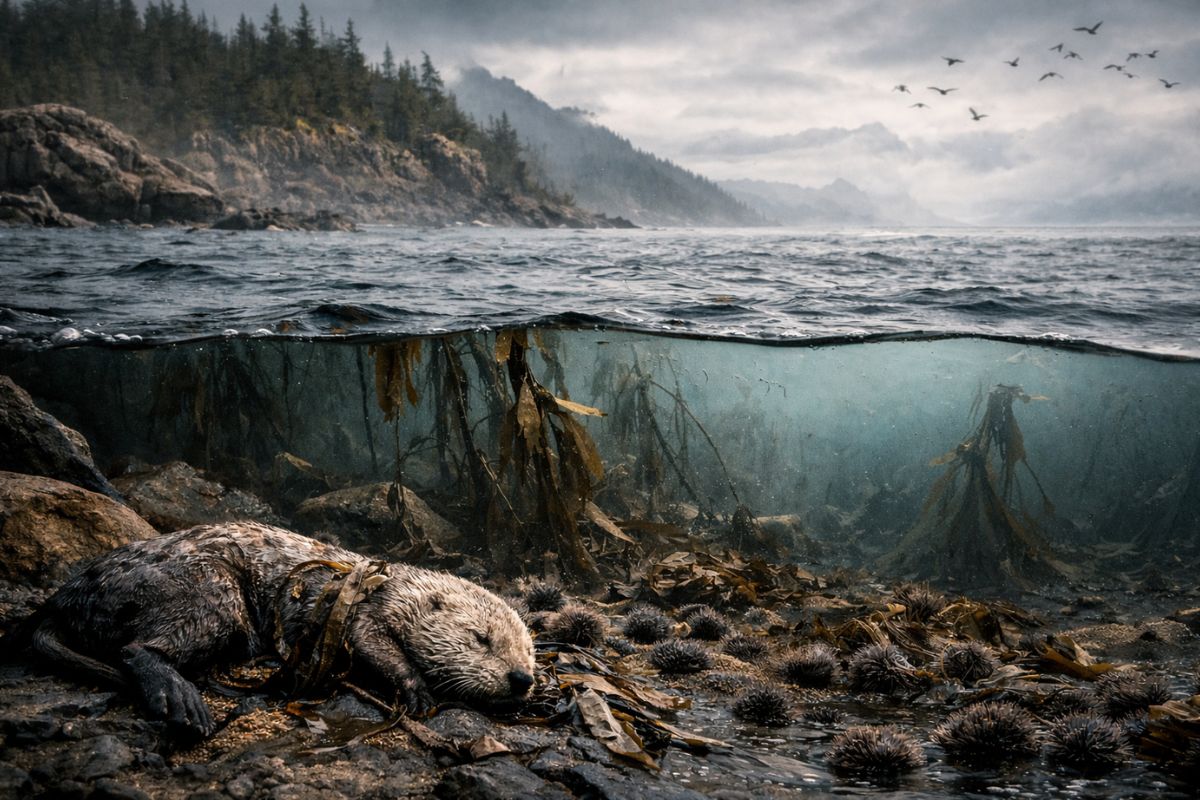


The Silent Disappearance of Sea Otters in Alaska Triggered an Explosion of Sea Urchins, Devastation of Underwater Forests, Fish Decline, and Revealed How the Forced Change in Orca Diet Reshaped the Ocean.
In less than a decade, the Alaskan coast lost more than 200,000 sea otters with virtually no physical trace. No bodies surfaced, no carcasses washed ashore, no signs of nets, disease outbreaks, or clear pollution were observed. The otters simply vanished, as if they had been erased from the ocean.
The impact of this disappearance was immediate and devastating. Forests of giant kelp, which once towered like true underwater buildings of up to 50 meters in height, were destroyed. The seabed was covered with dense carpets of sea urchins, small fish became scarce, crustaceans disappeared, and a chain reaction demonstrated how the loss of a single species can dismantle an entire ecosystem.
Where the Collapse Occurred and Why Alaska Became the Epicenter

The disappearance of sea otters occurred along vast stretches of the Alaskan coast, particularly in the Alaska Peninsula and the Aleutian Islands.
-
Submarine cables installed to transmit the internet now also help scientists detect earthquakes.
-
After so many blackouts, a family transforms an electric truck into a power source for their home and shows how a 100 kWh battery can keep everything running for days.

-
Ukraine is already testing, and China has already shown the world, and now the Brazilian Army is developing its own swarm of autonomous drones with artificial intelligence that share data in real time and operate without centralized control, uniting military and universities.

-
Few people know, but the most nutritious part of wheat has been discarded for decades to produce white flour, and the “polyamine” spermidine activates cellular cleaning, reduces mortality, and may slow down memory loss.


During the 1980s, this region was considered one of the last stable refuges for the species, with populations estimated around 137,000 individuals.
Starting in the early 1990s, this scenario began to reverse abruptly. In less than ten years, some areas lost between 50% and 90% of their sea otter populations.
In specific stretches of the Alaska Peninsula, over 90% of the animals vanished, leaving only small, isolated groups.
A Disappearance That Defied Biological Logic
The most disturbing aspect of the collapse was the lack of traditional mortality evidence. Aerial surveys, coastal monitoring, and environmental analyses found no bodies, floating remains, or signs of decomposition.
Even in a vast ocean, the mass death of hundreds of thousands of animals typically leaves traces.
None of this occurred. The sea otters disappeared excessively cleanly, with no visible injuries, no tissues, no bones, no recent oil stains, and no signs of illegal hunting.
This absence of clues quickly eliminated common explanations and plunged scientists into an unprecedented ecological mystery.
The Vital Importance of Sea Otters in the Ocean

Sea otters are a keystone species.
Despite representing a small fraction of the total biomass of the coastal ecosystem, they exert a disproportionate control over the environment.
One adult consumes daily between 20% and 30% of its own weight, primarily in sea urchins.
This constant consumption prevents sea urchins from multiplying uncontrollably.
While sea otters are present, kelp forests thrive, creating one of the planet’s most productive ecosystems, capable of supporting hundreds of species of fish, mollusks, crustaceans, seabirds, and mammals.
The Collapse of Kelp Forests and the Explosion of Sea Urchins

With the disappearance of sea otters, sea urchins found themselves without natural predators.
In just a few seasons, their populations exploded, reaching densities of over 100 individuals per square meter in some areas of the seabed.
These sea urchins began to consume not only the leaves but also the roots and shoots of giant kelp.
Entire forests were scraped down to the seabed, transforming once lush areas into underwater deserts. What remained was a purple carpet of hungry sea urchins.
The Phenomenon of “Zombie Urchins”
Even after completely destroying the kelp, the sea urchins did not die. Without food, they entered a state of extremely low metabolism, known as “zombie urchins.”
They hardly grow, reproduce little, but can survive for decades.
In this state, they continue to consume any new kelp sprout that tries to emerge, preventing the natural regeneration of the ecosystem.
This detail explains why many areas remain degraded years after the disappearance of sea otters.
Hypotheses Dismissed One by One
Diseases were investigated and dismissed.
There were no detectable outbreaks or weakened animals. Pollutants like heavy metals, PCBs, and other toxic compounds appeared in low concentrations, unable to explain a mortality on a continental scale.
Human hunting also did not hold as an explanation.
Legal protection for sea otters had been in place for decades, and even intense illegal hunting would not account for the elimination of more than 200,000 individuals in such a short time without leaving trace.
The Emergence of a Silent Predator
The first concrete indication arose when researchers began to record an unusual increase in orcas in shallow coastal areas, precisely where sea otters live.
These sightings intensified in the early 1990s, coinciding with the exact period of the collapse.
Regions like Prince William Sound, formed by narrow fjords and shallow waters that hinder hunting by orcas, did not experience such severe declines.
By contrast, open and deep areas showed dramatic falls, indicating a clear predation pattern.
Why Orcas Changed Their Diet

Orcas did not begin hunting sea otters out of preference. What changed was the ocean.
Throughout the 20th century, industrial whaling drastically reduced gray whale populations, one of the primary energy prey for orcas.
At the same time, industrial fishing diminished populations of large fish, seals, and sea lions.
Without large enough prey to meet their energy requirements, orcas were forced to change their diet.
Sea otters, small, abundant, and often floating at the surface, became a possible, albeit inefficient, alternative.
The Brutal Math of Predation
A single orca needs approximately 40,000 to 60,000 kilocalories per day. Each sea otter provides about 1,800 kilocalories. This means that an orca may consume between 20 and 30 sea otters per day just to survive.
Small groups of orcas, maintaining this pattern over the years, are capable of eliminating tens of thousands of sea otters. This calculation makes the disappearance of more than 200,000 individuals in less than a decade plausible.
A Predator That Leaves No Traces
Orcas swallow their prey whole or kill them quickly at the surface. Unlike other predators, they do not leave floating carcasses.
Moreover, sea otters rely entirely on their extremely dense fur for thermal insulation.
A single bite that allows cold water to enter, between 2°C and 4°C, can cause death by hypothermia within minutes.
Many animals likely died without even being consumed, sinking or being carried away by currents, leaving no visible signs.
The Ecological Cascade That Dismantled the Ocean
Without sea otters, sea urchins destroyed the kelp. Without kelp, fish eggs lost shelter. Juvenile fish became exposed.
Seabirds lost food. Seals and sea lions lost resting and hunting areas.
The collapse occurred from the bottom up, layer by layer, affecting the entire food web.
This type of chain reaction, known as a trophic cascade, is rarely observed so clearly, quickly, and devastatingly.
Recovery Attempts and Natural Limits
Reintroduction projects began to focus on shallow, narrow, and hard-to-access areas for orcas, functioning as natural safe zones.
In these areas, small groups of sea otters managed to establish themselves again.
In a few years, the presence of otters drastically reduced sea urchins and allowed kelp forests to begin recovering.
In some locations, regeneration occurred within two to five years, demonstrating the species’ strength as ecosystem engineers.
A System Still Under Pressure
Despite these local recoveries, the overall scenario remains fragile. Water warming weakens the kelp, acidification hinders its regeneration, and human pressure continues to alter the balance of the ocean.
If sea otters stray from these protected areas, the cycle of predation may restart. The system remains in an unstable state, vulnerable to new collapses.
The Lesson Left by the Silent Disappearance
The collapse of sea otters in Alaska does not point to an isolated villain.
It reveals how human actions accumulated over centuries can push an ecosystem beyond the limit, forcing predators to change behavior and triggering chain reactions.
When a keystone species disappears, the ocean responds relentlessly.
What happened in Alaska shows how thin the thread that sustains marine life is and how the loss of a single link can topple the entire structure.
Do you believe the ocean can fully recover from this collapse, or has the disappearance of sea otters already left irreversible marks on marine balance?






Se têm **** na natureza, têm a mão humana sempre ! O mundo seria um paraíso sem a presença do ser humano !