





 Portuguese
  English
  Spanish
  4 min of reading
  0 comments


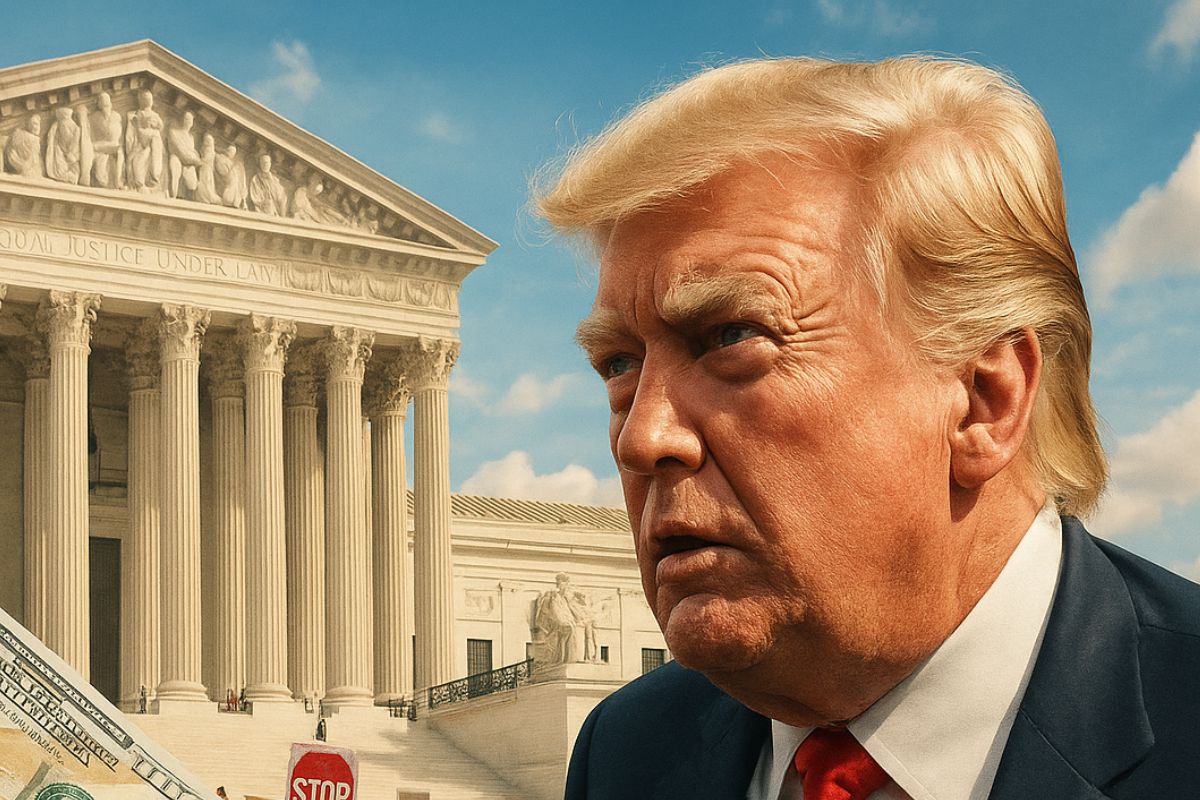
With More Than 40 Entities Against and Fewer Than 10 In Favor, The U.S. Supreme Court Will Rule on November 5 Whether Trump’s Tariff Exceeded Emergency Powers and How to Handle Over US$ 50 Billion Collected, In a Case That Could Redefine Presidential Authority Over Imports.
The Supreme Court of the United States has scheduled a hearing for this Wednesday, November 5, to test the legality of the tariff implemented by the Trump administration. The president stated that he will not attend, while the court will analyze whether the trade strategy supported by the International Economic Powers Emergency Act of 1977 exceeded what the legislation allows.
At the heart of the case are more than 40 opposing petitions and fewer than 10 in favor, as well as the dispute over the fate of over US$ 50 billion collected from the tariffs. The outcome could reshape the White House’s role in trade policy and generate immediate effects for sectors like steel, automobiles, and consumer chains that report “irreparable harm” due to rising input and final goods costs.
What Is at Stake in the Hearing
The justices will examine whether the tariff was correctly framed as a response to a national emergency related to the trade deficit.
-
Mercado Livre “opens the vault” and announces a record investment of R$ 57 billion in Brazil in 2026, a value 50% higher than the previous year, with an expansion plan that includes 14 new logistics centers, totaling 42 units in the country and hiring an additional 10,000 employees.

-
How investment in technology can revolutionize the national economy and enhance industrial gains, according to a study that highlights the direct impact on productivity, innovation, and wealth retention within Brazil.

-
The largest food company on the planet, JBS, has just opened a 4,000 square meter laboratory in Florianópolis to develop customized proteins that modulate muscle mass gain, immune response, and metabolic performance.

-
After nearly 30 bids and competition among industry giants, a Spanish company purchases one of the largest airports in Brazil for almost R$ 3 billion and takes over the management of Galeão in a concession that will last until 2039.


The key question is who can decide and under what terms when an economic emergency authorizes broad and prolonged tariffs on trading partners.
Two lower courts have already understood that part of the measures exceeded the legal mandate.
The Supreme Court, when reviewing the appeal, will define how much effective power the Executive can deploy without new approval from Congress, setting boundaries for future interventions in imports.
Who Supports and Who Opposes
Business associations, former national security officials, and pro-market think tanks have aligned against the tariff, claiming that the policy disrupted investments and increased costs in supply chains.
The central argument of the opponents is that the rise in costs reached consumers and contracted demand, with companies postponing projects.
On the other side, supporters argue that without tariffs there is no economic security, reiterating the thesis that partners have used barriers asymmetrically for years.
For this group, containing the trade deficit would justify a tough response, and the tariff would have been a legitimate pressure tool.
The Legal Basis of the Tariff
The government’s defense based the tariff on the International Economic Powers Emergency Act of 1977, which allows the president to take extraordinary measures in scenarios of threat.
The contention lies in how much the law covers when an “emergency” is defined by persistent trade imbalances.
At the same time, part of the tariffs in specific sectors, such as steel and automobiles, stems from other legal grounds.
Even if the Supreme Court limits the use of the emergency law, the Executive may still try to redirect measures through alternative regulatory avenues, making the outcome partial in the short term.
Economic Impacts Under Debate
Opponents describe the tariff as a factor of increased costs and friction in supply chains.
Reports from companies indicate postponement of CAPEX and price pass-through, compressing margins and slowing consumption.
The technical criticism is that the generalized tariff acts like a tax on the economy itself.
The pro-tariff campaign argues that in the short term there is a adjustment cost, but that the tool recalibrates negotiations and discourages practices deemed unfair.
For this group, the tariff threat strengthens the American position and anchors reindustrialization in strategic sectors.
Scenarios After the Ruling
If the Court validates the tariff in its current framework, the president retains broad discretionary power to impose tariffs under the guise of emergency, and discussions shift to duration and periodic review parameters.
This would maintain budget forecasting for additional revenue and preserve the leverage of external bargaining.
If the Court limits or overturns the use of the emergency law, it opens an immediate debate on refund, compensation, or reallocation of the over US$ 50 billion collected and about the regulatory handling of the remaining sector tariffs.
In this scenario, the Executive would have to reconstruct justifications on alternative legal bases, with a transition that could generate volatility for importers and consumers.
The ruling this Wednesday does not just decide one case, but the architecture of power over tariff policy in the U.S.
By scrutinizing the tariff, the Supreme Court will define who decides, with what limits, and for how long exceptional measures can reconfigure prices, investments, and competitiveness.
What is, in your assessment, the appropriate limit for using the tariff as an instrument of economic policy?









-

Uma pessoa reagiu a isso.