





 Portuguese
  English
  Spanish
  5 min of reading
  0 comments


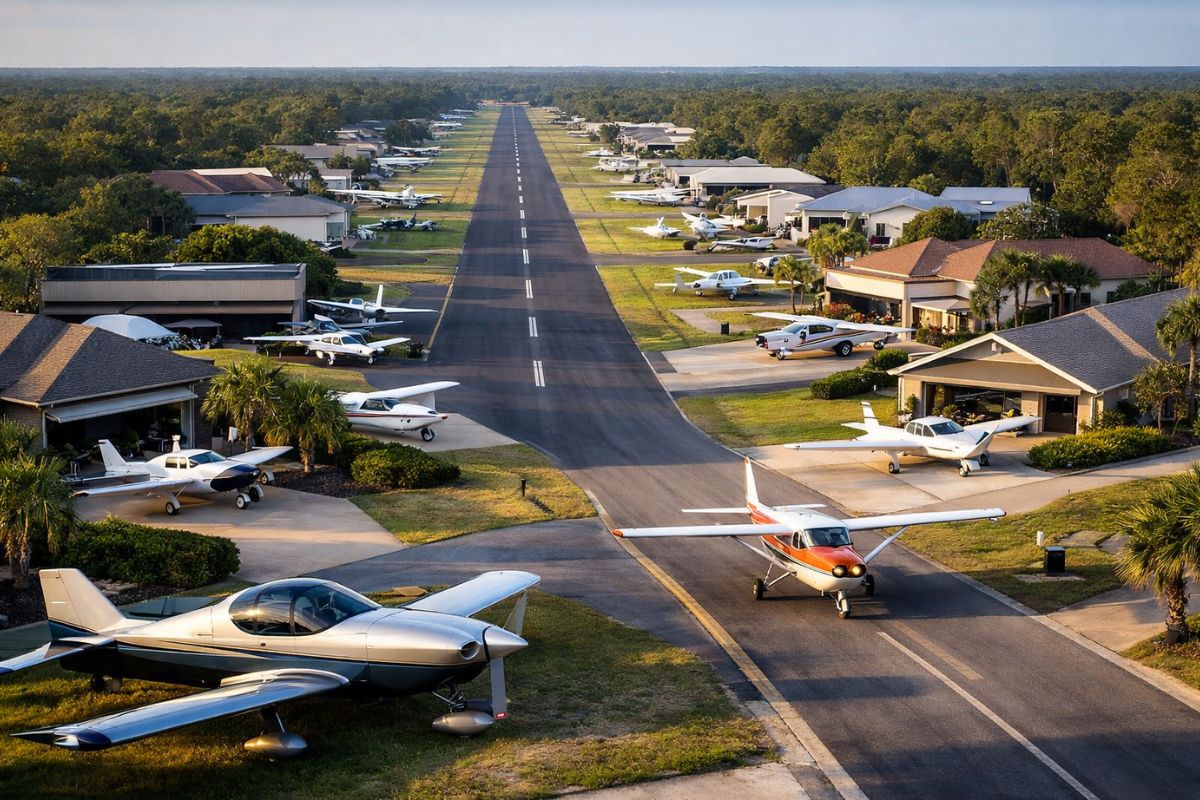
In The Heart Of Florida, Spruce Creek Combines Gated Community And Residential Airport 7FL6: There Are More Than 5 Thousand Residents, About 650 Private Planes And A 1,219 Meter Runway, As Well As 13 Km Of Roads Where Cars Stop And The Aircraft Always Go First, In A Routine That Seems Impossible
In a discreet area of Central Florida, Spruce Creek has become synonymous with a rare coexistence: planes taxiing in front of homes, as if the neighborhood had incorporated the airport into everyday life. Instead of separating housing and aviation, the proposal was to combine the two in the same urban design.
Also known as 7FL6, the community operates as a residential airport, planned from the structure of an old military airport that, after the base closure, was adapted to accommodate residences integrated with aviation infrastructure, forming an environment where transportation does not solely depend on cars.
Spruce Creek, The Neighborhood Where Planes Are Part Of The Address

What differentiates Spruce Creek is not just having planes nearby, but having planes within the everyday logic of the neighborhood. The village attracts aviation enthusiasts, former professional pilots, and people connected to the aerospace sector, creating a profile of residents for whom the airplane is not an exception, but rather a routine tool.
-
Friends have been building a small “town” for 30 years to grow old together, with compact houses, a common area, nature surrounding it, and a collective life project designed for friendship, coexistence, and simplicity.

-
This small town in Germany created its own currency 24 years ago, today it circulates millions per year, is accepted in over 300 stores, and the German government allowed all of this to happen under one condition.

-
Curitiba is shrinking and is expected to lose 97,000 residents by 2050, while inland cities in Paraná such as Sarandi, Araucária, and Toledo are experiencing accelerated growth that is changing the entire state’s map.

-
Tourists were poisoned on Everest in a million-dollar fraud scheme involving helicopters that diverted over $19 million and shocked international authorities.


With more than 5,000 residents and about 650 registered private planes, the community achieves sufficient scale for aviation to cease being an “attraction” and become infrastructure. This changes everything from internal circulation to how properties are conceived, as the neighborhood was designed to support the constant presence of moving aircraft.
The Residential Airport 7FL6 And The 1,219 Meter Runway In The Center Of The Neighborhood

In the heart of the community, the main runway is approximately 1,219 meters long, a size that allows operation from small aircraft to corporate jets, according to the information released about the structure. In a typical neighborhood, such a runway would pose a physical limitation; here, it serves as an organizing axis for how people enter, exit, and move around.
The runway is private, paved, and features lighting and GPS approach systems, reinforcing the idea of a planned operation for different conditions, including those outside daylight hours. According to Spruce Creek Realty, it can be used 24 hours a day by residents and authorized visitors, as long as they adhere to access and registration rules.
Streets That Become Runways And The Rule Where The Car Stops First

The urban structure incorporates sections where the streets function as taxiways, something that transforms what would be “residential streets” into shared-use paths.
According to the official website of the community, there are about 13 kilometers of double lane roads used by both cars and aircraft, a design that necessitates clear rules to prevent conflict between such different flows.
In these sections, planes have total priority: drivers must stop if an aircraft is approaching and cannot overtake it or drive alongside it.
The rule is simple, but it changes the traffic hierarchy: the land vehicle adapts to the rhythm of taxiing, and circulation is guided by a constant care for space, distance, and predictability.
Houses With Hangar And The Most Direct Way To Get Planes Out Of The “Garage”
In Spruce Creek, part of the real estate market revolves around so-called “houses with hangars,” designed so that the owner can take the plane directly from the garage to the runway without leaving the community.
It is architecture that does not treat the hangar as a distant annex, but as a component of everyday life, bringing planes closer to daily routines.
At the same time, the neighborhood is not composed solely of properties geared towards aviation: there are condominiums, townhouses, and traditional residences without structures for aircraft, but with access to the airport. This diversity creates layers within the community itself, where the connection to airplanes can range from frequent use to indirect coexistence with air traffic.
Management, 24-Hour Security And Access Control By Land And Air
The community is managed by the Spruce Creek Property Owners Association, responsible for establishing circulation and access rules, which helps maintain an operational standard in a place where cars and planes share space.
Security operates 24 hours a day, and both land and air access are controlled, reinforcing the private nature of the system.
Visitors require prior invitation, and all aircraft using the runway must be registered, which organizes traffic and limits uses outside of community standards.
For those arriving by air, there are specific areas designated for temporary parking of aircraft; meanwhile, those interested in purchasing properties must schedule private visits through local real estate agencies, maintaining the access logic under rules.
How Much Does It Cost To Live Near Planes And Why The Model Became A Reference

Prices vary widely, from around US$ 200,000 for simpler properties to larger properties that reach several millions of dollars, especially when there are multiple hangars and other amenities.
This price range indicates that aviation influences the cost, but does not define a single housing standard: there are different levels of “life with planes” within the same neighborhood.
The model of Spruce Creek has become one of the best-known examples of planned neighborhoods that integrate daily life and aviation because it combines infrastructure (runway, taxiways, and rules) with governance (association, security, and access control).
In practice, the community demonstrates how a residential airport can be more than just a runway: it can function as part of urban design, as long as priorities and limits are clear.
In your view, living in a place where planes have priority over cars would be freedom or stress?
And which detail seems most difficult to imagine in practice: the streets that become runways, the rule of not overtaking an aircraft, or the idea of taking the plane out of the hangar as one would leave the garage?










-

-

2 pessoas reagiram a isso.