





 Portuguese
  English
  Spanish
  3 min of reading
  22 comments


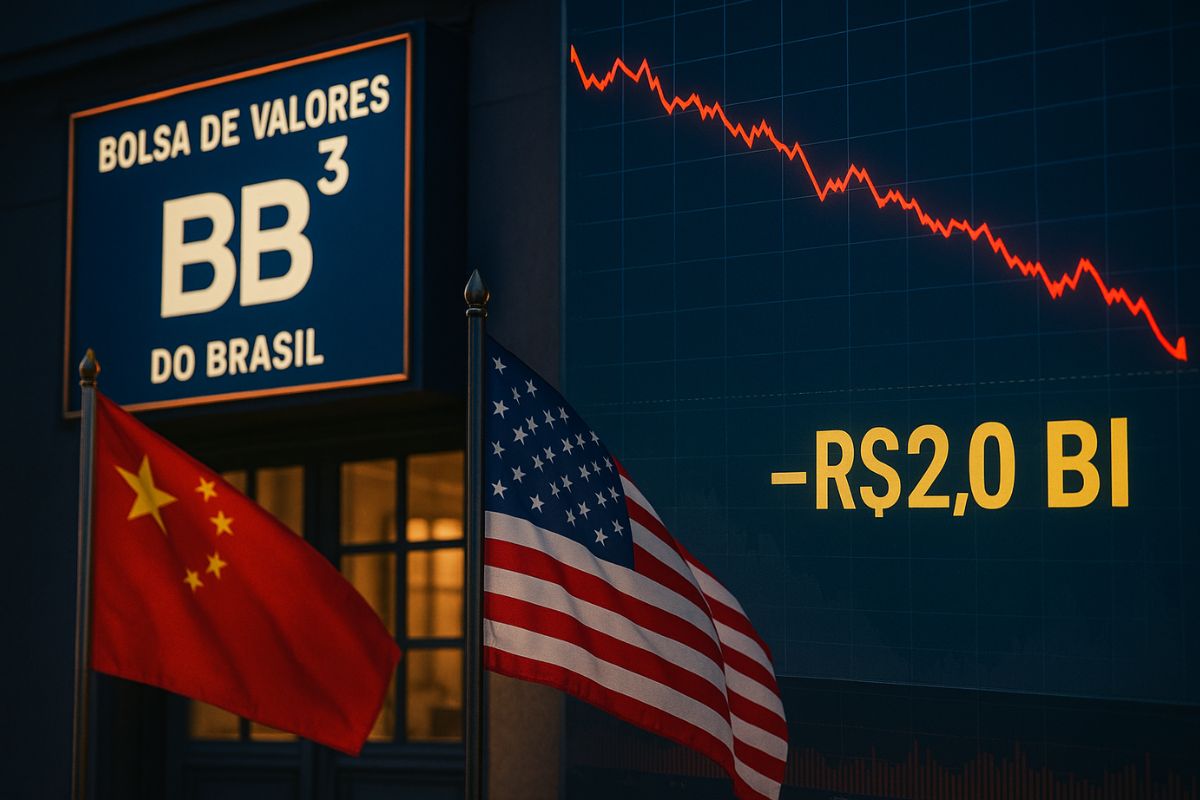


Exit of R$ 20 Billion from the Stock Market in 2024 Exposes Record Outflow of Foreign Capital and Reinforces Warning That Brazil Has Become a “Chinese Colony”.
The Brazilian stock market recorded an accumulated exit of over R$ 20 billion in foreign capital in 2024, according to data cited by analyst Nanda Guardian. In July alone, international investors withdrew R$ 4.1 billion, confirming a continuous movement of distrust toward the country.
This outflow reflects the growing perception of risk regarding the Brazilian economy, marked by stronger political alignment with China and uncertainty regarding medium-term guidelines.
Since foreigners account for a significant portion of B3’s liquidity, their withdrawal directly impacts prices, exchange rates and the attractiveness of the capital market.
-
A new Brazilian shopping center worth R$ 400 million will be built in an area equivalent to more than 4 football fields, featuring 90 stores, 5 cinemas, a supermarket, a college, and parking for 1,700 cars, potentially generating 3,000 jobs.

-
Larger than entire cities in Brazil: BYD is building a 4.6 km² complex in Bahia with a capacity for 600,000 vehicles per year, but the discovery of 163 workers in conditions analogous to slavery has shaken the entire project.

-
With an investment of R$ 612 million, a capacity to process 1.2 million liters of milk per day, Piracanjuba inaugurates a mega cheese factory that increases national production, reduces dependence on imports, and repositions Brazil on the global dairy map.

-
Brazilian city gains industrial hub for 85 companies that is equivalent to 55 football fields.


Why Investors Are Leaving the Brazilian Stock Market
The outflow of foreign capital does not occur due to a single factor, but rather a combination of elements that increase caution.
One of these is the deepening of commercial and financial relations with China, to the detriment of the historical trust of Western investors.
This geopolitical realignment raises doubts about the future of strategic partnerships with the United States and the European Union.
Another aspect is the lack of clarity in domestic economic policy.
Without firm signals regarding fiscal balance, a stable regulatory environment, and measures to encourage competitiveness, global investors tend to reduce their positions in the country and seek alternatives in emerging markets considered more predictable.
The Advance of Chinese Influence in Brazil


The Chinese presence in Brazil gained a new chapter in 2024 with the arrival of UnionPay, the world’s largest card operator, which now competes directly with Visa and Mastercard.
For analysts, this movement shows that China seeks to expand its presence in the Brazilian financial system in parallel with its global strategy to reduce dependence on the dollar.
This expansion coincides with the defense by the Brazilian government, in forums such as BRICS, of alternatives to the U.S.-led financial system.
Although the discourse reinforces the idea of sovereignty, investors perceive that Brazil is distancing itself from traditional capital centers and moving toward a more uncertain political-economic axis.
Politics and Market Getting Closer
The connection between politics and the market was also the subject of debate in 2024.
The participation of Edinho Silva, president of the PT, both in an act for national sovereignty at USP and in a panel at Expert XP, the largest financial sector event in Brazil, raised questions about the relationship between private companies and the government.
For part of the market, this proximity raises fears regarding greater political influence in sensitive sectors.
In addition, statements like that of President Lula’s granddaughter, Bia Lula, who accused the U.S. of “exploiting Brazil for 500 years,” reinforce the perception of diplomatic friction with Washington, even if they carry historical inaccuracies.
Risks and Consequences of the Outflow of Foreign Capital
The immediate effect of the exit of more than R$ 20 billion from the Brazilian stock market is a reduction in market liquidity, making it harder for new investors to enter and putting pressure on listed companies.
The outflow also impacts the foreign exchange market, as fewer dollars enter the country, increasing the volatility of the real.
In the medium term, capital flight may restrict economic growth, reduce financing for companies, and undermine Brazil’s perception as a long-term destination for global resources.
If this trend persists, the country may solidify its image as a high-risk market, requiring a higher return to attract investments.
The outflow of foreign capital from the Brazilian stock market in 2024 is more than a technical number: it reflects strategic changes in the country’s positioning.
Between alignment with China, confrontational rhetoric towards the U.S., and internal uncertainties, international investors prefer to stay away, and the numbers confirm this trend.
Do you believe that Brazil’s alignment with China strengthens the country in the long term or compromises its attractiveness to foreign investors?
Leave your opinion in the comments.








Kkk Estamos em set/25!!!! Bateram a cabeça?
Cenário apocalíptico, e chega dia 12.09 e a bolsa bate recorde de 142.900 pts! Realmente não entendo! Reconheço que sou ****! Talvez por isso nunca ganhei dinheiro em renda variável!
O que Bia Lula,que eu bem sabia que existia, influência nas relações diplomáticas e comerciais com os EUA com seu comentário?