





 Portuguese
  English
  Spanish
  3 min of reading
  0 comments


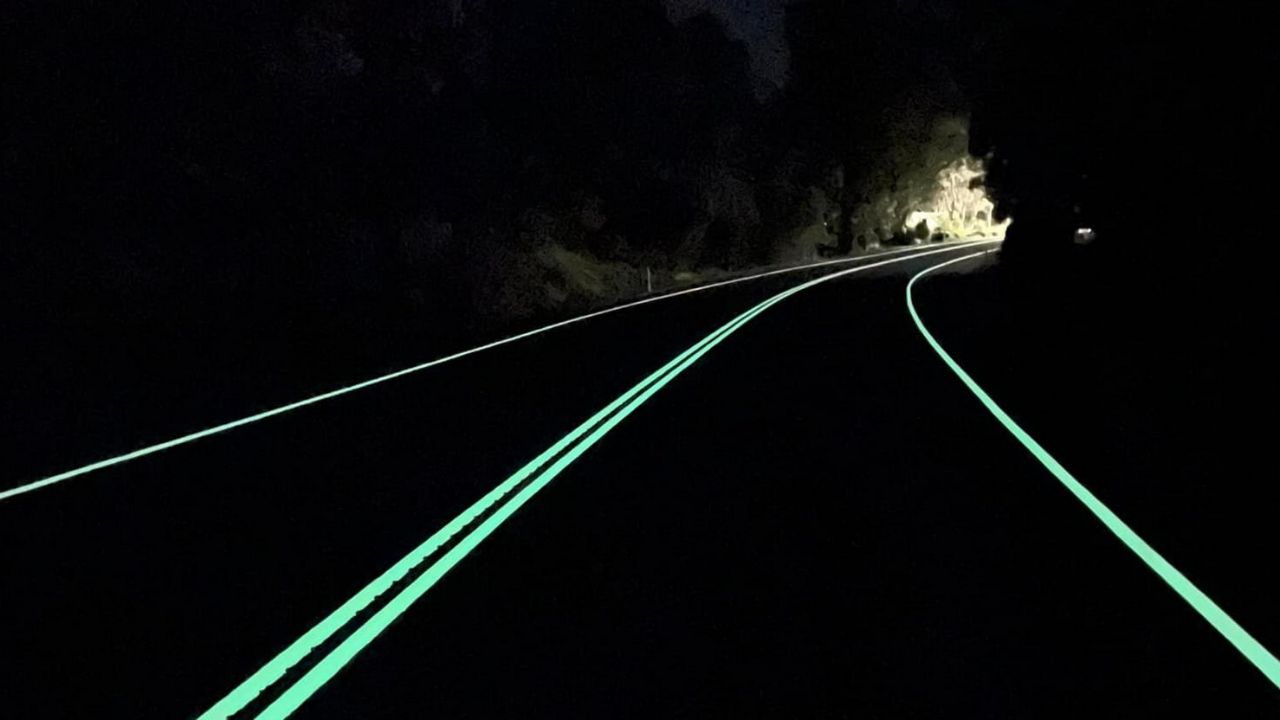
The Photoluminescent Paint, Applied to a Stretch of 245 Meters, Promises to Improve Road Safety Even Without Lighting, But Costs 20 Times More Than Regular Paint and Has Already Made the Government Rethink the Idea.
To enhance safety in dark and dangerous stretches of highways, the Malaysian government decided to use photoluminescent paint instead of traditional lamps. It seems like a brilliant idea, literally, but there’s a catch: this solution is up to 20 times more expensive than conventional paint.
What Is Photoluminescent Paint and How Does It Work?
Photoluminescent paint is a material that “absorbs” light during the day and glows at night, without relying on electricity or external power. It’s like those stars we stick on the ceiling as kids, only in giant size and with a much more practical application.
This innovation replaced reflective studs on a 245-meter stretch in Hulu Langat, a district known for its lack of street lighting. The paint provides constant visibility, which is especially useful in adverse weather conditions. For many drivers, the sensation was like driving in a “futuristic video game.”
-
A startup sends robotic gloves for users to wear at home while washing dishes, folding clothes, and making coffee; every finger movement is recorded and sent back to train a domestic robot that has already learned 10 million real tasks without ever having entered a kitchen.

-
In a flooded well, archaeologists found a 1,700-year-old Roman egg that still contains clear and yolk intact inside the very thin shell.

-
Something is happening around the Earth: Inside the huge explosion of fireballs in 2026

-
A hot air bubble coming from Argentina expands over Brazil, causing thermometers to exceed 38 degrees with a thermal sensation of 40 degrees in late March, affecting 6 states at once.


In rural areas without light poles, the paint shone as a solution to increase highway safety. After all, reflective studs require car headlights to “illuminate” them, while the paint is visible even in complete darkness.
Besides making night driving easier, the paint reduces reliance on expensive infrastructure like light poles and can save lives in areas where low visibility accidents are common.
Why Did Malaysia Choose This Alternative for Highways?

Malaysian highways face unique challenges, especially in rural areas. The lack of public lighting and high maintenance costs make innovative alternatives more attractive – at least in theory.
In many parts of the country, light poles are a luxury. The roads are dark and dangerous, making life difficult for those who depend on them for work or travel at night.
Rain, fog, and even tropical storms are common in Malaysia, drastically reducing the effectiveness of reflective studs and even vehicle headlights. Photoluminescent paint seemed like an ideal solution to these problems.
However revolutionary the idea may be, the math doesn’t add up. Photoluminescent paint costs 749 Malaysian ringgits per square meter, whereas conventional paint costs only 40 ringgits. This exorbitant cost was the main reason for the government to reconsider its large-scale implementation.
Imagine that, instead of painting the entire highway, the government had to choose between 1 kilometer of photoluminescent paint or 20 kilometers of regular paint. The financial impact would be enormous, especially for an already strained public budget.
Even with the population praising the initiative, specialists from the Ministry of Public Works concluded that the cost does not justify the benefits. At a press conference, Deputy Minister Ahmad Maslan summed up the situation: “The cost is very high, so we probably will not continue with the glow-in-the-dark lanes.”
The Balance Between Innovation and Financial Viability
This experience in Malaysia raises an important question: how far is it worth investing in innovative technologies for highways?
Safety is paramount, but the public budget is not infinite. Finding solutions that balance cost and effectiveness is a constant challenge, especially in countries with emerging economies.
While Malaysia may have taken a step back, other countries might adapt the idea. In high-risk highways or tourist areas, photoluminescent paint could be an interesting option, even with higher costs.









Seja o primeiro a reagir!