





 Portuguese
  English
  Spanish
  5 min of reading
  0 comments


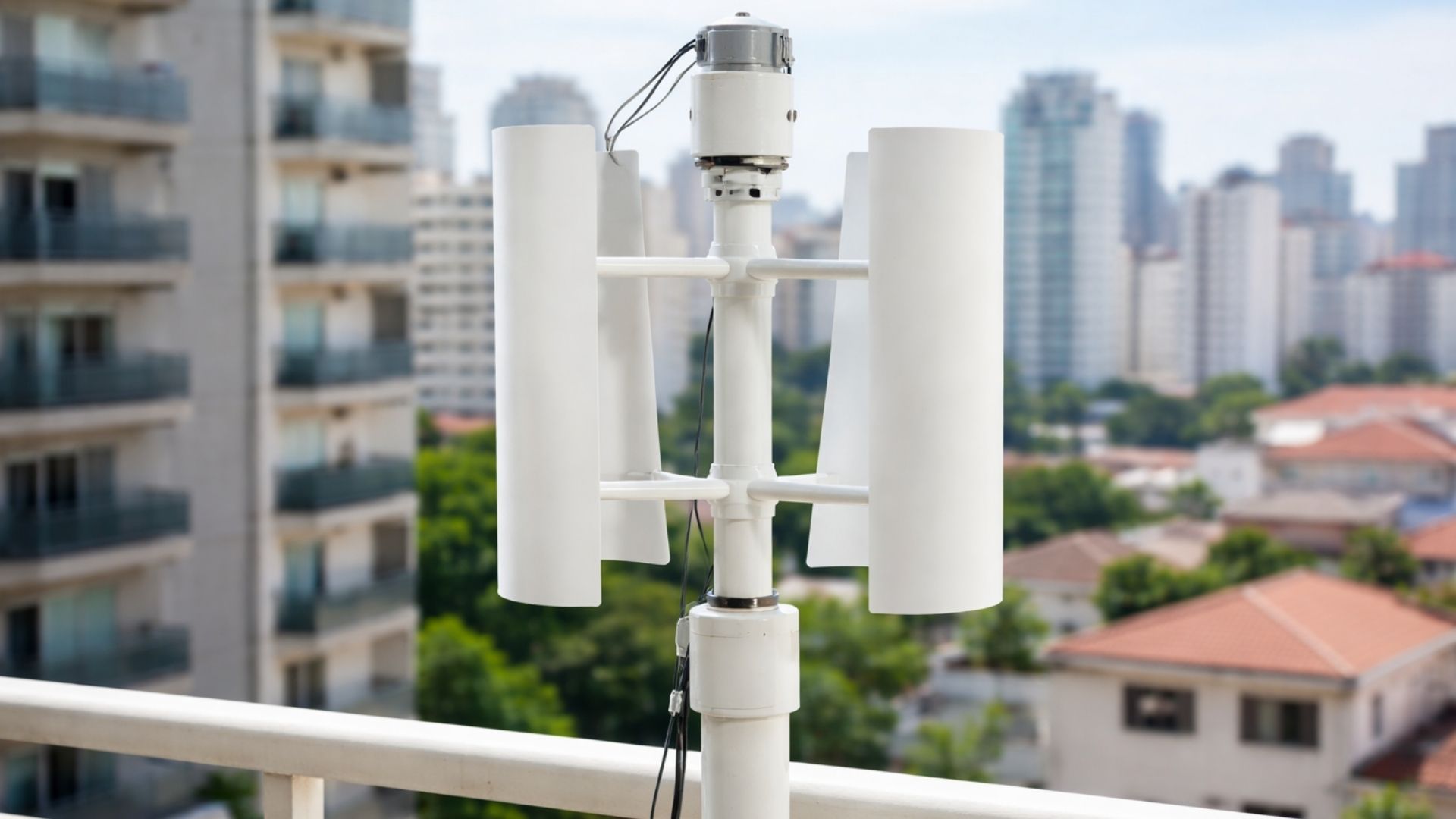
Homemade wind energy project with reused materials draws attention for its simplicity and proposal for small-scale electricity generation, using wind as an alternative source in a domestic environment, with a compact structure installed on a balcony and focused on powering low-consumption lighting.
A homemade wind generator assembled with reused parts, PVC, and a motor taken from a 12V water pump was presented as an alternative to light up the balcony with wind power.
The proposal combines an improvised tower, a vertical turbine with four blades, and a simple electrical set-up aimed at supplying a small, low-voltage load.
In practice, the described system is based on a principle known in artisanal microgeneration projects: utilizing the rotation of the blades to move a shaft connected to a reused motor, with the expectation of producing sufficient direct current to power low-consumption lighting.
-
An aquatic seed consumed for centuries in Asia is going viral in the West after studies highlighted its antioxidant compounds and potential anti-inflammatory properties. It pops like popcorn, has low fat content, and is already being called the new functional snack.

-
China showcases robot dogs that act in groups like a coordinated pack, make decisions together, and could change the way modern wars operate.
-
The coldest seawater ever recorded in Earth’s history was hidden under extreme ice 717 million years ago and reached an impressive -15°C.

-
China has launched the world’s first floating artificial island, a scientific structure designed to face open seas, test equipment weighing hundreds of tons, and reach depths of 10,000 meters.


The assembly, however, does not equate to an infinite source of energy, because performance directly depends on the intensity, regularity, and quality of the wind available at the location.
How the homemade wind generator with a 12V pump motor works
The structure begins with the disassembly of a 12V pressurized water pump to remove the internal motor, the central piece of the set.
After removal, the shaft is tested and receives a perforated PVC cap, secured with a screw to form the connection point between the motor and the turbine.
Next, a larger diameter PVC pipe serves as the main tower.
The wires are routed inside the piece, while the motor is fitted inside the pipe to remain protected and aligned with the top of the assembly, where the turbine will be installed.
The connection between the tower and the rotor is made with a perforated top cap, screws, and support points that keep the turbine attached to the structure.
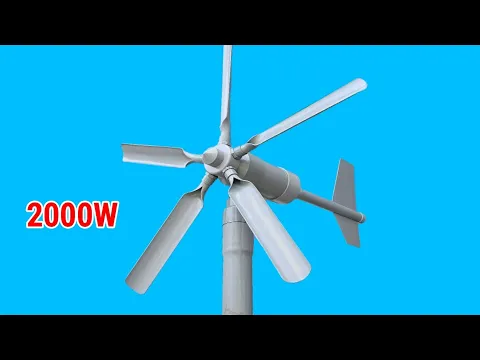

This arrangement serves to support the rotation of the set and, at the same time, provide stability to the shaft that transmits the movement to the reused motor.
The four blades are cut from another PVC pipe, divided into equal parts to form the vertical blades.
After cutting, each segment is screwed to the frame, creating a vertical axis turbine, a compact model that is often chosen in domestic projects for taking up less lateral space.
With the mechanical part ready, the tower is installed on a balcony or in a high point of the house where there is air circulation.
The logic of the assembly is simple: when the wind moves the blades, the shaft rotates, the motor is mechanically activated, and the generated energy can be directed to a load compatible with the system’s voltage.
Generated energy depends on the wind and is not continuous
Although the project is presented as capable of operating even with weak wind, residential wind generation does not function continuously by definition.
Organizations linked to the U.S. Department of Energy and the distributed generation market emphasize that small wind systems only yield useful results when there is sufficient wind resource at the installation point, as well as space, proper positioning, and compatibility between the machine and electrical demand.
This means that the energy produced can fluctuate significantly throughout the day, even in places where there is a sensation of wind for those on the balcony.
For any turbine, what matters is not just having a breeze, but having airflow with speed and stability capable of keeping the rotor in useful rotation for a sufficient time.
Moreover, the electricity obtained in artisanal assemblies tends to be more suitable for modest uses, such as low-power bulbs, small tests, and isolated applications.
Without measurement data, nominal power, voltage under load, and delivered current, there is no secure basis to assert how much the system actually produces or how long it can sustain lighting in a stable manner.
Installation on a balcony can reduce turbine efficiency
The idea of installing the equipment on the balcony or roof seems practical, but this type of location often imposes important limitations.
Guides from the U.S. Department of Energy discourage the installation of turbines directly on roofs due to vibration, noise, and potential structural problems, while technical materials from NREL point out that turbines positioned near buildings often operate below expectations due to turbulent wind around the structures.
In urban areas, air diverted by walls, fences, awnings, and neighboring buildings creates sudden changes in direction and intensity.
This behavior reduces rotor efficiency, complicates generation regularity, and may even increase mechanical wear on the set, especially when the assembly uses reused parts and improvised fastening solutions.
Therefore, the installation point influences as much as the turbine design.
A compact system may even visually rotate in an environment with a lot of interference, but rotating is not the same as generating useful energy consistently.
Without instrumentation and testing, the perception of operation is often greater than the actual electrical delivery.
Reusing reduces cost but requires technical attention
Reusing a motor taken from a 12V pump reduces the initial cost and helps transform scrap into functional equipment.
Still, the result depends on factors such as internal friction, condition of the winding, shaft compatibility, electrical losses, quality of connections, and behavior of the set when subjected to irregular wind.
There is also a safety point that cannot be ignored in assemblies of this type.
Poor fastening, loose screws, unbalanced blades, and insufficient protection against rain or oxidation can compromise both the durability and operation of the equipment, especially when it is exposed in an outdoor area and subject to sudden gusts.
In the case of use with lighting, the described system seems to fit better in the category of isolated microapplication than in that of a broad domestic solution.
Reports on distributed generation show that small turbines meet specific loads or locations, often with battery support or another means of storage when the system is not connected to the grid.
Simple project aimed at small domestic applications
The appeal of the generator lies precisely in the simplicity of the assembly.
PVC pipes and caps, screws, a reused motor, and a lightweight structure form a relatively low-cost equipment, accessible for bench experiments or for very small applications where the consumption expectation is also limited.
Still, the most accurate description for this type of initiative is that of a mini homemade wind generator made for testing and for reduced loads, rather than a permanent, free, and inexhaustible source of electricity.
The energy from the wind is not dispatchable on demand, varies according to the environment, and depends on conditions that do not arise just because the turbine is installed on a balcony.







Seja o primeiro a reagir!