





 Portuguese
  English
  Spanish
  5 min of reading
  0 comments


Extreme survival experience in tropical forest reveals routine of construction, isolation, and adaptation away from technology, with suspended shelter, limited food, and constant psychological challenges over 100 days in a hostile natural environment.
A solo survival project that lasted 100 days in a tropical forest has once again drawn attention by showcasing the construction of a suspended shelter using natural materials and basic tools, without the support of modern technology.
The record circulates on the channel ปอ สวย on YouTube, where the video about the treehouse has garnered around 1.1 million views, while the profile appears with approximately 18.6 thousand subscribers in the latest searches.
The proposal fits within the universe of bushcraft, a practice based on techniques for survival in a natural environment with limited use of industrialized resources.
-
In the USA, a city is considered the World Capital of the Horse due to having over 1,200 farms and around 75,000 horses. Understand how the soil of Ocala transforms horses into champions and generates over $190 million a year.

-
The United Kingdom is throwing six-ton concrete blocks to the bottom of the North Sea, and the reason is the opposite of what you might think, as each block carries 4,000 oysters capable of filtering millions of liters of water per day.

-
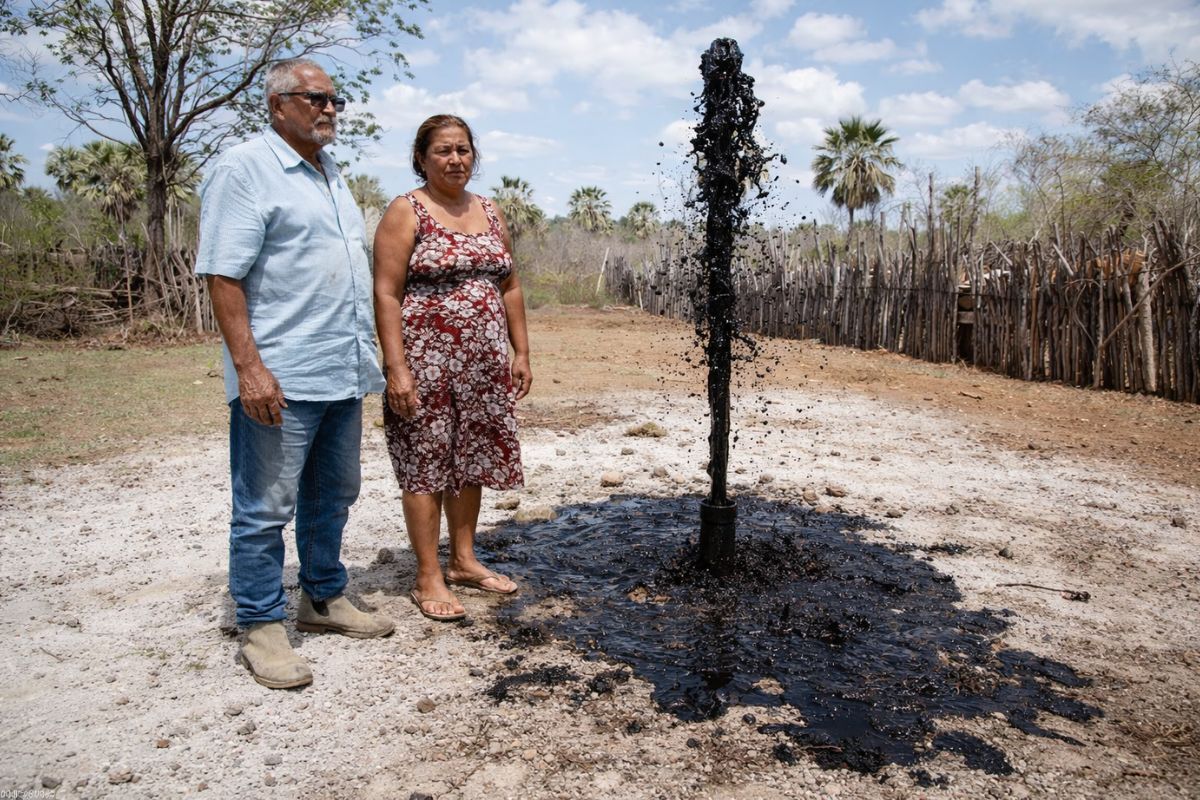
Family without running water in the interior of Ceará takes out a loan to drill an artesian well and discovers possible oil, but cannot use it, cannot sell it, and is left with a debt of R$ 15,000.
-
At 100 years old, an elderly man who dreamed of “making it to the newspaper” finally shares his story, reaching his centenary with children, grandchildren, great-grandchildren, and great-great-grandchildren, moving his family with a life of hard work, farming, honesty, and without vices.


In this case, the core of the challenge was to raise a shelter above the wet ground of the forest, a strategy associated with both protection against persistent rain and the need to reduce exposure to terrain risks during the night.
The choice of a sturdy tree as the base of the structure appears as a central point of the described and publicized project.
Construction of treehouse with bushcraft techniques
Instead of replicating a conventional house, the construction was designed to function as a functional refuge in an area of dense vegetation and severe climate.
The effort began with the assembly of a wooden platform supported by joints and bindings, following a logic that prioritizes stability, weight distribution, and insulation from the permanently wet ground.
The absence of modern items, such as synthetic ropes and hardware, imposed a slower execution model dependent on the raw materials available around.
Throughout the endeavor, manual labor played a decisive role.
Logs and pieces of wood were cut with simple tools, while vines and other natural elements served as fastening materials.
In tropical environments, where constant rain compromises improvised structures in a short time, the shelter needs to combine firmness, drainage, and minimal ventilation to remain usable.
Therefore, construction is not limited to raising walls: it requires reading the terrain, careful selection of materials, and continuous maintenance.
Protection against rain and humidity in the tropical forest
The roofing appears as one of the most sensitive stages of the experience.
In dense forest regions, a small failure in the roof can transform the entire routine, as water compromises rest, makes it difficult to start a fire, and accelerates the deterioration of clothes, utensils, and food.
In this context, overlapping broad leaves and other organic resources function as a temporary barrier, although they depend on frequent replacement and careful assembly to provide an acceptable result.
Also noteworthy is the attempt to transform a rudimentary shelter into a minimally habitable space.
The presented project associates internal organization with the retention of body heat during cold nights and moisture control, two factors that directly affect physical wear in prolonged isolation.
More than appearance, the cabin needed to meet objective needs: drying materials, allowing rest, protecting tools, and maintaining some level of predictability amidst the forest.
Routine of food and survival in the forest
Survival, however, did not depend solely on the suspended house.
Living for three months in relative autonomy required a daily routine focused on the search for water and food, as well as maintaining the fire and the structure.
The account shared about the experience mentions gathering items from the flora, purifying water, and obtaining protein from watercourses and through rudimentary capture techniques, always within a logic of continuous effort and low margin for error.
Without refrigeration and external supply, each meal came to depend on what could be found, prepared, and consumed within the same work cycle.
This dynamic completely alters the notion of routine, as tasks considered simple in an urban environment take up hours of physical energy.
Cooking ceases to be the final step of the day and becomes part of a broader system, involving gathering dry firewood, protecting embers from the rain, and constant attention to the sanitary safety of food.
Psychological impacts of prolonged isolation
Although the construction effort is the most visible element of the challenge, the psychological component appears as one of the toughest layers of the journey.
Prolonged isolation, without constant communication and far from urban references, tends to amplify the impact of noises, abrupt climate changes, and signs of threat around.
In the material shared, loneliness is treated as a test as severe as manual labor, especially on nights marked by storms, dense darkness, and sleep deprivation.
In such environments, the repetition of small tasks can serve as a way to maintain focus and reduce mental disorganization.
Reinforcing bindings, collecting dry material, reorganizing the shelter, and preparing the fire cease to be merely practical obligations and begin to structure time.
Still, the combination of permanent humidity, accumulated fatigue, and constant vigilance imposes a level of wear that is rare for those accustomed to the mediation of screens, electric energy, and stable infrastructure.
What the experience reveals about life without technology
The appeal of the video lies precisely in this contrast between connected life and the elemental logic of survival.
By swapping the cellphone and modern routine for a wooden cabin attached to a tree, the creator of the project exposes how much comfort, security, and predictability depend on invisible systems in urban daily life.
Clean water, dry shelter, rest, food, and protection cease to be assumptions and return to being daily achievements, obtained with time, technique, and physical endurance.
At the same time, the experience also helps explain why bushcraft content has gained a broad audience on digital platforms.
There is interest in the extreme challenge, but also in the observation of simple solutions applied to concrete problems.
In the case of the channel ปอ สวย, the impact of the video about the treehouse indicates that this type of narrative reaches an audience well beyond the survival niche, especially when it combines isolation, manual construction, and tropical landscape in a single record.
In the end, the experiment does not transform the forest into a romantic setting nor suggest ease where there is exhaustion.
What it offers is a direct portrait of adaptation, discipline, and human limits, where each advance depends less on spectacular improvisation and more on the patient repetition of basic gestures, executed under rain, mud, and almost continuous silence.


Seja o primeiro a reagir!