





 Portuguese
  English
  Spanish
  6 min of reading
  0 comments


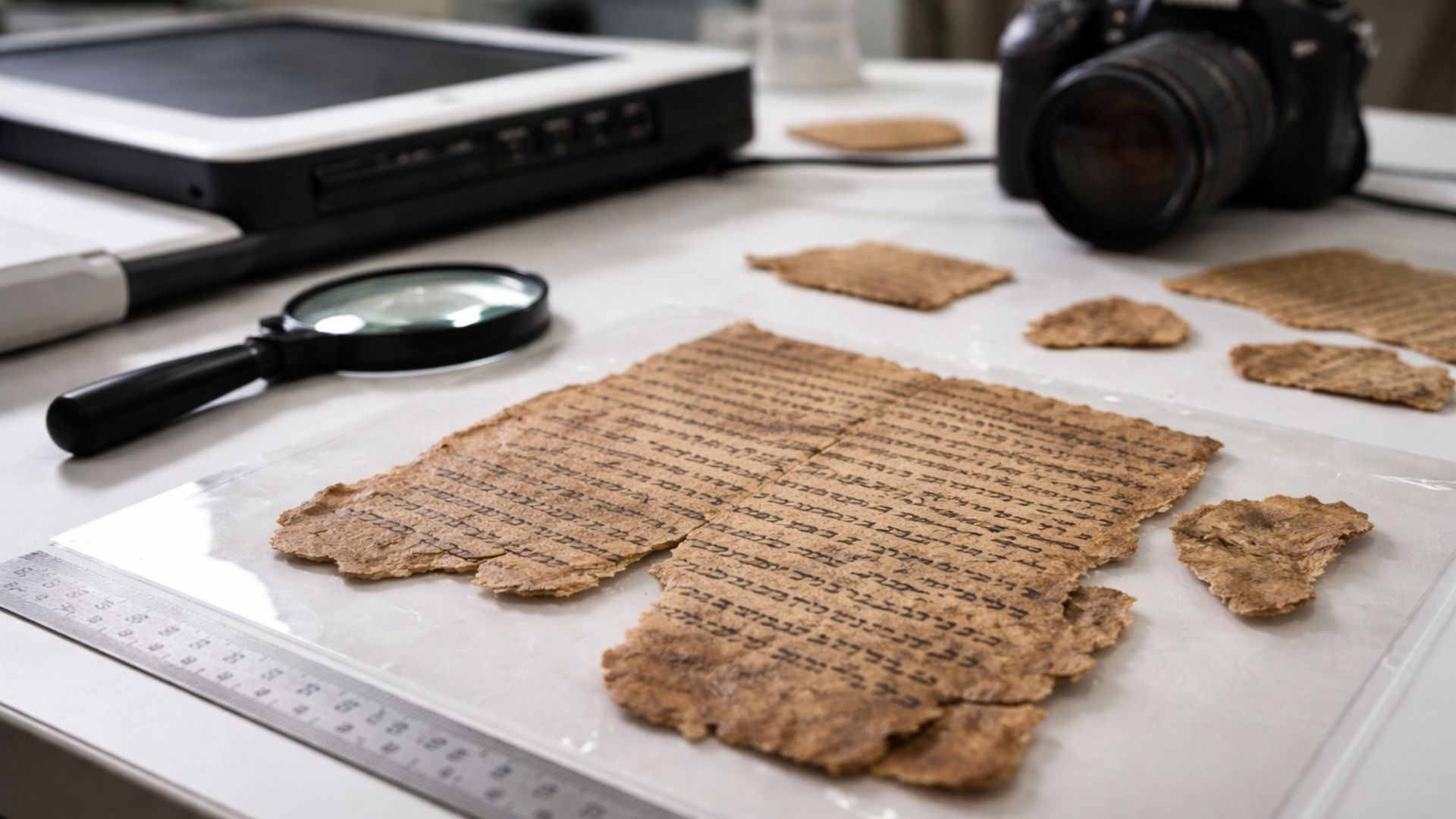
New Technique Combines Carbon-14, Artificial Intelligence, and High-Resolution Images to Recalibrate the Dating of the Dead Sea Scrolls.
Results suggest that some fragments may be older than previously indicated by paleography, directly impacting the reading of Hasmonean and Herodian styles.
A new study published in the scientific journal PLOS ONE proposed a method that intersects carbon-14 dating, digital images, and artificial intelligence to more accurately estimate when fragments of the Dead Sea Scrolls were produced.
By applying the model to materials that had not yet been dated in the laboratory, the team found cases where the suggested chronological windows are older than traditional estimates mainly based on paleography, reigniting discussions about the chronology of biblical texts and writing in ancient Judaism.
-
Friends have been building a small “town” for 30 years to grow old together, with compact houses, a common area, nature surrounding it, and a collective life project designed for friendship, coexistence, and simplicity.

-
This small town in Germany created its own currency 24 years ago, today it circulates millions per year, is accepted in over 300 stores, and the German government allowed all of this to happen under one condition.

-
Curitiba is shrinking and is expected to lose 97,000 residents by 2050, while inland cities in Paraná such as Sarandi, Araucária, and Toledo are experiencing accelerated growth that is changing the entire state’s map.

-
Tourists were poisoned on Everest in a million-dollar fraud scheme involving helicopters that diverted over $19 million and shocked international authorities.


Found in caves in the Qumran region, by the shores of the Dead Sea, the manuscripts comprise a broad set of documents: religious texts, commentaries, community rules, and daily life records.
Among them are ancient versions of books that are part of the Hebrew Bible, making the collection a central reference for understanding how textual traditions circulated and were transmitted across different periods.
Changes in the date assigned to a fragment do not merely reflect a number in a catalog.
When a manuscript “moves” forward or backward by a few decades, hypotheses about the circulation of works, the formation of literate communities, and the coexistence of writing styles within the same historical span are also affected.
Paleography and the Uncertainties in Manuscript Dating
Rarely do these materials carry explicit dates.

For decades, paleography was the primary tool used to position scrolls and fragments in time, comparing features, proportions, and patterns of letters with other manuscripts considered chronological “milestones.”
This procedure is widely used but can lead to broad time ranges, especially when comparable samples are lacking or when different styles coexist in nearby regions and contexts.
Moreover, the very condition of the manuscripts affects the quality of the analyses.
Old photographs, highly damaged fragments, and the handling and treatment history of certain materials complicate fine comparisons of handwriting and hinder consensus when there are divergences among specialists.
What Carbon-14 Measures and Why This Does Not End the Debate
Radiocarbon dating is an important independent basis because it measures the age of organic materials, like parchment and papyrus.
In practice, it indicates when the material was produced, and not necessarily the exact moment the text was written.
Nonetheless, by narrowing the “window of the material,” carbon-14 acts as a brake against excessively elastic interpretations and can correct estimates when the graphic style alone does not allow for a precise cutoff.
Researchers working with the scrolls also emphasize technical cautions.
Part of the previous discussions about radiocarbon involved possible interferences from preservation procedures and contamination, which need to be controlled so that measurements reflect the original material with maximum reliability.
Model Enoch and the Reading of Strokes in Digital Images
The study introduced a predictive system named Enoch, developed to analyze characteristics of letter strokes in digital images and relate them to dating probabilities.
The starting point was fragments that already had carbon-14 results: with this set, the model learned statistical associations between writing patterns and chronological intervals anchored in laboratory measurements.
The work describes that the training relied on 24 samples of manuscripts with radiocarbon dating.

From there, Enoch was applied to a larger set of fragments without available carbon-14, generating estimates that were later compared with paleographic evaluations.
In a validation stage, the research reports that specialists considered most of the predictions “realistic,” and the study also points to an average uncertainty of about around 30 years for the model under certain conditions, according to the description released by the authors and institutions associated with the project.
Even with these results, the article and the impact of the study reinforce an essential limit: the system does not “replace” human analysis.
The proposal is to add a quantitative layer that helps narrow intervals and signal cases where the date suggested by paleography deserves revision in light of laboratory evidence.
Styles Hasmonean and Herodian Under Review
One of the points that drew the most attention in the public discussion of the work was the potential impact on the labels used to organize writing styles.
In many studies, categories like “Hasmonean” and “Herodian” serve as markers to group manuscripts into approximate chronological ranges.
By suggesting older dates for some fragments that were once associated with specific phases, the method opens space to reconsider when these styles emerged, how long they coexisted, and how they overlapped.
As the overlap increases, interpretations also change regarding transitions between schools of scribes, the speed of dissemination of graphic forms, and the circulation of texts in different environments.
It is not just about “moving forward” a manuscript, but about redrawing the map of coexistence among writing practices in a time when textual production had a strong connection to religious life, community identities, and the transmission of traditions.

Debate on Biblical Texts and Ancient Judaism
A more accurate chronology helps frame debates that span academia and public interest.
At what point did versions of certain books begin to circulate more steadily?
When did certain religious formulations gain recognizable form?
At what rate did reading and copying practices spread?
Still, the study does not provide ready answers to these questions.
The research deals with probabilities, intervals, and validations conditioned to image quality, training set, and control of the material’s physical variables.
On the other hand, by combining different sources of evidence, the method attempts to reduce reliance on a single indicator and offers a way to test hypotheses with greater rigor.
Cautions with Algorithm, Images, and Historical Interpretation
Experts consulted on the repercussions of the study emphasized that machine learning depends on what it receives as input.
If the training set is limited, the model may be less reliable when dealing with rare writing variations, specific damages, or underrepresented graphic traditions.
The quality of images is also decisive: photography, lighting, resolution, and fidelity of stroke recording directly influence the measures that the algorithm uses.
Another frequently highlighted point is the distinction between dating the support and dating the act of writing.
Even when carbon-14 indicates a narrow range, there may still be a gap between the production of the parchment and its use, depending on the context of storage and availability of the material.
Thus, the practical utility of Enoch is likely to grow as new data sets, more radiocarbon measurements, and tests on different collections emerge, always with independent validation.
The study appears, in this sense, as an attempt to consolidate a bridge between laboratory, computation, and paleographic expertise, rather than as a replacement of traditional methods.
Once a tool can reduce uncertainties and indicate revisions in specific fragments, how should this influence how historians and specialists reposition the early stages of circulation of biblical texts and the evolution of writing traditions during the period?









-

2 pessoas reagiram a isso.