





 Portuguese
  English
  Spanish
  5 min of reading
  0 comments


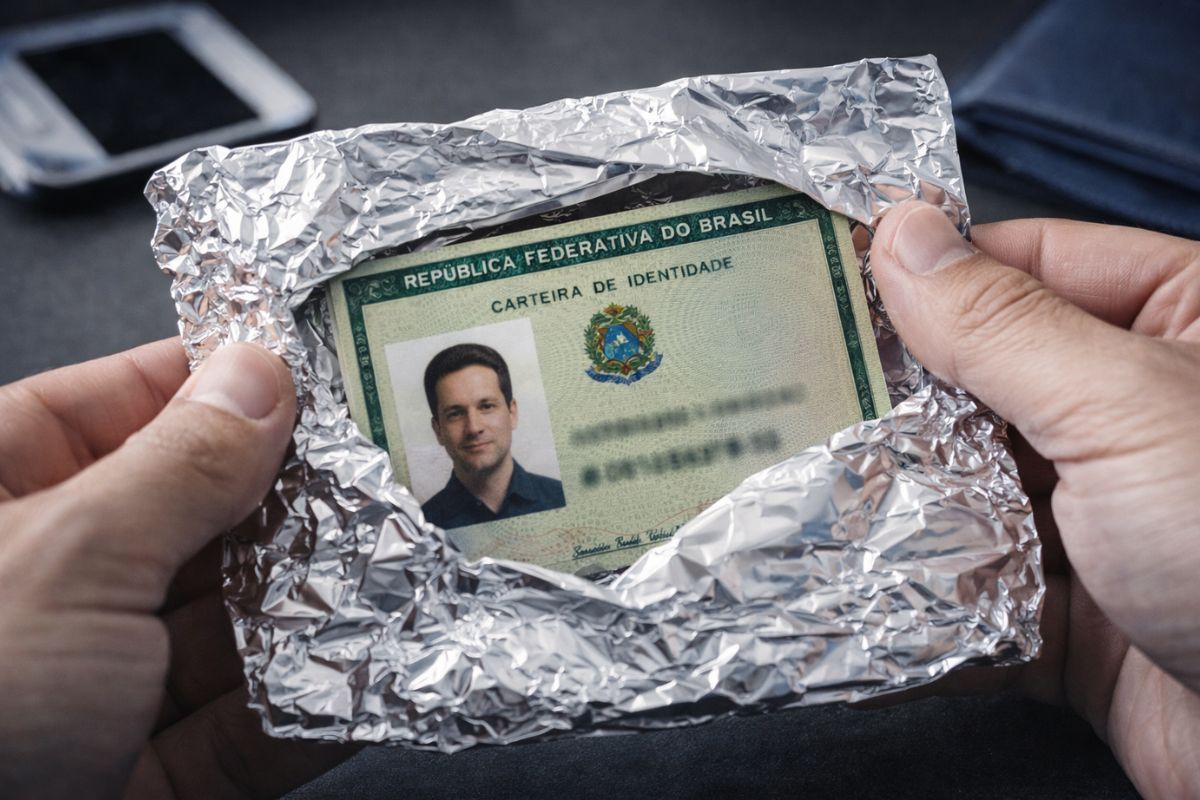
Wrapping the ID card in aluminum foil has become a popular trick against electronic scams, but the Brazilian identity document does not have an RFID or NFC chip, and the aluminum ends up serving only as improvised physical protection that can scratch the plastic and damage the document.
Have you ever seen someone taking their ID card out of their wallet and the document wrapped in aluminum foil as if it were a piece of chocolate? The practice has gone viral on social media as a supposed protection against electronic cloning and proximity spying, inspired by videos about contactless credit cards and corporate badges that actually have radio frequency chips. The problem is that the Brazilian ID card does not work that way. Most models are completely analog, without any RFID or NFC chip that transmits data via radio frequency.
This means that wrapping the ID card in aluminum foil does not provide any real digital protection for the Brazilian identity document. The aluminum acts as a barrier to electromagnetic waves, a concept similar to a Faraday Cage, but this shielding would only make a difference if there were a chip to be blocked. In practice, what happens when you wrap the ID card in aluminum foil is that the material tears, crumples, collects dirt, and can even scratch the surface of the document, causing more problems than solutions.
Why so many people started wrapping the ID card in aluminum foil
The origin of the habit lies in the confusion between different documents. Contactless credit and debit cards actually have NFC chips that can be read by proximity, and there are documented cases of clandestine readers used to capture data from these cards in public places.
-
Scientists have overturned a 327-year-old law of physics by discovering that friction can exist without any contact between surfaces, and this finding published in Nature could revolutionize machines and devices of the future.

-
The South Atlantic is not as peaceful as Brazil imagines: there are nuclear weapons on foreign islands in the region, open territorial disputes, and great powers eyeing Brazil’s maritime wealth.

-
Solar panels freeze water during the day, a fan and radiator release the cold at night, and a man demonstrates that small spaces can be cooled without an electrical grid.

-
For less than R$ 200, container hotels become the solution for those traveling by car, with affordable prices, 24-hour accessible beverage machines, air conditioning, television, a full bathroom, and high-quality beds.

For these cards, wrapping in aluminum foil or using RFID-blocking wallets makes sense and provides an extra layer of protection.
The problem arose when this logic was extended to the ID card without checking if the document has the same technology. Traditional Brazilian ID cards were issued on paper or simple plastic, with watermarks, crests, special inks, barcodes, or QR Codes that depend exclusively on direct visual reading.
There is no radio signal emission, so there is no risk of electronic interception, and aluminum foil does not add any digital security of any kind.
What really happens when you wrap the document in aluminum foil
In practice, aluminum foil creates more problems than it solves for those using it on the ID card. The material is fragile, tears easily when handled inside the wallet, and leaves metallic residues on the surface of the document.
On plastic ID cards, aluminum can scratch the lamination with daily friction. On paper ID cards, it can adhere to the damp surface and damage the printed information when removed.
The appearance of the document is also negatively affected by aluminum foil. A crumpled ID card inside a layer of aluminum conveys carelessness and can generate distrust during inspections, banking services, or at airports.
Moreover, the aluminum needs to be replaced frequently because the material deteriorates quickly with use, requiring constant replacement of something that, in the end, offers no real security benefit for the identity document.
The National Identity Card has a chip and aluminum foil works on it
The new National Identity Card (CIN) unifies the document across the country, adopts the CPF as a unique number, and brings more advanced graphic and digital features than the traditional ID card.
The QR Code present on the CIN allows authenticity verification in official applications and systems, but this verification occurs through optical reading, not radio frequency. So far, the use of RFID in the CIN is not a reality in Brazil.
This means that aluminum foil remains irrelevant for digital security even in the new CIN. Since the document is already issued with more durable material and its own plastic layer, wrapping it in aluminum is even more unnecessary than in the case of the old ID card.
The CIN was designed to be durable without needing improvised protection, and wrapping it in aluminum foil can even hinder handling during official verifications.
For which documents and cards does aluminum foil really work
The technique of blocking with aluminum has real scientific basis when applied to objects that have radio frequency chips.
Contactless credit and debit cards, corporate badges with RFID, and passports with electronic chips are the items that can effectively have data intercepted by proximity readers. In these cases, aluminum foil acts as a temporary barrier that prevents the signal transmission between the chip and the reader.
However, even for these items, aluminum foil is not the best solution. Wallets and cases with integrated RFID blocking offer more stable, durable, and discreet protection than kitchen aluminum.
There are specific products on the market that provide electromagnetic shielding sewn into the material, without the inconveniences of tears, dirt, and poor appearance that aluminum foil causes. For those who take card protection seriously, investing in a suitable wallet is more efficient than improvising with a roll of aluminum.
What really protects your ID card and CIN from damage and fraud
If aluminum foil does not serve to protect the identity document against cloning, what does work?
For physical protection, transparent plastic covers and good quality wallets are sufficient to preserve the ID card and CIN against moisture, friction, folds, and wear. These are inexpensive solutions, available at any stationery store, that keep the document readable and presentable for much longer.
For protection against fraud, the focus should be on sharing personal data, not on electromagnetic waves. Scams involving identity documents occur when someone photographs, copies, or gains visual access to the information on the ID card, not through radio signal interception.
Avoiding unnecessary exposure of the document, not sending photos of the ID card via messaging apps without need, and keeping digital copies only in secure environments are much more effective measures than any layer of aluminum foil.
Have you ever wrapped your ID card in aluminum foil thinking you were protecting it against cloning? Do you know someone who still does this? Share in the comments. This is the kind of myth that spreads quickly, and many people only find out it is useless when they read an explanation like this.









Seja o primeiro a reagir!