





 Portuguese
  English
  Spanish
  5 min of reading
  0 comments


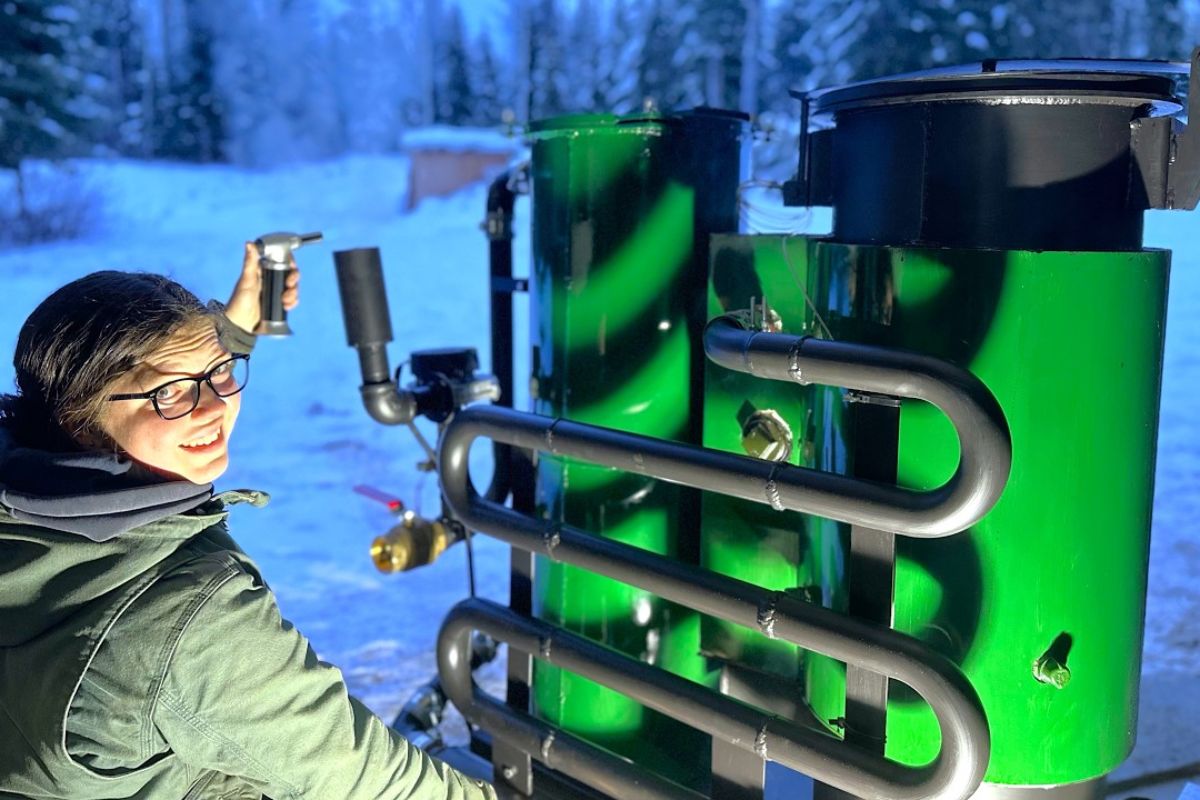
In an Off-Grid Project, Energy is Born When the Wood Gasifier Heats Firewood to Release Quality Gas, Filtered and Cooled Before Feeding a Generator, with Startup Goals in 10 Minutes, Power at Home, and Typical Problems Like Leaks, Wet Wood, and Valve Adjustments.
In a cold climate workshop, Christina describes the search for stable energy without relying on gasoline and without being hostage to weeks of little sun. The bet is on a more recent wood gasifier, capable of turning firewood into fuel gas and, from there, sustaining a home generator for real daily use.
Next to her is Steve, introduced as someone off the grid for 48 years and responsible for designing the system that the group is trying to replicate. What stands out is not the speech, but rather the technical sequence: failures, leaks, improvised seals, and wet wood compromising the quality of the gas, showing that wood energy requires engineering and routine, not faith.
Wood Energy, Autonomy, and Operational Risk

The proposal is simple in theory: convert wood into energy by turning firewood into gas and burning this gas in an engine connected to a generator.
-
With a cost per shot close to zero, the DragonFire laser could change naval warfare in 2027 and provide British ships with nearly unlimited defense against drones.

-
A British startup creates tires that generate electricity in electric vehicles when passing over potholes, speed bumps, and cracks.

-
Scientists have created robots made with living cells that have their own nervous system, swim on their own, explore the environment, and self-organize without any genetic engineering, and now they want to do the same with human cells.

-
Students create a solar-powered ambulance that operates without a plug, without fuel, and still keeps medical equipment running in remote areas.


The wood gasifier becomes the center of the system because it does not “multiply” energy; it changes the state of the fuel, trying to deliver a mixture that the engine can accept without stalling, without excess moisture, and without residues that compromise the mechanics.
In practice, the account itself makes it clear that autonomy is not synonymous with ease. Working with fuel gas implies zero tolerance for leaks, caution with extreme heat, and maintenance discipline.
This detail changes the discussion: the promise of off-grid energy only stands when the system is sealed, clean, and operating within repeatable parameters.
Wood Gasifier: From Reactor to Gas Feeding the Generator

The wood gasifier is described as a “production line” in stages. In the reactor, the firewood is heated and receives oxygen through air jets, generating heat and promoting the conversion that ends in charcoal and gas.
The temperature appears as an indicator of the process: records of 450°C are mentioned, then 650°C, and in more stable operation moments, fluctuations in the range of 900°C.
After the reactor, the gas goes through a heat exchanger and enters a condenser tank, an stage dedicated to cooling and reducing moisture.
Then, the gas passes through a filter housing filled with straw and, above, foam filters, aiming to arrive “fresh, dry, and clean” at the engine of the generator. When the gas does not arrive clean, the promised energy turns into maintenance and hidden costs.
Startup, Time, and Power: Where Energy Must Prove It Works

The operational plan is presented with clear goals: to get the useful system running in 10 minutes, with batteries charging and the generator already stable.
For this, the startup is described as a period in which a fan maintains the flow while the gasification “takes off”, something placed in the range of 5 to 10 minutes until the gas reaches sufficient quality for the engine to take over on its own.
In delivery numbers, the projection mentioned in the account estimates that, with fuel in the reservoir, the system could operate for 3 to 5 hours when used as a generator of around 5 kilowatts, treated as a typical residential backup level.
What this practically answers is “how much” energy is expected per cycle: it is not a whole week non-stop, but a window of hours in which the firewood, if well prepared, can sustain electricity for domestic use.
Cost, Welding, and the Invisible Price of Off-Grid Energy
The cost debate appears in two layers. On one hand, it is mentioned that a ready-made system may cost around 15 thousand.
On the other, DIY assembly is estimated at around 7,500, with the caveat that the total cost changes depending on the off-grid infrastructure around, such as engine, generator, testing, parts, and labor time.
This time, by the way, becomes the “who pays” silent cost of energy. In the account, it is mentioned that about 80 hours of welding are needed, while another estimate suggests that the whole package could add up to something like 50 hours of assembly and welding, depending on experience and adjustments.
Wood energy may reduce recurring purchases but increases the demand for labor, validation, and repetition.
Leaks, Wet Wood, and Restarts: The Part That Decides the Outcome
The path to operation exposes what often stays outside the headlines. There are pressure tests, marking holes, and corrections in specific points, in addition to moments when RTV sealant is used as an attempt to seal before new checks.
The technical focus is coherent: in gas systems, small failures are not details, they are the divide between useful energy and interruption.
The moisture of the firewood appears as another critical point. The group attributes performance drops to overly wet wood, reports the need for smaller and drier pieces, and cites an internal part that had not been fully welded.
There is also a stirrer with a timer, described as acting for 3 seconds every 4 minutes, to keep the internal bed in motion. Energy here does not depend only on fuel; it depends on process control.
The picture that emerges is of a feasible and demanding technology: wood gasifier, firewood converted into gas, and a common generator producing energy when the system is well sealed, filtered, and operated within time and temperature goals.
The numbers cited give a framework, not fantasy: startup in minutes, windows of hours around 5 kilowatts, and a cost account that ranges between buying ready and building with welding, testing and trial.
If you had to choose one point to trust your energy to this model, what would be your personal limit: accepting the work of preparing firewood, dealing with hot gas, and the risk of leaks, or preferring a traditional generator even with recurring expenses? And, in your routine, would this energy serve as a primary system off-grid or as a backup plan for emergencies?








-

-

3 pessoas reagiram a isso.