





 Portuguese
  English
  Spanish
  10 min of reading
  0 comments


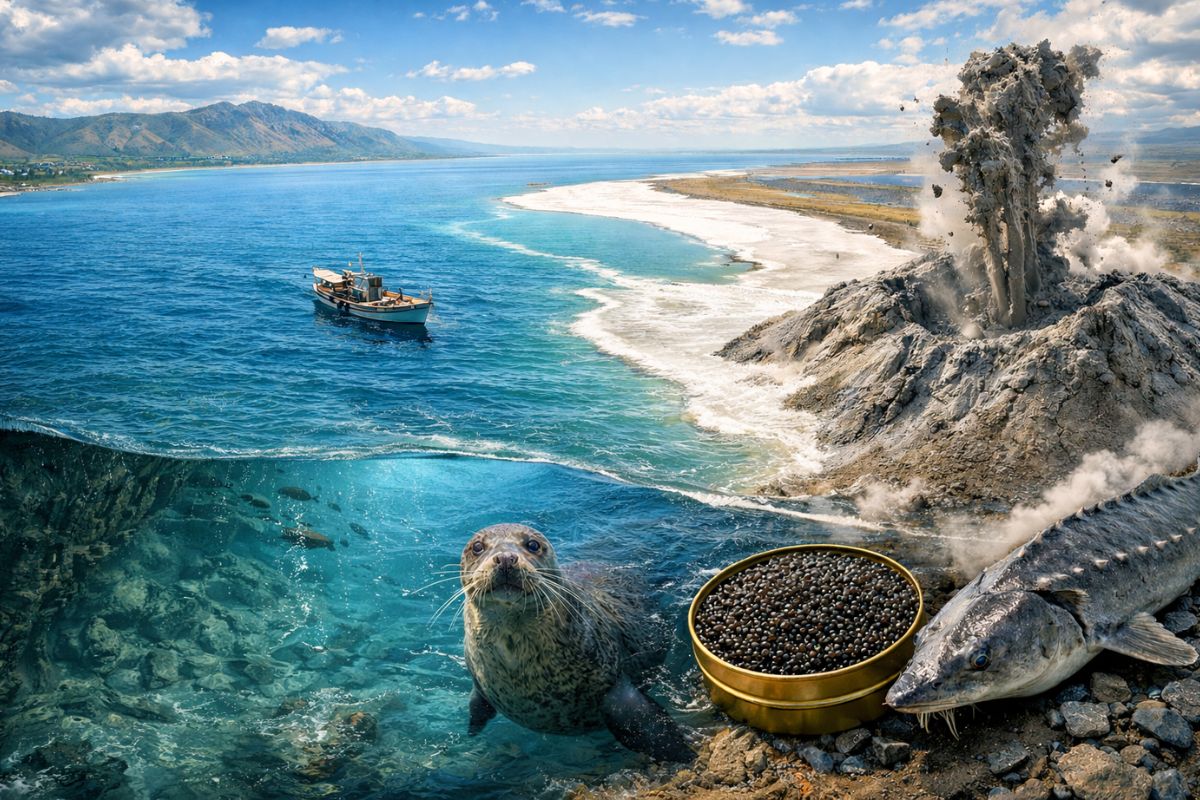
Hybrid Between Sea and Lake, the Caspian Sea Gained a Unique Legal Status, Mixing Oceanic and Continental Bottoms, Has Water Stolen by a Saline Lagoon, Houses Sunken Cities, Caviar, Seals, and Explosive Mud Volcanoes Still Active.
The borders between sea and lake seem simple on the map, but crumble when we look at the Caspian Sea. At first glance, it is just a large body of water surrounded by land, a gigantic “lake.” But the more one investigates this hybrid of sea and lake, the clearer it becomes that it does not fit into any box known to science or international law.
In 2018, an agreement among the five countries surrounding it created a political definition for the Caspian that does not resolve the central question: after all, is it a sea or a lake? At the same time, its bottom is hybrid, its water behaves strangely, its level rises and falls without following obvious patterns, and its ecosystem shelters species that do not exist anywhere else on the planet. To top it off, there are sunken cities, sunken ships, gigantic oil reserves, and mud volcanoes that can spew fire out of the water.
Sea or Lake: When Neither Politicians nor Scientists Can Decide

On August 12, 2018, during a summit of the five countries that border the Caspian Sea, something unusual happened. Instead of deciding whether it would be treated as a sea or a lake, the leaders opted to create a third category.
-
The Argentine government celebrates the lowest poverty rate in 7 years, but experts warn that the methodology has changed, real wages have fallen, unemployment has risen, and the number of people on the streets of Buenos Aires has increased by 57% since Milei took office.

-
7.8 magnitude earthquake in Indonesia frightens the population, triggers tsunami alert, and hits an island with over 200,000 inhabitants this Thursday.
-
Google will finally let you change that embarrassing Gmail address you created in your teenage years without losing any accounts, logins, or old emails: the feature is already available in the United States.

-
Heading to Brazil in a Bonanza F33 single-engine aircraft: a couple departs from Florida on a visual flight, makes technical stops in the Caribbean to refuel and organize paperwork, and begins the staged crossing until they reach the country.

In the international treaty, what everyone referred to as the Caspian Sea became defined as a “closed basin with its own special regime”.
In practice, the dispute over whether the Caspian is a sea or a lake remained open, but now disguised as a legal formula that does not resolve the original enigma.
Even scientists have not reached a consensus. Geographers tend to call it a lake because it has no direct connection to the ocean. Many geologists prefer silence, and sailors simply treat it as what they have always lived with: a real sea.
In terms of size, it clearly behaves like a sea. The Caspian is the largest lake in the world, with about 371,000 km² of surface, slightly smaller than the Black Sea and the Baltic Sea, and much larger than the Sea of Azov. But everything gets even more complicated when we look beneath the water.
A Hybrid Bottom: Where Continental Crust and Oceanic Crust Mix
The first clue that the Caspian is a hybrid of sea and lake lies in its bottom. The Earth’s crust is generally divided into two main types: continental, thicker and formed from granites and metamorphic rocks, and oceanic, thinner and predominantly basaltic.
The problem is that the bottom of the Caspian Sea does not behave like either of the two classic patterns. It combines characteristics from both crusts, creating a hybrid structure.
In the north and part of the central zone, the seabed has typical continental crust features, as if it were a submerged extension of the Eastern European platform. This makes the north quite shallow, with depths barely exceeding 15 m.
As we approach the central region, the bottom drops hundreds of meters and begins to show traits of oceanic crust. There, the average depth reaches about 208 m.
Further south, the structure becomes even more complex, with thickness and composition that closely resemble the bottom of a real ocean, reaching depths close to 1,025 m.
Seen this way, the north and part of the center behave like a shallow lake, while the south behaves like a deep sea, with slopes and basins reminiscent of oceanic environments. The more one tries to fit the Caspian into a simple definition, the more confusing it becomes.
Tethys Sea: The Geological Phosphorus That Explains Why There Is Still Salt and Water

Geologically, the Caspian’s enigma begins with the ancient Tethys Sea, which during the Mesozoic period stretched from the area of present-day Indonesia to Europe. Over time, this giant sea fragmented into isolated water masses, known as Paratethys.
About 5.5 million years ago, what remained of this system divided into three large bodies: Black Sea, Caspian Sea, and Aral Sea. Up to this point, nothing so strange.
The real mystery is another: if the Caspian Sea is completely isolated from the ocean, why has it not dried up and how does it manage to maintain salty water in a relatively stable manner?
The average salinity of the Caspian hovers around 1.2 to 1.3%, about one-third of the average salinity of the oceans. In some areas, it is saltier than the center of the Baltic Sea, even receiving huge volumes of freshwater from rivers like the Volga.
This combination of significant salinity, oceanic origin, and feeding by rivers has led some researchers to argue that the Caspian is, in fact, a kind of hybrid: an oceanic-origin basin that, over time, has also come to behave like a lake fed by rivers.
The fluctuations in water levels reinforce this idea. In the 19th century, the level dropped. In the 20th century, it rose about 2.5 m relatively quickly.
In this century, it has shown a tendency to fall again. The most astonishing detail: these oscillations do not happen over thousands of years, but in much shorter periods, challenging the simplest explanations.
The Lagoon That Steals Water: Kara-Bogaz-Gol, Glauber Salt, and a Toxic Desert
To understand the behavior of this sea and lake, one must look at a curious “leak”: the Kara-Bogaz-Gol Gulf, a huge shallow lagoon on the eastern coast of the Caspian, linked to it by a narrow channel. Seawater continuously flows into this lagoon and practically does not flow back.
Under an extremely dry and hot climate, the water evaporates intensely, concentrating salts and forming large amounts of mirabilite, the so-called Glauber salt.
The lagoon has turned into one of the largest mirabilite reserves on the planet, attracting large-scale industrial exploitation.
But this profitable business had a hidden cost: the level of the Caspian began to fall dangerously, threatening ports, shipping routes, and ecosystems.
Scientists concluded that the approximately 18,000 km² of the lagoon were evaporating tens of cubic kilometers of water per year, literally “stealing” water from the main sea.
The solution found was drastic. A concrete dam was built to block the channel. The water stopped flowing, the lagoon dried almost completely, and what remained was an immense saline desert.
Aquatic species disappeared, birds that nested there lost their habitat, and mirabilite extraction collapsed.
As if that weren’t enough, salt storms began to sweep the region, damaging agriculture, equipment, and the health of the population.
And the most ironic part: the Caspian Sea seemed to ignore the sacrifice. The level continued to fall for a time and only then gradually began to rise, as if following its own logic.
With the end of the Soviet Union and the independence of Turkmenistan, the dam was demolished in 1992. Water re-entered Kara-Bogaz-Gol, mirabilite extraction resumed, and the salt storms diminished.
But the complete recovery of the ecosystem is still an open question, yet another reminder of how difficult it is to “correct” such a complex system as this sea and lake.
Caviar, Seals, and Species That Only Exist There
In addition to the strange geology and hydrology, the Caspian holds a biological enigma. Between 62% and 66% of the fish species in the Caspian Sea are endemic, meaning they do not exist anywhere else on the planet. The same goes for many mollusks.
Among the fish, notable species include herrings and, especially, the sturgeons. The Caspian sturgeon is a true living fossil, a survivor from the time of the dinosaurs. Several species of this group inhabit the sea and lake and are responsible for producing one of the most luxurious products in the world: caviar.
The largest of all is the beluga sturgeon, which can reach about 7 m in length and weigh over 1.5 tons. It is from this giant that the coveted beluga caviar comes. In the 20th century, between 80% and 90% of the world’s caviar came from three species from the Caspian: beluga, Russian sturgeon, and Persian sturgeon.
Another symbol of the Caspian is the Caspian seal, a marine mammal that lives in a completely enclosed water mass, with no direct contact with the ocean.
Scientists are still discussing how this seal got there. There are hypotheses about migration during the last glaciation or remnants of the fauna from the ancient Tethys Sea.
To this day, the fact that a marine seal survives in a partially freshwater and isolated environment remains a biological enigma.
The loss of this set of species would not only be environmental damage but an irreversible loss of unique biodiversity, impossible to be “recreated” elsewhere.
Myths, Sunken Cities, and the Atlantis of the Caspian
Since civilization established itself around the Caspian, the region has become the setting for stories, maps, and legends. The sea and lake appear in texts by authors from ancient Greece and Rome, such as Herodotus, Strabo, and Ptolemy. For many peoples, it marked the boundary of the inhabited world, the end of the known map.
Persians saw their northernmost limit there. Turkic nomadic peoples used the area as a caravan route. Russian kingdoms viewed the Caspian as a stage for trade and also for plunder.
Over time, legends of sunken cities, sea monsters, and caravans disappearing in the nearby deserts emerged, especially in the Mangystau region.
In the waters near the Iranian coast, locals have reported for centuries creatures taking human form called Runan Sha, “lords of the water.”
In 2005, a fishing boat from Azerbaijan reportedly saw something similar swimming among a school of fish, according to a story attributed by the captain to an Iranian journalist. It is very likely that it was a gigantic sturgeon, but the legend gained new life.
In terms of concrete evidence, the Caspian has its own “Atlantis.” This is the medieval fortress of Sabayil, built between 1232 and 1235 on an island near Baku, Azerbaijan. In 1306, an earthquake caused the fortress to sink.
In the 17th century, when the Caspian’s level receded, the towers reappeared. Between 1939 and 1969, underwater excavations discovered about 700 stone slabs with inscriptions and drawings. Today, the towers are once again submerged.
Even more famous is the city of Itil, capital of the ancient Khazar Khaganate. It appears in several historical documents, including a letter preserved in Spain, written by the Khagan to the caliphate of Córdoba.
Archaeologists have been searching for Itil for generations, without definitive success, but travelers have long reported submerged stone structures that may be remnants of this lost city.
Sunken Treasures, Oil, Gas, and Mud Volcanoes That Spit Fire
At the bottom of the Caspian Sea lie not only cities and legends. There are also the remains of countless shipwrecks over millennia of navigation. In modern times, perhaps the most famous loss was that of the fleet of Russian czar Peter the Great.
In 1722, he descended the Volga with 274 vessels towards the Caspian to open a route to Asia. A storm struck the fleet, and many ships sank. Their remains still lie in the bay of Derbent.
And these shipwrecks may not even be the most valuable treasure. Geological estimates indicate that beneath the Caspian’s bed there may be up to 50 billion barrels of oil and 8.3 trillion cubic meters of natural gas.
Even representing only a fraction of global reserves, these deposits have enormous strategic importance for diversifying energy supply, especially towards Europe.
But the Caspian holds another even more dramatic spectacle: the mud volcanoes. Only in Azerbaijan’s waters have more than 140 submarine volcanoes of this type been identified.
It is not uncommon for columns of water, gas, and mud to suddenly surge from the bottom, reaching the height of a five-story building.
Sometimes, these eruptions form small mud islands that appear and disappear within a few years. In 2023, for instance, an island about 400 m wide, named Kumani Bank, appeared near the coast of Azerbaijan. It emerged in February and, by the end of 2024, had already been destroyed by erosion.
The gas expelled by the volcanoes contains methane and, when ignited, produces flames that seem to sprout directly from the sea, feeding the idea that beneath that sea and lake, the very Earth continues to boil.
The Enigma Continues: What to Do with a Place That Is Both Sea and Lake at the Same Time
After looking at the hybrid geology, the origin linked to the Tethys Sea, the lagoon that steals water, the endemic species, the sunken cities, the oil, the gas, and the mud volcanoes, one thing becomes clear: the Caspian Sea is indeed the planet’s ultimate enigma, a true sea and lake at the same time.
It does not fit into traditional definitions, escapes the categories of international law, and continues to challenge scientists from various fields.
At the same time, it is under environmental, climatic, and economic pressure, with fragile ecosystems, unique species, and natural resources contested by several countries.
Perhaps, in the end, the greatest challenge is not to decide whether the Caspian is a sea or a lake, but to understand how to coexist with this unique body of water without destroying it, respecting its limits, its history, and its still unresolved mysteries.
And you, looking at all this, do you think the Caspian Sea should be treated more as a sea, more as a lake, or as a totally new third category?








-

2 pessoas reagiram a isso.