





 Portuguese
  English
  Spanish
 4 min of reading
  5 comments





The New Frontiers of Oil Are in the North and Northeast of Brazil – and Can Transform Whole Cities with the Force of the Equatorial Margin Economy
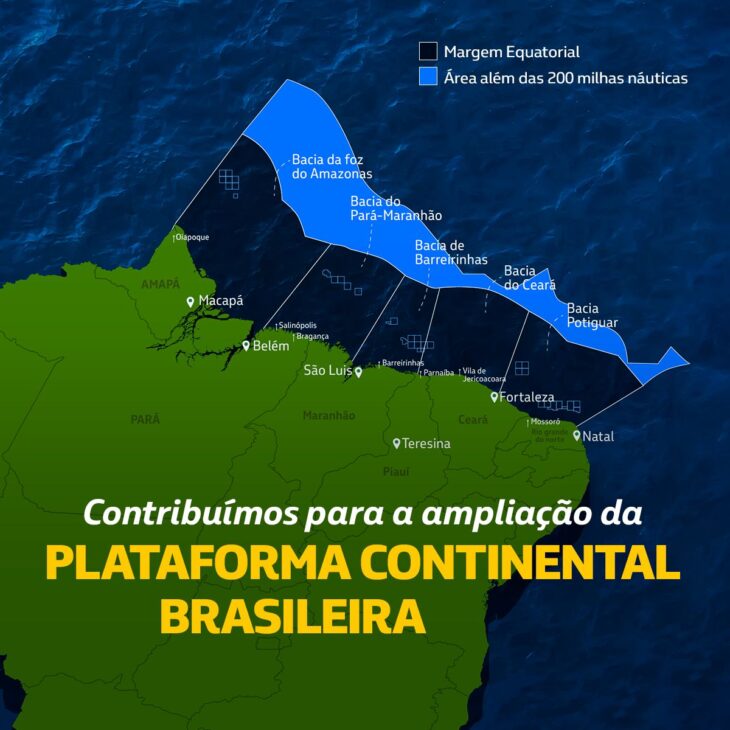
The Equatorial Margin emerges as the big bet for the future of oil production in Brazil. Located along the coastline of the North and Northeast, this region is home to five important sedimentary basins that extend from Amapá to Rio Grande do Norte. Therefore, the expectation is that as exploration advances, various coastal cities will receive investments, infrastructure, and thousands of jobs, elevating them to the status of new wealth hubs — just like what happened with Macaé (RJ) at the height of the pre-salt.
The Promise of the Equatorial Margin: New Energy Power of the Country
The so-called Brazilian Equatorial Margin brings together five strategic basins for Petrobras and other companies in the sector:
- Amazon River Mouth
- Pará-Maranhão
- Barreirinhas
- Ceará
- Potiguar
These areas present geological conditions very similar to those of the marine regions of Guyana and Suriname, where significant oil discoveries have recently emerged. Therefore, Petrobras sees an enormous potential in the Equatorial Margin, capable of ensuring the country’s energy security for several decades. Additionally, the interest of international giants also reinforces this optimistic projection.
-
How investment in technology can revolutionize the national economy and enhance industrial gains, according to a study that highlights the direct impact on productivity, innovation, and wealth retention within Brazil.

-
The rise in oil prices could ensure an extra revenue of R$ 100 billion for the Federal Government, indicates a recent economic study.

-
Naturgy begins an investment of R$ 1.6 million to expand the gas network in Niterói and benefit thousands of new residences and businesses.
-
The largest food company on the planet, JBS, has just opened a 4,000 square meter laboratory in Florianópolis to develop customized proteins that modulate muscle mass gain, immune response, and metabolic performance.


Cities That Can Become Rich with Oil from the Equatorial Margin
With the new operations, wells, and support bases planned, several cities near the basins should benefit directly. See below which municipalities have potential to become wealthy in this new phase of the oil economy:
Oiapoque (AP)
Located on the border with French Guiana, Oiapoque is strategically positioned in front of the Amazon River Mouth Basin. The city can attract logistical investments, infrastructure, and jobs, serving as a gateway to operations further north.
Macapá (AP)
Macapá is close to the Amazon River Mouth Basin, the most debated in the country due to its environmental issues. However, if approval for exploration occurs, the city could become the main logistical support point in the extreme north of Brazil.
Belém (PA)
Belém already has a structured port and strategic position. Thus, it can provide support to the Pará-Maranhão Basin, handling vessels, supplies, support companies, and specialized technicians.
São Luís (MA)
The capital of Maranhão is positioned to lead support for the Barreirinhas Basin. Additionally, the Port of Itaqui strengthens its role as an essential logistics base, potentially attracting national and international investments.
Parnaíba (PI)
Although Parnaíba is a smaller city, it can gain regional relevance by supporting the Ceará Basin. Consequently, logistics, hospitality, and transportation companies can multiply rapidly in the region.
Fortaleza (CE)
With a strong economy and consolidated infrastructure, Fortaleza already stands out as the main support center for the Ceará Basin. Thus, job generation can intensify as exploration progresses.
Mossoró (RN) and Natal (RN)
These two cities have a tradition in onshore oil production. Therefore, they are well prepared to support activities in the offshore Potiguar Basin, leveraging accumulated experience and the existing supplier base.
Petrobras Leads Investments and Bets on the Equatorial Margin
Petrobras is at the forefront of Equatorial Margin exploration projects. The state-owned company has already announced investments exceeding R$ 24 billion between 2024 and 2028. This amount will be directed to seismic campaigns, drilling of wells, and construction of infrastructure. Therefore, the movement of resources promises to boost the economies of the involved states.
Nonetheless, the process faces environmental licensing challenges. In 2023, Ibama denied authorization for drilling a well in the Amazon River Mouth Basin, citing risks to marine biodiversity. Nevertheless, Petrobras remains committed to additional studies and promises to comply with all required environmental standards.
Economic Impact Will Be Direct in Coastal Cities
If the planned investments materialize, the effects will be immediate. Oil exploration in the Equatorial Margin can:
- Generate thousands of jobs in various sectors
- Increase municipal revenue through royalties
- Boost technical courses and training centers
- Strengthen local commerce, services, and transportation
Furthermore, small and medium-sized enterprises are likely to emerge in response to the demand for logistics, food, hospitality, maritime transport, and industrial maintenance. Thus, the cycle of regional development tends to be continuous and long-lasting.
Golden Opportunity for the North and Northeast
The Equatorial Margin represents a concrete chance to decentralize growth driven by oil in Brazil. Unlike the concentrated model in the Southeast, this new frontier can broadly benefit the North and Northeast. Thus, the country moves towards regional equity, with more jobs, increased public revenue, and greater prominence for previously overlooked states.
However, this transformation depends on technical, legal, and political decisions. After all, Brazil will need to balance economic development with environmental protection. Still, it is possible to move forward responsibly and ensure a promising future for thousands of Brazilians.
Do you think cities like Macapá, São Luís, and Mossoró are ready to experience a new cycle of prosperity with oil exploration in the Equatorial Margin? Or will environmental and political obstacles still delay this revolution?







Fake News do início ao fim. Mais de 90% das cidades confrontantes com campos de petróleo offshore não apresentam aumento significativo do orçamento público. Aumento de empregos então é irrisório, pois a indústria offshore em intensiva em capital, não em trabalho. A maior parte da mão de obra qualificada virá de outras regiões. As cidades que mais recebem royalties acabam atraindo população e aumentando a demanda por serviços públicos, tendo que lidar com diversos impactos associados ao crescimento desordenado. Quem conhece o norte Fluminense, o Espírito Santo, Sergipe e mesmo Mossoró (onde há produção de petróleo há décadas) sabe que petróleo é sinônimo de riqueza pra poucos e impactos pro resto.
Macapá mais beneficiado que o Oiapoque? Materia muito rasa, diversas outras cidades serão beneficiada, até mais que as capitais.
Né Oiapoque sequer foi citado no texto.
É verdade, mas já foi corrigido. Obrigado pela observação.
É verdade senhores, me desculpe pela falta de atenção, matéria corrigida! Segue também um artigo especifico sobre a cidade de Oiapoque: https://en.clickpetroleoegas.com.br/amapa-sera-a-nova-macae-devido-a-exploracao-da-margem-equatorial-pela-petrobras/