





 Português
  Inglês
  Espanhol
  6 min de leitura
  0 comentários


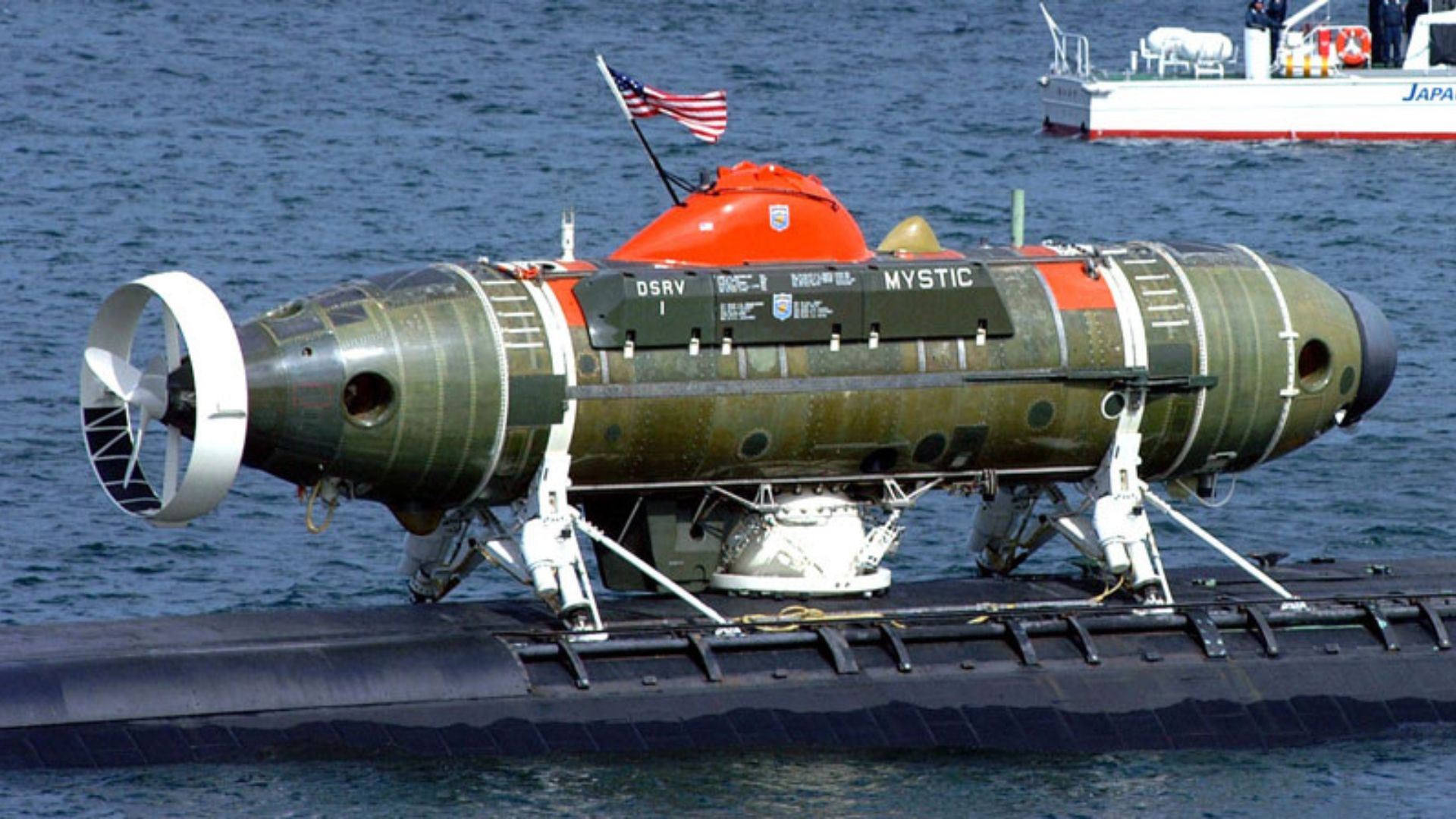
Technology Created to Couple with Stricken Submarines and Retrieve Crew Safely Pushed Naval Engineering to the Limit of Pressure and Precision. Capable of Diving to 1,500 Meters and Transporting 24 People, the DSRV-1 Mystic Became a Silent Symbol of Readiness.
In a scenario where a submarine can become immobilized hundreds of meters deep, the difference between a possible rescue and a tragedy is often defined by a mechanical detail: being able to precisely connect to a hatch, seal the connection, and transfer people without exposing them to ocean pressure.
It was to face this type of emergency that the United States Navy operated, for decades, an unusual vehicle, resembling a capsule and with a direct mission: to couple with stricken submarines and retrieve crew safely.
The equipment became known as DSRV-1 Mystic, an acronym for Deep Submergence Rescue Vehicle, a rescue “minisub” designed to operate at great depths and transport people in repeated cycles, from the damaged submarine to a support platform.
-
The world’s first octopus farm wants to open in the Canary Islands and is already provoking an international reaction: the plan aims to produce 3,000 tons per year.

-
Drought may be creating stronger superbugs in the soil and helping antibiotic resistance reach hospitals, warns a study highlighting a problem that could grow alongside extreme weather.

-
The biggest scam in history: Napoleon’s France deceived the United States by selling them a territory that was Spanish.

-
Why is the Danakil Desert so dangerous? It has unstable terrain and how extreme temperatures and toxic gases turn the region into one of the most hostile environments on Earth.


Records preserved by institutions linked to North American naval history, such as the Naval Undersea Museum, describe that the Mystic was prepared to operate up to 5,000 feet, about 1,500 meters, and transport up to 24 rescued per trip, in addition to the crew responsible for the operation.
DSRV-1 Mystic and the Deep Rescue
The principle of the system was simple to explain and difficult to execute at sea.
Instead of trying to bring an entire rescue submarine to the exact point and maintain position over the target, the solution was to create a smaller vehicle, with its own propulsion and fine maneuverability, capable of descending to the depth of the stricken submarine, “settling” over the hatch area and creating a watertight seal.
With this hermetic coupling, the interior of the minisub and the submarine compartment could be equalized, allowing for the safe opening of passages and the transfer of people without contact with water.

The coupling, in this context, is more than just touching.
The seal must compensate for small inclinations of the hull on the seafloor, currents and irregularities of the terrain, as well as tolerate interference from debris and the limitation of visibility at great depths.
Therefore, the Mystic was designed as a set of engineering that combines buoyancy control, thrusters for lateral adjustments, and navigation and observation systems for the final approach.
Hermetic Coupling and Sealing Under Pressure
The operational goal was to make the “fitting” repeatable in real conditions, because a rescue rarely resolves in a single descent.
The need for equipment of this type gained traction when submarine warfare began to be treated as a central component of deterrence and naval power, raising the number of patrols and, along with them, the concern for incidents in remote locations.
Deep rescue programs began to receive attention not only as a response to accidents but as part of a strategic infrastructure: maintaining trained crews, available support ships, and a vehicle capable of reaching the right point quickly.
One of the most striking aspects of the Mystic was the mobility planned for a real emergency.
Instead of being tied to a single port, the system was designed to be relocated as needed, with logistics that included transport by strategic means and integration with support vessels.
This characteristic, often associated with “any ocean” operations, did not mean that the minisub could traverse great distances on its own, but rather that it could be brought to the incident region, loaded onto a suitable platform, and then launched for rescue descents.
The work of the minisub did not depend only on itself.
For the vehicle to reach the bottom, locate the submarine, and successfully couple, a complete chain would come into action, with scans, positioning, and coordination on the surface.
In rescue operations, time control is also a critical factor, as the vehicle’s autonomy, travel rhythm, and surface support capacity define how many people can be retrieved per operational window.
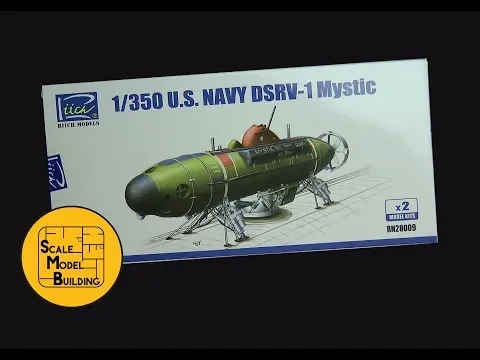

Therefore, a nominal capacity of 24 seats per trip has practical weight: it transforms the rescue into a repetitive process, where each cycle needs to be predictable to accommodate a larger number of crew members.
Capacity of 24 Seats and Retrieval Cycles
The term “unlikely capsule” is justified by the way the Mystic condensed functions.
While combat submarines are built to remain submerged for long periods and operate with great discretion, a rescue minisub prioritizes other attributes: structural robustness to withstand pressure, adequate life support systems to transport people who may be weakened, and maneuvering controls capable of working close to a stationary target.
The result is a vehicle with designs and technical choices that seem displaced from the imagination of a “traditional submarine,” but that make sense when the goal is to touched, seal, and return.
The environment in which a DSRV operates imposes its own challenges.
The great depth alters how light and sound behave, limits visibility, and requires reliable instruments for guidance and final approach.
Moreover, the stability needed for coupling can be affected by seafloor conditions and by the geometry of the submarine to be rescued, which will not always be in an ideal position.
Therefore, the operation depends on preparation and training, with procedures aiming to standardize what is possible in a situation that, by nature, is irregular.
Even when not in a real rescue, such a system needs to exist as readiness.
The logic is similar to emergency equipment in aviation: the rarer the use, the more necessary it is to maintain constant maintenance, testing, and training.
Public documentation of collections and historical records indicates that the Mystic remained in service for decades and was decommissioned only after the U.S. Navy transitioned to newer capabilities for rescue and deep diving support, ending the era of the DSRV as a central piece of this type of operation.

Readiness, Training and Operational Legacy
The period during which the Mystic operated coincides with a phase when submarine technology advanced in speed and complexity, both in propulsion and in sensors, navigation and communications.
At the same time, public perception of accidents in deep water also grew, and the idea of a vehicle capable of “sticking” to a submarine and retrieving people, silently and under extreme pressure, began to represent a frontier of engineering with universal appeal, regardless of country or politics.
The minisub was not a weapon in the conventional sense, but it was part of an ecosystem in which the survival of crews and the capacity for rapid response had operational and human value.
Looking at the Mystic as an engineering object, what stands out is not an isolated record, but rather the combination of operational depth, transport capacity and the technique of hermetic coupling, which transforms ocean pressure into a manageable problem through sealing, control, and procedures.
The image of a capsule descending to “touch” a hull lost on the seafloor continues to spark curiosity because it visually and directly conveys the idea that technology can create a bridge where there was once only isolation.
If a submarine were to become trapped today at great depth, which part of this capsule rescue logic would still make a difference and what would change with current technology?








-

-

-

-

8 pessoas reagiram a isso.