





 Portuguese
  English
  Spanish
  4 min of reading
  0 comments


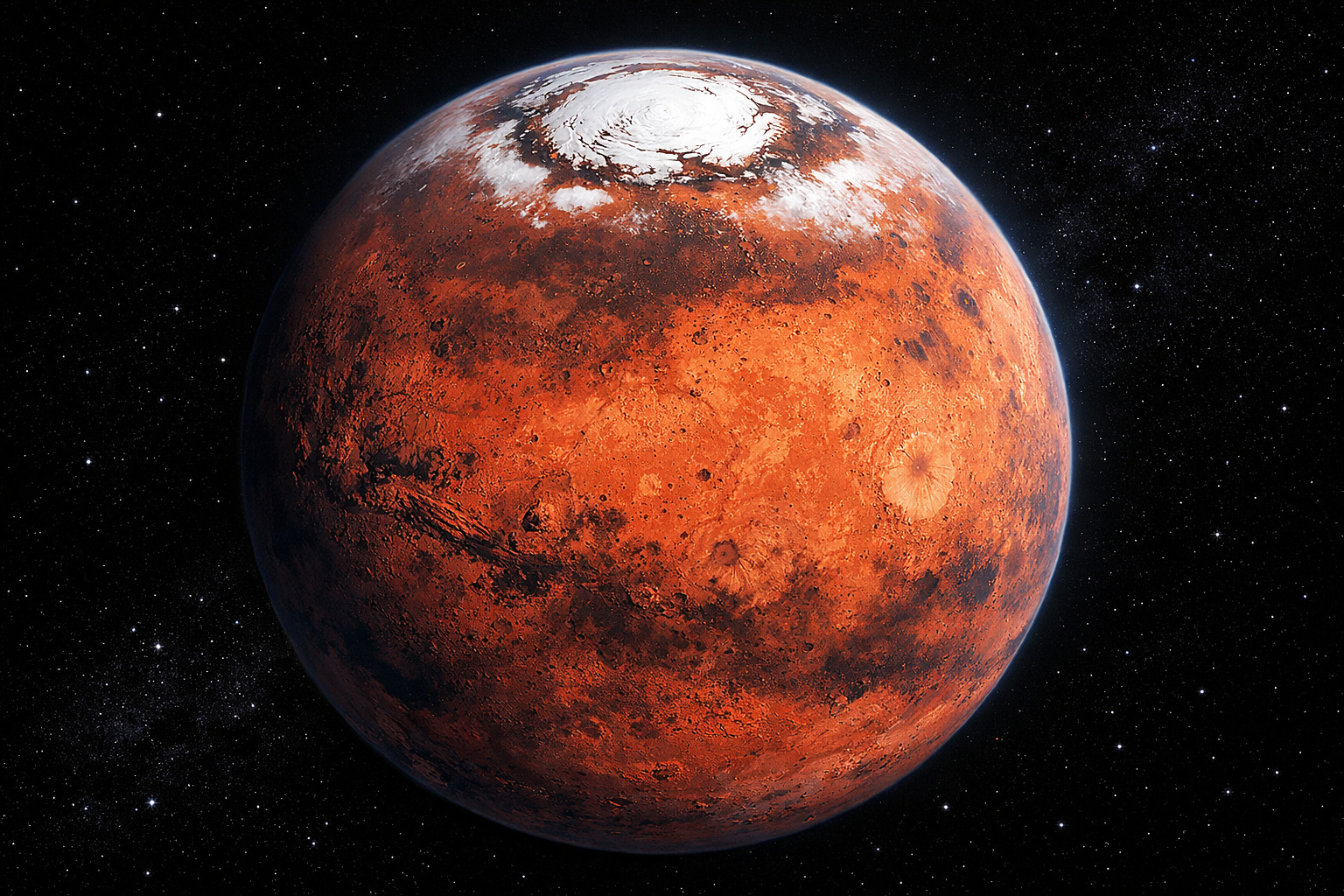
Recent data from the InSight mission show changes in Martian rotation, indicating mass movement, active liquid core, and geological processes still in progress on the red planet
A surprising discovery revealed that Mars is not as “still” as previously thought. Scientists identified that the red planet is accelerating its rotation, causing the duration of its day, known as a “sol,” to become slightly shorter over time.
The information was released based on in-depth analyses from the InSight mission by NASA, which operated on Mars from 2018 to 2022 and had its data re-evaluated in March 2026.
Although the change is extremely small, just a few milliseconds per year, the phenomenon has caught the attention of the scientific community as it indicates active internal processes on the planet.
-
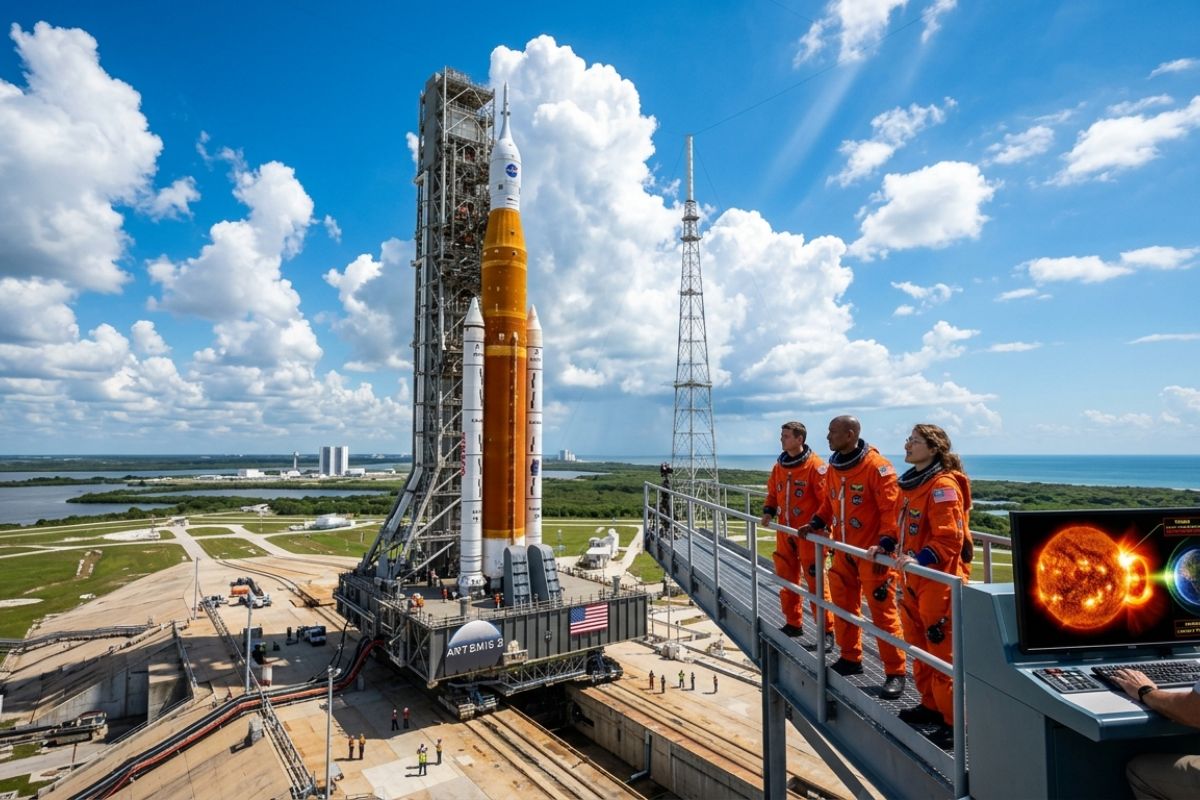
Artemis 2 is set to launch on April 1 at 7:24 PM to orbit the Moon with four astronauts, but a class X solar flare and coronal mass ejection could interfere with communications and threaten the launch.
-
The largest deposit of Vale was discovered by accident and today represents almost all the ore produced by the company.

-
The Brazilian Army takes F-5 fighters out of the garage and stars in an air combat with support from the KC-390.

-
In just 3 years, OMODA 5 surpasses 400,000 units and reaches a milestone that takes most cars a decade to achieve.


How scientists measured Mars’ rotation with extreme precision


The InSight mission used an experiment called RISE (Rotation and Interior Structure Experiment) to measure the planet’s rotation with high precision.
The system operated by sending radio signals between Mars and Earth. As the planet rotated, the position of the probe changed, generating variations in the frequency of the captured waves — an effect known as Doppler.
With this, scientists were able to calculate the rotation speed of Mars with precision to fractions of a second.
After more than four years of data collection, the analysis revealed that Mars is accelerating about 4 milliseconds of arc per year. This value represents an extremely small angular change, but enough to shorten the Martian day, which currently lasts about 24 hours, 37 minutes, and 22.663 seconds.
Ice movement and the planet’s interior may explain the acceleration
Scientists point to two main hypotheses to explain this phenomenon.
The first involves the movement of mass in the polar ice caps. Mars has water and carbon dioxide (CO₂) ice, which undergo cycles of sublimation and deposition throughout the seasons. This movement can redistribute the planet’s mass.
When this mass approaches the poles, an effect similar to that of a ballerina spinning faster as she pulls in her arms occurs — a physical principle known as the conservation of angular momentum.
Additionally, another hypothesis involves the so-called post-glacial rebound. In the past, large layers of ice compressed the Martian crust. With melting over time, the ground begins to slowly rise.
This movement also alters the mass distribution and may contribute to the acceleration of rotation.
Liquid core reveals that Mars is still active

In addition to the rotation, the InSight mission brought another significant discovery: Mars has a liquid metallic core.
Composed mainly of iron and nickel, along with lighter elements such as sulfur and oxygen, this core exhibits density variations that have not yet been fully explained.
These anomalies may directly influence the planet’s rotation dynamics and also help explain why Mars lost its global magnetic field throughout its history.
Today, the planet only exhibits residual magnetic fields in the crust, remnants of a stronger system that existed billions of years ago.
Discovery changes view of Mars and impacts future missions
This discovery completely changes how we perceive Mars. The planet is not entirely inactive. On the contrary, it exhibits internal movements, mass redistribution, and a still dynamic core.
These factors directly influence important aspects such as seismic activity, soil stability, and even the possibility of liquid water existing in subterranean regions.
Furthermore, understanding this dynamics is crucial for future crewed missions. Ground stability, geothermal heat sources, and protection against radiation are critical factors for human colonization.
Therefore, the acceleration of Mars’ rotation goes far beyond a technical data point. It represents a clear signal that the planet is still undergoing transformations.
A planet that is still in motion
Even being viewed for decades as a “dead” world, Mars shows that it still has significant internal activity.
Small changes, measured in milliseconds, reveal gigantic processes on a planetary scale.
Thus, each new discovery brings us closer to better understanding not only Mars but also the evolution of other planets in the universe.
Do you believe that Mars could be habitable in the future based on these discoveries?







Seja o primeiro a reagir!