





 Portuguese
  English
  Spanish
  4 min of reading
  0 comments


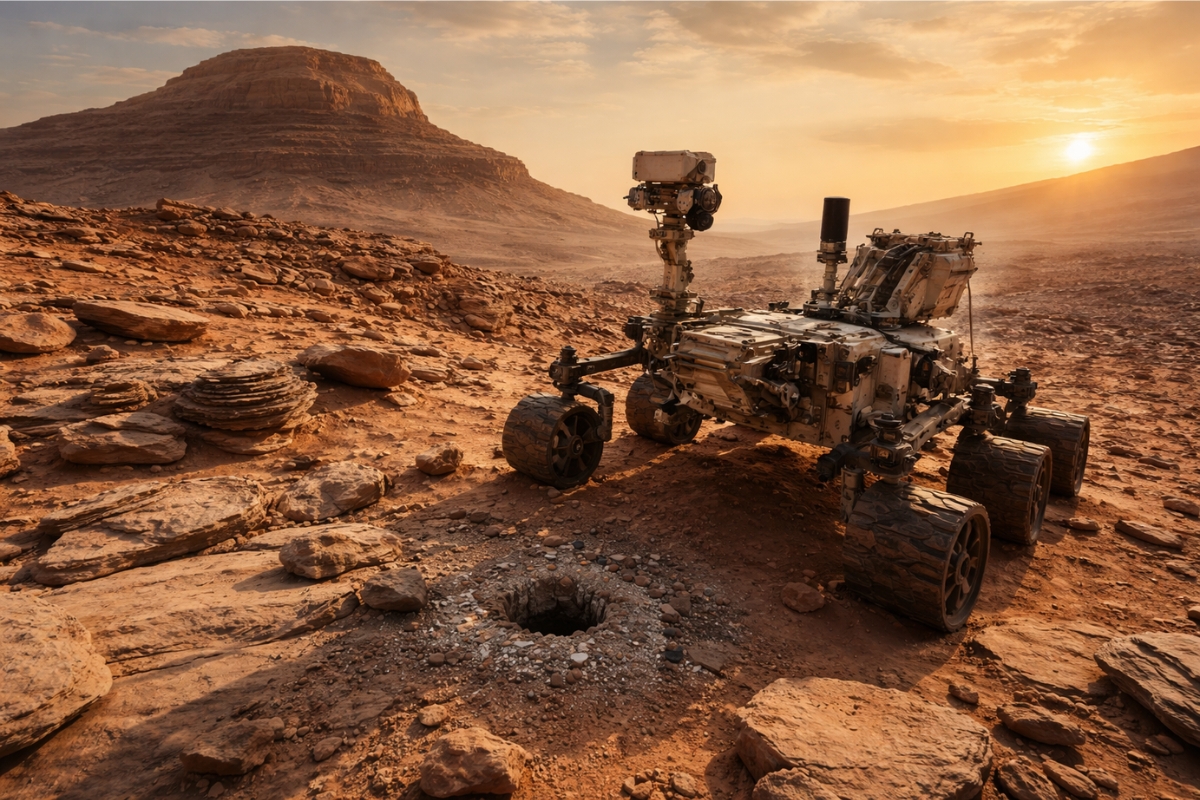
After years of doubts about the disappearance of Martian CO₂, the Curiosity rover finds siderite in Gale crater in concentrations of 4.8% to 10.5% and offers a new key to understanding how Mars transitioned from liquid water to a frozen desert.
Mars has just gained a new piece in one of the oldest mysteries of space exploration. The Curiosity rover found signs of a mineral capable of storing part of the carbon that once was in the planet’s atmosphere.
The result helps to understand how a world that had liquid water on its surface ended up transforming into a cold, dry, and much more hostile environment. The finding also changes the interpretation of what happened to the ancient Martian carbon dioxide.
Mineral appeared in 3 drillings in Gale crater
The discovery was made in 3 drillings conducted by Curiosity in rock layers of the Gale crater, an area studied for years for concentrating clues about Mars’ climatic past.
-
At 100 years old, an elderly man who dreamed of “making it to the newspaper” finally shares his story, reaching his centenary with children, grandchildren, great-grandchildren, and great-great-grandchildren, moving his family with a life of hard work, farming, honesty, and without vices.

-
Germany proposes silent propellers to solve a centuries-old problem: the damage caused in the ocean by ship noise.
-
What the Public House of Julius Caesar was like inside in the Roman Forum: layout, atrium with compluvium and impluvium, tablinium and peristyle, and the scandal of the Bona Dea, revealed in an AI recreation.

-
While digging a trench next to a pool in Germany, workers found more than 1,500 silver coins from 1320 in the rubble, revealing a treasure buried for over 700 years.

In these samples, the rover identified siderite, an iron carbonate that draws attention for being directly linked to carbon storage in rocks. This point is central because scientists have long been trying to locate where part of the carbon from the ancient Martian atmosphere went.
Siderite may store part of the planet’s ancient CO₂

When a planet has an atmosphere rich in carbon dioxide and the presence of water, part of that gas can react with rocks and turn into a mineral. It was precisely this process that began to gain strength with the new evidence found on Mars.
The presence of siderite suggests that a fraction of the carbon did not simply disappear into space. Part of it may have been trapped in the Martian soil, recorded in mineral form over millions or billions of years.
Range of 4.8% to 10.5% reinforces the significance of the discovery
The data obtained from the samples indicated concentrations of 4.8% to 10.5% by weight within a geological section of 89 meters. This range adds more consistency to the finding and shows that the material did not appear in isolation.
According to NASA, the U.S. space agency responsible for the mission, the identification helps to address the ancient mystery of carbonates on Mars, as the expected amount of these minerals always seemed lower than the models indicated.
Layers with sulfates may have hidden this record
Another important detail lies in the type of terrain analyzed. Siderite appeared in layers rich in sulfates, materials associated with drier environments and water evaporation.
This opens the door for a relevant interpretation. The carbonates may have been hidden for a long time in these formations, making detection by orbiting instruments difficult and causing the carbon record to appear smaller than it actually was.
Discovery does not solve everything, but changes the scenario
The finding does not alone conclude the discussion about Mars’ ancient atmosphere. The identified amount still does not explain all the carbon volume needed to sustain, by itself, a warmer planet with stable water for long periods.
Even so, the result repositions the investigation. Instead of an almost total absence, the possibility grows that part of the carbon is distributed in areas and layers still little accessed by direct measurements.
What this reveals about Mars’ past
The new reading suggests a clearer sequence for the planet’s transformation. Mars had more CO₂, had circulating water, and at some point, part of that carbon was incorporated into the rocks.
With the progressive loss of the atmosphere and the reduction of the greenhouse effect, the environment became drier and colder. The planet that once had more favorable conditions for the presence of water ended up as a frozen desert.
The discovery enhances the scientific value of Curiosity’s work and strengthens the search for new mineral deposits on Mars. Each analyzed layer now gains extra weight in reconstructing the planet’s climatic history.
In the end, the siderite found in Gale crater does not provide all the answers, but offers a concrete clue about the disappearance of part of Martian carbon. And this changes the strategic reading of Mars’ evolution.





Seja o primeiro a reagir!