





 Português
  Inglês
  Espanhol
  6 min de leitura
  0 comentários


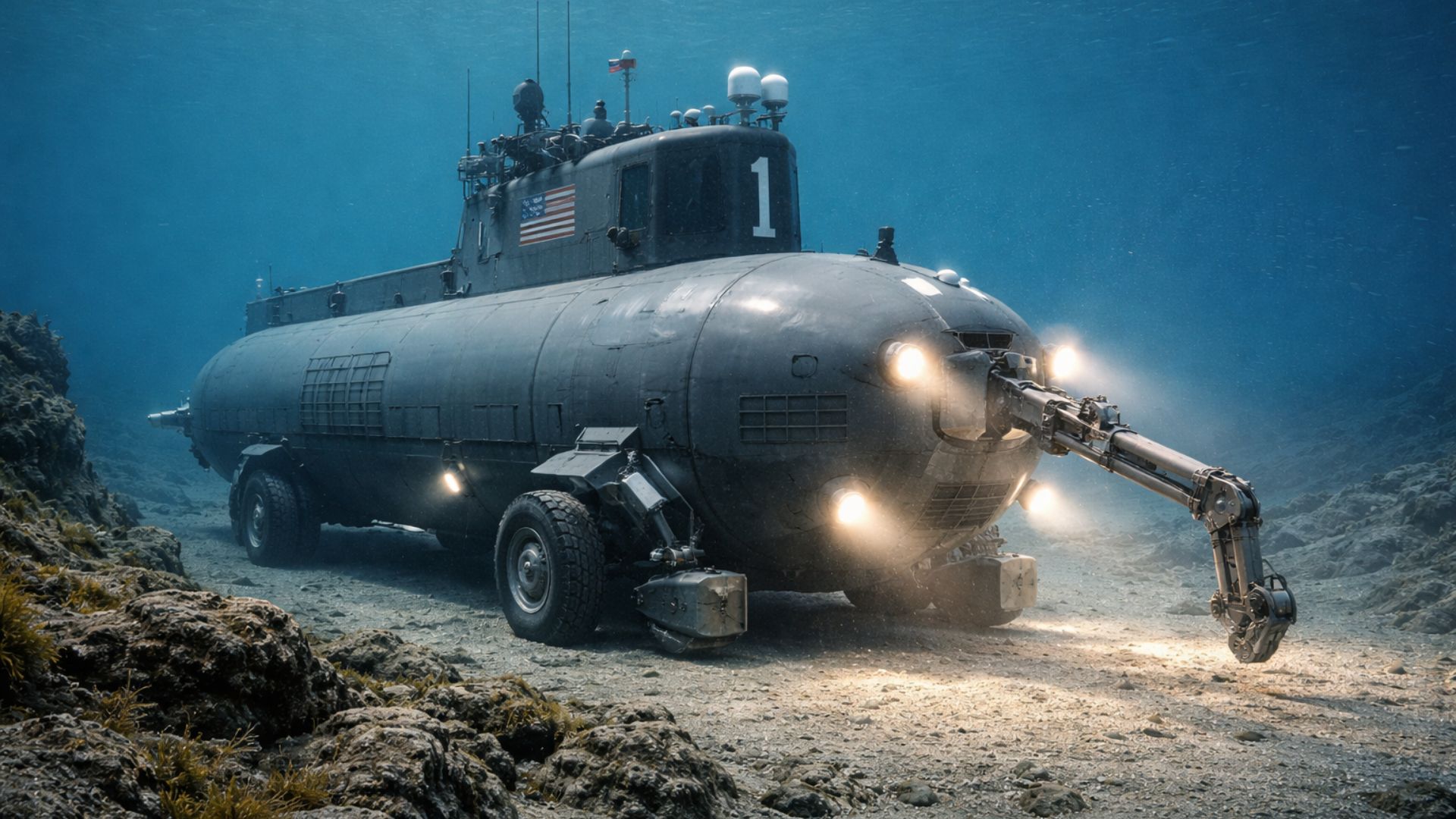
Rare project combined nuclear propulsion, retractable wheels, and direct operation on the ocean floor, allowing long, precise, and discreet missions at great depths with a compact and highly specialized structure, unlike any other submersible ever placed in service by the United States Navy.
Few naval projects combined as many unusual solutions as the NR-1, a vessel operated by the United States Navy that united nuclear propulsion, deep diving, and the ability to work practically glued to the underwater terrain.
Compact by military standards, it was employed in missions of search, recovery, oceanographic research, geological surveys, and installation or maintenance of equipment on the seabed.
Unique nuclear submersible in naval history
The uniqueness of the vehicle began with its very definition.
-
Millions of people eat oats without knowing that this simple cereal contains a fiber called beta-glucan, which studies have linked to lower bad cholesterol and smaller spikes in blood sugar.

-
Nestlé said it always encourages people to take a break with KitKat, but the thieves took the message too far by stealing 12 tons of chocolate from a truck that disappeared between Italy and Poland.

-
Neither in the refrigerator nor in a plastic bag: this is the correct way to store garlic.

-
While breaking the kitchen floor during a renovation, residents in England found 260 gold coins hidden for over 300 years, with pieces dated between 1610 and 1727 and an estimated value of hundreds of thousands of pounds.

The U.S. Naval Undersea Museum describes it as the first and only nuclear submersible of the U.S. Navy, while the historical documentation of the force records it as a research and ocean engineering platform with no direct equivalent in its category.
It was not, therefore, a miniature combat submarine, but a specialized piece for tasks that required permanence, precision, and continuous observation at great depth.
Retractable wheels allowed it to “walk” on the seabed
The feature that most differentiated it appeared below the waterline.

The hull featured two retractable rubber wheels, housed in wells in the keel, that could be lowered to maintain a fixed distance from the seabed and facilitate movement during delicate operations with manipulators and sensors.
In material reproduced in NASA’s JASON project, with content attributed to the Department of the Navy, this system is presented as a resource for working on the bottom with more stability, something rare even among specialized submersibles.
Robert Ballard, in an article published by the U.S. Naval Institute, noted that the NR-1 spent most of its time at sea on or very near the ocean floor.
This characteristic helped explain why the vessel could inspect sensitive areas, navigate around obstacles, and perform meticulous tasks in regions where larger, faster, or less maneuverable platforms had clear operational limitations.
Compact dimensions and operation at great depths
The dimensions reinforced this out-of-standard condition.
According to the naval museum, the submersible was 145.8 feet long, equivalent to about 44.4 meters, with a diameter of 12.5 feet, approximately 3.8 meters, and a displacement of 366 long tons, or 410 short tons.
Its usual submerged speed was 3.5 knots, with a maximum of 5 knots, and the operational depth reached 3,000 feet, close to 914 meters.
To sustain prolonged missions, it also relied on support from the SSV Carolyn Chouest, used as a logistical and scientific platform.
Nuclear autonomy and austere routine on board

The autonomy came from the nuclear reactor, one of the central points of the project.
According to the U.S. Naval Undersea Museum, the crew of 11 submariners, all certified in nuclear propulsion, could remain submerged for up to 30 days, with the limit defined basically by food and air purification supplies.
This gave the NR-1 an unusual duration at depth for a research vehicle, allowing long operations even in remote areas and in more challenging sea windows.
On the other hand, life on board was far from comfortable.
The internal space was extremely cramped, with only four bunks in a rotating system, no shower, and minimal structure to heat meals, a condition cited in historical accounts about the vessel’s routine and consistent with the reduced diameter of the hull.
The configuration favored range, depth, and work capacity, not prolonged well-being for the crew, which helped consolidate the reputation of the NR-1 as a highly specialized and austere machine.
Advanced sensors and high operational precision
The onboard instrumentation also explained its relevance.
The set included side sonar, obstacle avoidance sonar at great depths, sub-bottom profiler, low-light cameras, three observation portholes, recovery claw, manipulator arm, and four ducted thrusters to increase maneuverability at low speed.
This combination allowed the submersible to map, observe, identify, and manipulate objects on the ocean floor with a level of control that, for the time, was particularly valuable in scientific and recovery operations.
Project origin and hybrid profile between science and defense
The origin of the program helps to understand this hybrid profile between military engineering and underwater exploration.
The project was conceived under the influence of Admiral Hyman G. Rickover, a central figure of the U.S. Navy’s nuclear era, and the overall configuration took advantage of references already used in ballistic submarines to reduce costs and accelerate development.
The result was a compact, silent, and deep platform, designed not for offensive patrol but to remain over a target, examine the terrain, and operate methodically in complex environments.
Real missions: rescues, archaeology, and ocean exploration

Throughout its career, the history of public missions consolidated this vocation.
The naval museum records the recovery of an F-14 fighter and a Phoenix missile lost in the Atlantic, the search for components of the Challenger space shuttle in 1986, the raising of the HMHS Britannic, the discovery of Roman shipwrecks in the Skerki bank, and the investigation of the remains of the battleship USS Monitor.
These were not just flashy operations: each required locating, documenting, or recovering materials at depth, often under difficult visibility and access conditions.
In the case of the USS Monitor, the Navy’s involvement also appears in NOAA records.
The agency reports that, after a 41-day operation in 2002, the ship’s turret was raised with support from the U.S. Navy, in one of the most well-known underwater archaeological works ever conducted in U.S. waters.
The NR-1’s participation in this type of mission shows how the vessel could serve both technical and military objectives as well as historical and scientific research with great public visibility.
The utility of the submersible also appeared in campaigns aimed at oceanography.
In 2007, in the area of the Flower Garden Banks in the Gulf of Mexico, NOAA recorded that the NR-1 was taken to the region by its support ship and began operating at depth to examine areas beyond the reach of conventional autonomous diving.
On another front, Ballard reported a campaign in southern Iceland where the vessel navigated volcanic peaks at about 3,000 feet, sailing very close to the rock without touching it, which illustrates the precision that made the vehicle so rare in service.
End of operation and preserved legacy
The operational trajectory ended on November 21, 2008, the date of its deactivation reported by naval documentation and historical records of the Navy.
Part of the control set was preserved by the U.S. Naval Undersea Museum, which received equipment from the vehicle in May 2018, keeping alive the memory of a vessel that brought together, in the same hull, a nuclear reactor, retractable wheels, advanced sensors, and real capacity to work as if the ocean floor were a maneuvering surface.





Seja o primeiro a reagir!