





 English
  Francês
  Alemão
  Italiano
  Japonês
  Norueguês
  Portuguese
  Spanish
  4 min of reading
  0 comments


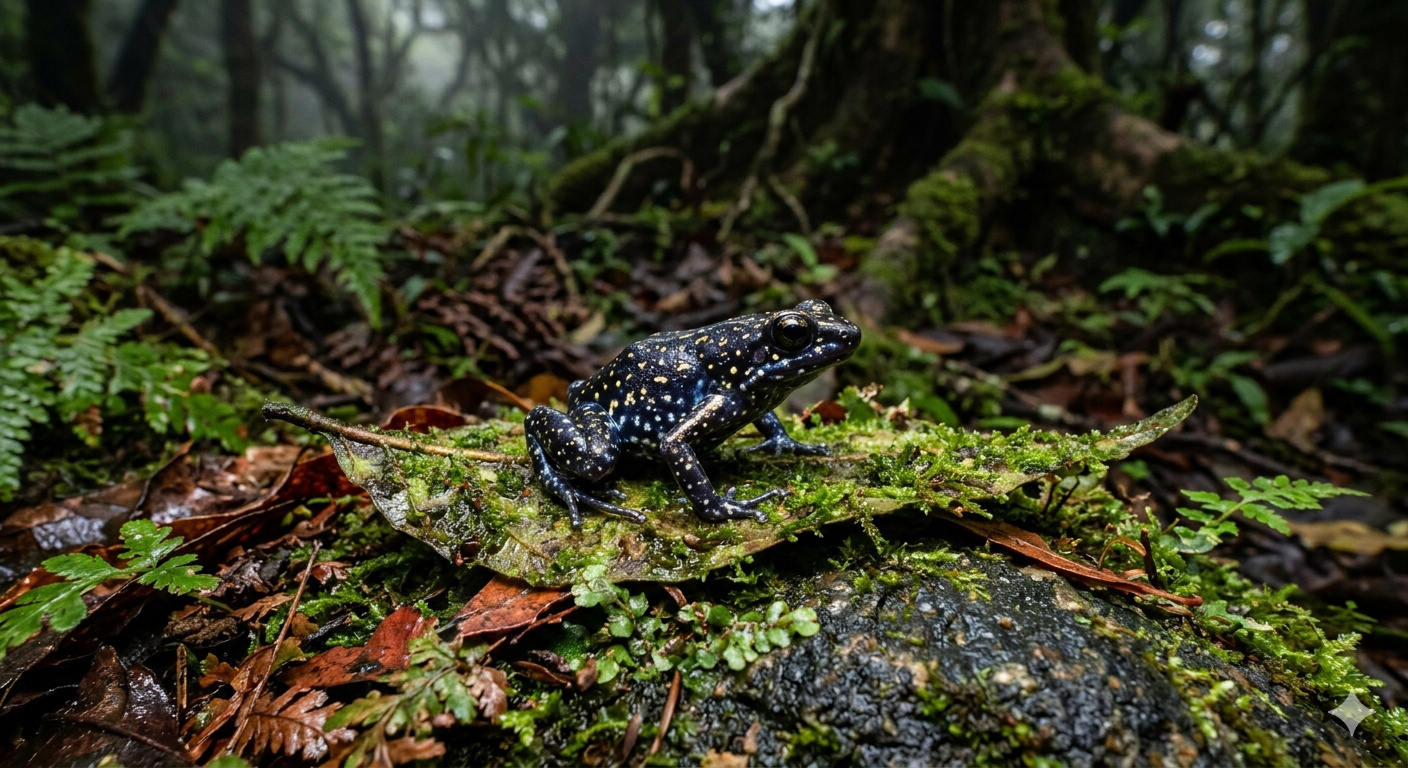
The Indian galaxy frog draws attention for its starred skin and extreme rarity in the forests of the Western Ghats, one of the richest ecosystems on the planet.
In 2024, rare images released by wildlife photographers and reported by international outlets brought attention back to one of the most unusual amphibians on the planet. The so-called “galaxy frog”, scientifically known as Melanobatrachus indicus, returned to the center of discussions following reports and analyses about its rarity and vulnerability, as highlighted by the Discover Wildlife portal, specialized in biodiversity and linked to the BBC group. The species, originally described in 1878, is endemic to the mountainous forests of the Western Ghats in southern India, a region considered one of the world’s main biodiversity hotspots.
Although not a recent discovery, the animal remained practically invisible to science and the public for decades, being rarely observed in its natural habitat. Its unusual appearance — with bright spots resembling a starry sky and its extremely restricted distribution have made the galaxy frog one of the most intriguing amphibians today.
What is the galaxy frog and why does it draw so much attention
The popular name “galaxy frog” is not official, but it accurately describes what makes this species so unique.
-
350-year mystery may have been solved: remains of a soldier who inspired the hero of The Three Musketeers found beneath a church in the Netherlands.

-
NASA photographed a nearly perfect square with 3 km sides on Mars, 13 times larger than the Great Pyramid of Giza, but the official explanation is natural erosion; still, no one has explained why the four sides have almost identical lengths.

-
Starlink breaks the barrier of 10,000 satellites in orbit and takes its expansion to an unprecedented level, with a direct impact on global internet, technological competition, and the race for space.

-
Japan finds an alternative to oil amid rising prices by transforming ocean balance into electricity with a new technology that maintains efficiency even when the sea changes.


The body of Melanobatrachus indicus is predominantly dark, almost black, covered by small bright bluish spots that resemble stars scattered across the night sky. This visual pattern is extremely rare among amphibians and is the main reason why the animal gained international notoriety.

The contrast between the dark background and the light spots creates a visual effect that seems artificial, but is entirely natural, resulting from evolutionary processes that are still not well understood.
A tiny amphibian that lives in one of the most isolated environments in India
The galaxy frog is a small animal, measuring about 2.5 to 3 centimeters in length. Its small size, combined with discreet habits, makes it extremely difficult to observe.
It inhabits specific regions of the Western Ghats mountains, characterized by:
- dense tropical forests
- high humidity
- high altitudes
- soils rich in organic matter
These environments are highly specialized, meaning the species depends on very specific conditions to survive.
Why is the galaxy frog considered rare
The rarity of Melanobatrachus indicus is not only in its appearance but mainly in its extremely limited geographic distribution. The species is considered:
- endemic (exists only in that region)
- rarely observed in the field
- difficult to study due to the closed habitat
Moreover, its activity is predominantly nocturnal and underground, which further reduces the chances of recording. Even in areas where it exists, it is possible to go years without seeing a single individual.
Western Ghats: the cradle of one of the greatest biodiversities on the planet
The habitat of the galaxy frog, the Western Ghats, is a mountain range that extends over 1,600 kilometers along the western coast of India.

The region is recognized for:
- hosting thousands of endemic species
- having high biological diversity
- being considered a world heritage site by UNESCO
This environment functions as a true natural laboratory of evolution, where unique species emerge and remain isolated for long periods.
The silent threat: why the species is at risk
Despite living in a relatively preserved region, the galaxy frog faces increasing threats. Among the main risks are:
- deforestation
- agricultural expansion
- habitat fragmentation
- climate change
The species is classified as vulnerable, which means it could be at risk of extinction if these pressures continue. The loss of habitat is especially critical for species with such restricted distribution, as is the case with this amphibian.
A visual pattern that intrigues scientists
In addition to its rarity, the color pattern of the galaxy frog still raises scientific questions. Researchers are investigating possible functions for this appearance, such as:
- camouflage in dark environments
- signaling to predators
- communication between individuals
However, there is no definitive consensus on the exact function of these spots, which further increases scientific interest in the species.
Why the galaxy frog became a viral phenomenon
In recent years, the galaxy frog has gained global prominence after high-quality images circulated on the internet and in scientific outreach outlets.
The reason is simple: its appearance completely deviates from what is expected of a common amphibian.
In a scenario where biodiversity often goes unnoticed, visually striking species like this manage to capture immediate attention and generate public interest.
A reminder of how little we still know about life on Earth
The case of the galaxy frog shows that, even on a widely explored planet, there are still little-known species living in specific and often threatened environments.
It represents not only a biological curiosity but a symbol of the complexity and fragility of natural ecosystems.
As new technologies expand knowledge about space and oceans, the discovery and study of species like Melanobatrachus indicus remind us that there is still much to be understood here on Earth, especially in regions where biodiversity remains silent.







Seja o primeiro a reagir!