





 Portuguese
  English
  Spanish
  7 min of reading
  2 comments


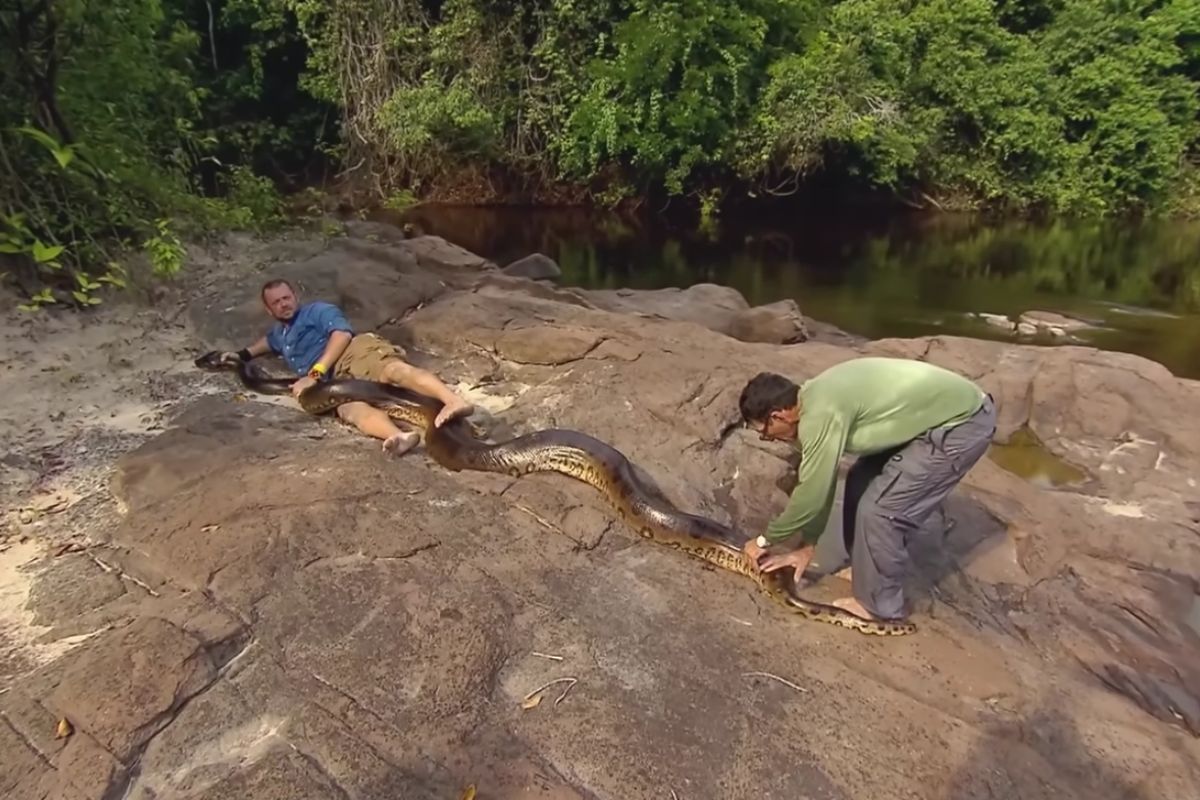


Black snake, with a thick body and meters in length, appears in freshwater reports as an ambush predator capable of lifting its head to the height of a person and using constriction against large prey; experiences in the crystal-clear river show why encounters require distance, behavior, and respect in practice.
In 2006, a field record by Richard Rasmussen in the crystal-clear river described the approach of a black snake in freshwater, paused after feeding, in an encounter that required caution to avoid stress and retreat from the animal.
In 2012, new footage captured in the crystal-clear river reinforced the pattern: when the black snake is visible in the surface water, the decisive factor is not courage, but rather reading behavior, distance, and understanding constriction as hunting strategy.
What Makes the Black Snake a Critical Encounter in Freshwater

Freshwater reduces the predictability of contact.
-
China is building a city in Brazil: a complex with an investment of R$ 5.5 billion comes to light, but allegations involving workers draw attention.

-
While Argentina buys old war equipment, Brazil is keeping an eye open and joins the select group of nations with advanced military technology by investing $5.2 billion, producing 36 Gripen fighters in the country, and reducing operational costs.

-
Brazil on alert? Why invading Brazil is a NIGHTMARE for the USA: 8.5 million km², 213 million inhabitants, Amazon covering 60% of the territory, trillion-dollar war, and resistance that even 13,000 aircraft could not control.
-
How to build a floating island from scratch with reeds, giant blocks, and stakes in the lake in a process that needs to be repeated almost every day.

Visibility changes with currents, reflections, and bottom colors, which alters the real distance between a person and the animal.
In practice, the risk is not in “attack,” but in the error of approaching quietly when the black snake is motionless and confused with a trunk or shadow.
The thick body mentioned in the basis has objective implications. A thick body means greater mass and greater short-range movement capability in water, even without wide movements.
In freshwater environments, the black snake can keep part of its body submerged and lift its head to assess its surroundings, behavior compatible with ambush.
The basis also mentions “one of the most frightening encounters.”
What sustains this perception is the sum of surprise, freshwater as a means of silent approach, and the idea of constriction applied to large prey, even when a person is not the target.
Constriction: The Mechanism Behind the Force Attributed to the Black Snake
Constriction, in the described context, is the immobilization technique by compressing the body around the prey.
The basis does not deal with numbers, but points out a principle: the black snake has sufficient constriction strength to dominate large prey.
In the field report, constriction appears linked to the ambush strategy and post-feeding time.
There is a practical explanation: after ingesting prey, the snake rests, “floating,” and can regurgitate if disturbed, wasting energy. This guides safety conduct: avoid touching, pushing, and stirring the water.
When speaking of constriction, the central variable is space.
In narrow margins or shallow stretches, a person can reduce the escape route and increase the chance of involuntary contact. In open areas, distance is the most efficient control.
Meters of Length and Thick Body: What Is Said About Size

The basis points out “several meters” and “thick body” as indicators of size.
The complementary report brings field examples that help quantify what “giant” means in the language of those who work with the animal: there is mention of snakes that can exceed 100 kg and even 150 kg.
The same report mentions, as a scale reference, that an animal “with 9 meters” can have great thickness, used to explain why the snake impresses more by mass than by length.
A common scenario appears after feeding: the middle of the body has evident volume, suggesting a whole swallowed prey, and the animal remains still for digestion.
This detail explains why the encounter in freshwater can be misleading: the animal seems “inert,” but is in a resting phase and can react to stimuli.
For the black snake, these points are relevant because they reinforce the contrast between what a person sees and what the animal can do. “Several meters” is not just length, but also operational range in water.
Large Prey and the Logic of Ambush in Freshwater
The basis states that the black snake can dominate large prey.
The field report complements with an explanation about a broad diet, described as a predator that “eats everything,” and with compatible examples from freshwater environments, such as the hypothesis of capybara in one of the encounters.
The ambush is the element that connects large prey to the perceived risk.
In freshwater, the animal can remain partially submerged, waiting for the approach of prey and using constriction upon contact.
The technical point is that the ambush reduces previous signals and shortens the reaction time of those approaching out of curiosity.
Therefore, speaking of large prey is not an invitation to unfounded fear.
It is a way to understand that behavior is aimed at efficiency, not spectacle.
Common Myths and What the Report Disproves About Feeding
The report brings a direct correction of a recurring myth: “the black snake does not swallow a cow,” although it can ingest large prey within certain limits.
This type of myth tends to grow in freshwater environments with low visibility, where surprise turns into exaggeration.
By separating myth from observation, the topic “black snake” shifts from folklore back to the field, where real risk and behavior are measured.
Crystal-Clear River as a Reference Scenario for Documented Encounters
The crystal-clear river appears in the material as the location of two significant events.
In 2006, the narrator describes the encounter with the largest specimen he has ever seen, at a moment of return, when he was called to observe the snake paused after feeding.
In 2012, the report describes recording with a team and guide, an attempt to measure the animal and its release back into the crystal-clear river, handled without biting.
These episodes help to take the theme away from exaggeration and place it in method.
The crystal-clear river, being mentioned as an observation area, becomes a reference for two ideas: the importance of not stressing the black snake and the need to read behavior in freshwater.
Even when the report does not use the term “black snake” for each individual, the described pattern is compatible with what the basis requests: large size, freshwater, constriction, and the potential to dominate large prey.
Where It Appears in Brazil, According to the Material Used
The report states that the snake occurs in the Amazon and also in the Pantanal, the Cerrado, and other biomes, with mentions of records in Mato Grosso and even in the interior of São Paulo, and emphasizes that it does not occur in the extreme south.
This occurrence map helps to understand why freshwater is the central stage. Rivers, flooded areas, puddles, and vegetated margins create the setting for ambush and silent movement.
When there is freshwater and available prey, there is a chance of encounter, especially in less frequented stretches.
Observation Safety: Distance, Silence, and Absence of Provocation
The basis does not prescribe rules, but the field report offers three operational principles that can be transformed into safe conduct when seeing a black snake in freshwater:
Maintain distance and avoid circling the escape route, especially in narrow margins.
Do not touch and do not poke with objects, as the animal may be in digestion and react out of stress.
Reduce noise and sudden movements in freshwater to avoid turning curiosity into involuntary contact.
There is also an indirect warning: when someone enters the water without seeing the animal and accidentally approaches its head, the risk increases.
The report describes falling into the water and approaching the head, followed by precautions to avoid stressing the snake.
The goal is simple: observe without interfering. This reduces risks for people and avoids harm to the animal.
Why the Black Snake Becomes a Symbol of Fear, and How to Avoid Exaggerations
The black snake concentrates elements that feed fear narratives: size, freshwater as a means of surprise, thick body, and constriction associated with large prey.
These factors, combined, produce the “frightening encounter” described in the basis.
At the same time, the report reinforces that much of the risk is in inadequate approaches.
When the observer maintains distance, avoids manipulation, and reads stress signals, the encounter can be documented without escalation.
The journalistic and technical path is to treat the topic as an interaction in a natural environment. The black snake is not a character; it is an animal with strategy. And its strategy, in the basis, is freshwater, ambush, and constriction.
The basis describes the black snake as a giant of freshwater with a thick body, meters in length, and constriction capable of dominating large prey.
The reports in the crystal-clear river, in 2006 and 2012, reinforce that encounters occur, but require method: distance, calm, and zero provocation.
If you frequent rivers and flooded areas, the most useful attitude is to document from afar, avoid entering the water without visibility, and inform local authorities when there is a concentration of people in the same spot, reducing risk and stress for the fauna.
Have you ever seen a black snake up close in freshwater and thought that the distance was safe?






Aqui onde moro tem um monte delas,distrito de itacare, taboquinhas.
Nossa, é muita coragem e paixão mesmo!