





 Portuguese
  English
  Spanish
  4 min of reading
  0 comments


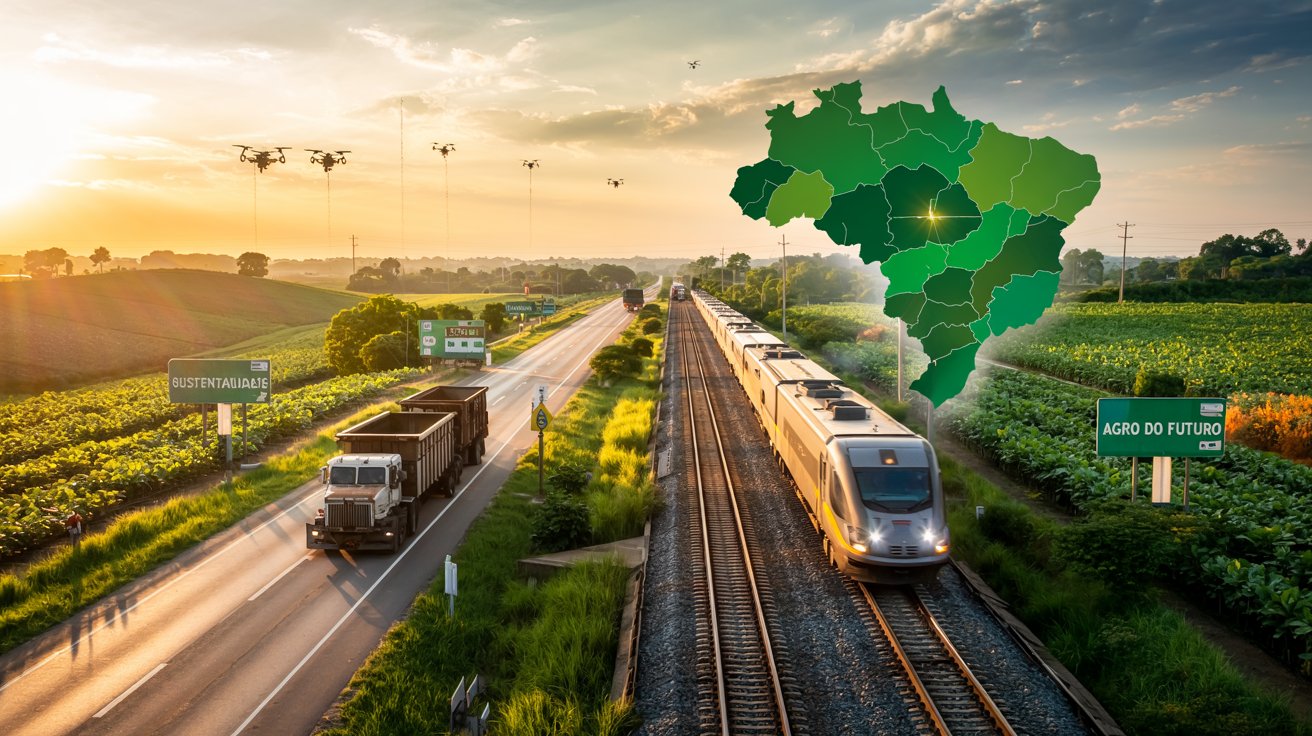
With a Billion-Dollar Railway Cutting Through the Heart of Brazilian Agriculture, Rumo Changes the Logistics Game and Turns BR-163 into a Secondary Piece, Promising a New Future for Grain Transport in the Midwest.
A new railway line of 740 kilometers between Rondonópolis and Lucas do Rio Verde, in Mato Grosso, promises to revolutionize grain transport in Brazil and alleviate the historical overload of BR-163.
The project is led by Rumo Logística, the largest independent railway operator in the country, and involves a robust investment estimated at R$ 6.5 billion.
The project has the potential to increase agricultural production in Mato Grosso by up to 60% without causing deforestation, by converting pasture areas into croplands.
-
From sertanejo star to international investor: Ana Castela invests millions in a mansion in the USA, creates a themed accommodation in Orlando, and shows that the “boiadeira” also wants to grow away from the stage.

-
The 10 most stunning motorhomes in the world: a $3 million trailer with a rooftop nightclub and garage for a Ferrari, “palaces on wheels” with Italian marble, private cinema, and five-star hotel luxury for billionaires.

-
Trump wanted to spend $400 million on the White House, but the courts prohibited the million-dollar construction.

-
How the Egyptians erected giant structures like pyramids, temples, and obelisks without modern technology, cranes, or engines still amazes the world and reveals the power of engineering based on ramps, levers, ropes, and colossal organization.

Additionally, the railway is expected to drastically reduce dependence on the road modal, which is considered inefficient and more environmentally polluting.
Sustainable Railway Expected to Partially Begin Operations in 2026
According to Rumo, the initial section of the railway will be inaugurated in 2026, with the activation of the terminal in Dom Aquino (MT), which will have the capacity to move up to 10 million tons annually.
The forecast for total project completion is between 2028 and 2029, when the new railway corridor will be fully operational.
The initiative is seen as a game-changer for the logistics of the national agribusiness, connecting the country’s main grain-producing hub to the Port of Santos (SP), without the need for truck transport along the entire BR-163, which often faces congestion and poor conditions along its stretches.
Socioeconomic Impact and Job Creation
In addition to gains in logistical efficiency, the new railway is expected to generate more than 160,000 jobs during the construction phase.
In the first nine years of operation, the expectation is that the project will transport up to 120 million tons of grains and 20 million tons of industrial products.
The railway network will cross 16 municipalities in Mato Grosso and will include a branch to Cuiabá, integrating regions that have previously been poorly connected to the national railway system.
The initial section between Primavera do Leste, Tomaquino, and Campo Verde — approximately 160 km — will be the first to go into operation.
Capacity and Financial Projections of Rumo
By 2025, Rumo projects transporting between 82 and 86 billion TKUs (tons per kilometer unit), representing a growth of more than 2% compared to the previous year.
The estimated EBITDA for the period is up to R$ 8.7 billion — surpassing the R$ 7.7 billion recorded in 2024.
This growth is directly linked to advancements in railway infrastructure and the expansion of logistics terminals, such as the Private Use Terminal (TUP) at the Port of Santos, which is also being expanded.
Parallel Investments at the Port of Santos Strengthen the Chain
Rumo is also investing in modernizing the TUP operated by DPW at the Port of Santos, in partnership with the American cooperative CHS.
The expansion plan includes the construction of two new berths, along with an increase in the capacity for loading 10 million tons of grains and 3 million tons of fertilizers.
With the duplication of the Paulista Network, the main railway connection from the interior of São Paulo to the Port of Santos, the expectation is that transport capacity will reach 80 million tons by 2028, exceeding the current 55 million.
Reduction of Emissions and Obstacles in Green Financing
In addition to improving logistics, the new railway represents a significantly more sustainable alternative.
According to the company, carbon emissions from the railway modal are up to 8 times lower than those from road transport.
However, one of the main obstacles faced by Rumo is the scarcity of green financing, such as resources from the Climate Fund.
According to Rumo’s Vice President of Institutional Relations, Natália Marcassa, 70% of BNDES resources are still allocated to road projects, which hinders the advancement of cleaner and more efficient solutions.
She reinforces that, despite the challenges, the company remains focused: “Railway only pays off with scale and heavy cargo. And that’s exactly what the Midwest agriculture offers,” she stated in an interview with the videocast Exame Infra.
Rumo Reinforces Its Role as a Protagonist in the New Era of Brazilian Agriculture
With this ambitious project, Rumo consolidates itself as one of the main drivers of logistical transformation in Brazil, not only optimizing grain transport but also boosting the regional economy, promoting rational land use, and contributing to the construction of a more efficient, competitive, and sustainable agribusiness.
The initiative may also pave the way for future railway concessions and private investments in infrastructure, something increasingly urgent given the limitations of the predominant road model in the country.
The investment in railways represents a strategic shift towards modernizing the national logistics matrix, with economic, social, and environmental gains.
Do you believe Brazil should invest more in railways as a sustainable solution for the logistical bottlenecks of agribusiness? Share your opinion in the comments!







Seja o primeiro a reagir!