





 Portuguese
  English
  Spanish
  5 min of reading
  0 comments


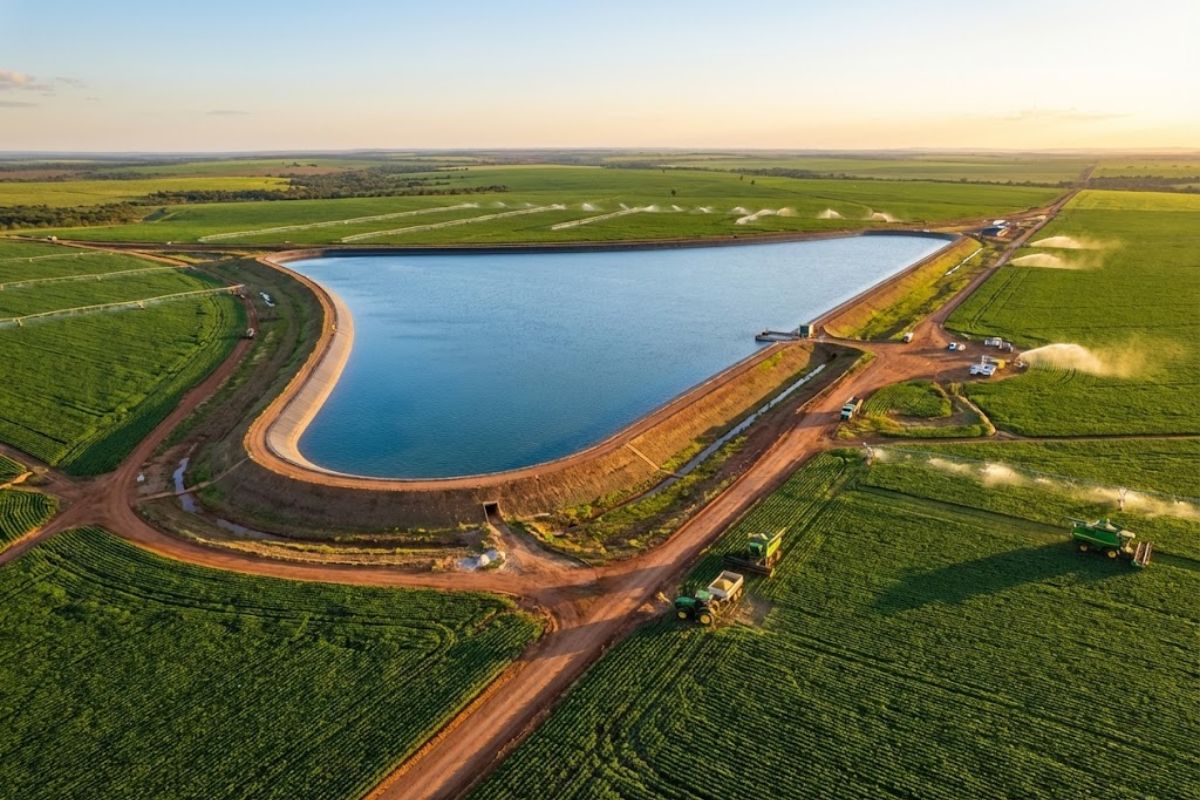
Recently Completed In Uruçuí, The Mega Reservoir Of 1,000,000 M³ Promises To Reduce Losses Due To Infiltration With Geomembrane And Provide Predictability To Large-Scale Irrigation. The Structure Strengthens The Water Security Of The Property, Supports Multiple Annual Harvests And Evidences The Speed Of Agriculture In The Piauiense Savannah Today
The Mega Reservoir completed in Uruçuí, Piauí, comes with a direct proposal: to store 1 billion liters of water within a private property to keep irrigation functioning predictably. In a region where the agricultural calendar often dialogues with the irregularity of rains, storage becomes a strategic piece to sustain production at scale.
In practice, the reservoir fits as an infrastructure of water security for the farm, paving the way for multiple harvests throughout the year. At the same time, the work highlights a movement that has been gaining strength in the savannah: increasing investments in private water solutions to enhance productivity and reduce operational risks.
What Was Built And Why This Changes The Farm Logic

The Mega Reservoir was implemented in the municipality of Uruçuí, in a private rural area, explicitly aimed at large-scale agricultural irrigation. This is not a public dam, but rather a structure focused on the internal operation of the farm: storing water, releasing it according to demand, and reducing dependence on climate fluctuations.
-
The sugar-energy sector advances with agricultural technology, but agricultural productivity still raises concerns.

-
The eggshell that almost everyone throws away is made up of about 95% calcium carbonate and can help enrich the soil when crushed, slowly releasing nutrients and being reused in home gardens and vegetable patches.

-
This farm in the United States does not use sunlight, does not use soil, and produces 500 times more food per square meter than traditional agriculture: the secret lies in 42,000 LEDs, hydroponics, and a system that recycles even the heat from the lamps.

-
The water that almost everyone throws away after cooking potatoes carries nutrients released during the preparation and can be reused to help in the development of plants when used correctly at the base of gardens and pots, at no additional cost and without changing the routine.

When a property begins operating with a large volume of stored water, irrigation stops being merely a technique and becomes a system. This tends to affect planting decisions, harvesting scheduling, and input planning, because water begins to be managed as stock, not just as an external variable that “helps” when the weather cooperates.
Capacity And Scale: What Does “1 Billion Liters” Mean In The Field

The stated capacity for the Mega Reservoir is 1,000,000 m³, equivalent to 1 billion liters. Operationally, this volume serves as a safety cushion: storing to navigate critical periods and maintaining a level of irrigation compatible with intensive production.
The sizing associated with the project has also been described as sufficient to support an irrigated area of approximately 1,000 hectares, with the possibility of intensifying production cycles to the point of enabling up to five harvests in two years. This type of figure, when associated with a reservoir of this size, indicates the ambition of the model: to produce at the pace of industry, but in the rural environment.
Waterproofing With PEHD Geomembrane: Why This Layer Determines The Result

A reservoir of this size cannot be sustained solely by excavation and containment: it relies on controlling losses. Therefore, the project was associated with the use of geomembranes for waterproofing, coated with PEHD (high-density polyethylene). The logic is simple and decisive: if water infiltrates, the reservoir becomes an “invisible drain” to the soil.
PEHD is cited as the barrier that reduces infiltration and preserves useful volume, allowing the irrigation system to operate with greater predictability.
A maintenance routine was also described, based on periodic visual inspections and repairs with thermoplastic welding, a crucial point because micro-damages result in accumulated loss over time in large structures.
For durability, a lifespan range of 20 to 50 years was mentioned, depending on conditions and material management.
Where The Water Comes From And How It Is Moved To The Reservoir

In addition to storing, the Mega Reservoir relies on a stable “source” of water to be supplied. In the described operation, subterranean capture appears with mention to the Urucuia Aquifer and the use of two deep wells cited at around 350 to 500 meters.
When the source is subterranean, the debate shifts from merely storage to include control, granting, and monitoring use.
A total flow of 800,000 liters per hour was also associated with the system, a number that helps to understand the dynamics of filling and replacing volume according to irrigation demand. For pumping, the use of solar energy was mentioned, indicating an arrangement where energy cost and operational continuity enter the same planning: capture, pump, store, and distribute.
Companies Linked To The Project And What Usually Weighs On Licenses
Being a project on private property, public detailing tends to appear more through technical communications than through widely released notices or reports.
Still, the names associated with the execution and central inputs include the Nortène Group, the company that provided the geomembranes. In projects of this type, “who did it” matters because it indicates the standard of design, assembly, and quality control.
On the regulatory front, it was noted that projects of this size require environmental licensing and water resource usage rights, with mention to SEMARH-PI (Secretariat for the Environment and Water Resources) as the responsible agency at the state level.
The possibility of federal guidelines involving ANA (National Water Agency) was also mentioned when the discussion touches on the Urucuia Aquifer, in addition to the need for a hydrogeological study and processing in a digital system (SIGA). Authorization in this scenario is no mere detail: it defines limits on capture, conditions, and monitoring obligations.
Impact On The Piauiense Savannah And The Contrast With Large Public Dams
The central argument of the Mega Reservoir is production: continuous irrigation, more harvests, and operational stability. This type of infrastructure often resonates in a chain because it demands labor, mobilizes suppliers, and tends to increase productive intensity.
This is where mentions of job and income generation enter, along with the increase in food production in the Piauiense savannah, a region frequently regarded as the agricultural frontier of the state.
At the same time, the contrast with public dams helps to place scale and purpose in the right context. The Salinas Dam was cited, with a capacity exceeding 380 million m³ (380 billion liters), aimed at supply and river perennialization, a logic distinct from that of the private reservoir, focused on agricultural productivity within one property.
The difference is not just in size: it is in social function and water governance, and that is precisely where the topic often generates discussion.
The Mega Reservoir of 1 billion liters in Uruçuí synthesizes a visible change in the savannah: water ceases to be merely “a condition” and becomes planned infrastructure, with engineering, high-durability coating, and an operational model aimed at multiple harvests.
For some, it is a portrait of efficiency and water security; for others, it is a signal of how the dispute for predictability can accelerate private investments and further pressure the need for clear rules.
In your region, has irrigation already changed the way of planting and harvesting, or is it still something distant? And when you see a Mega Reservoir of this size, does it feel like an inevitable advance of agribusiness, or that water management needs to be discussed with more transparency to balance production, environment, and community?










-

-

-

-

6 pessoas reagiram a isso.