





 Portuguese
  English
  Spanish
  4 min of reading
  0 comments


Construction Of Mega Structure With 463 Platforms On The Roof Of The University, 28 Meters High, Creates Open Arena For 9 Thousand Spectators In Extreme Heat Region And Puts Indian Engineering In The Spotlight Global Attention
Climbing on the roof of a building and finding an auditorium capable of accommodating 9 thousand people seems absurd. It’s not a park. It’s not a stadium. It’s a university. In the city of Indore, in central India, a five-story building decided to ignore the traditional pattern of academic constructions and bet on something that few would have the courage to execute.
The result is a structure that draws attention not only for its size but for the strategy behind it.
The Challenge Of Building A Roof Of 97 Thousand Square Meters In One Of The Hottest Climates In India
Indore faces temperatures ranging between 30 and 40 degrees for much of the year. In such scenarios, any design error means higher energy costs and more pressure on cooling systems.
-
The section of Serra da Rocinha on BR-285 is now open in Timbé do Sul: 50 m tensioned curtains and top-down technique stabilize the slope, with a stairway duct controlling the water.

-
Scientists use sawdust mixed with clay to create a lighter brick, promising efficient thermal insulation and impressing by transforming waste into a solution for construction.

-
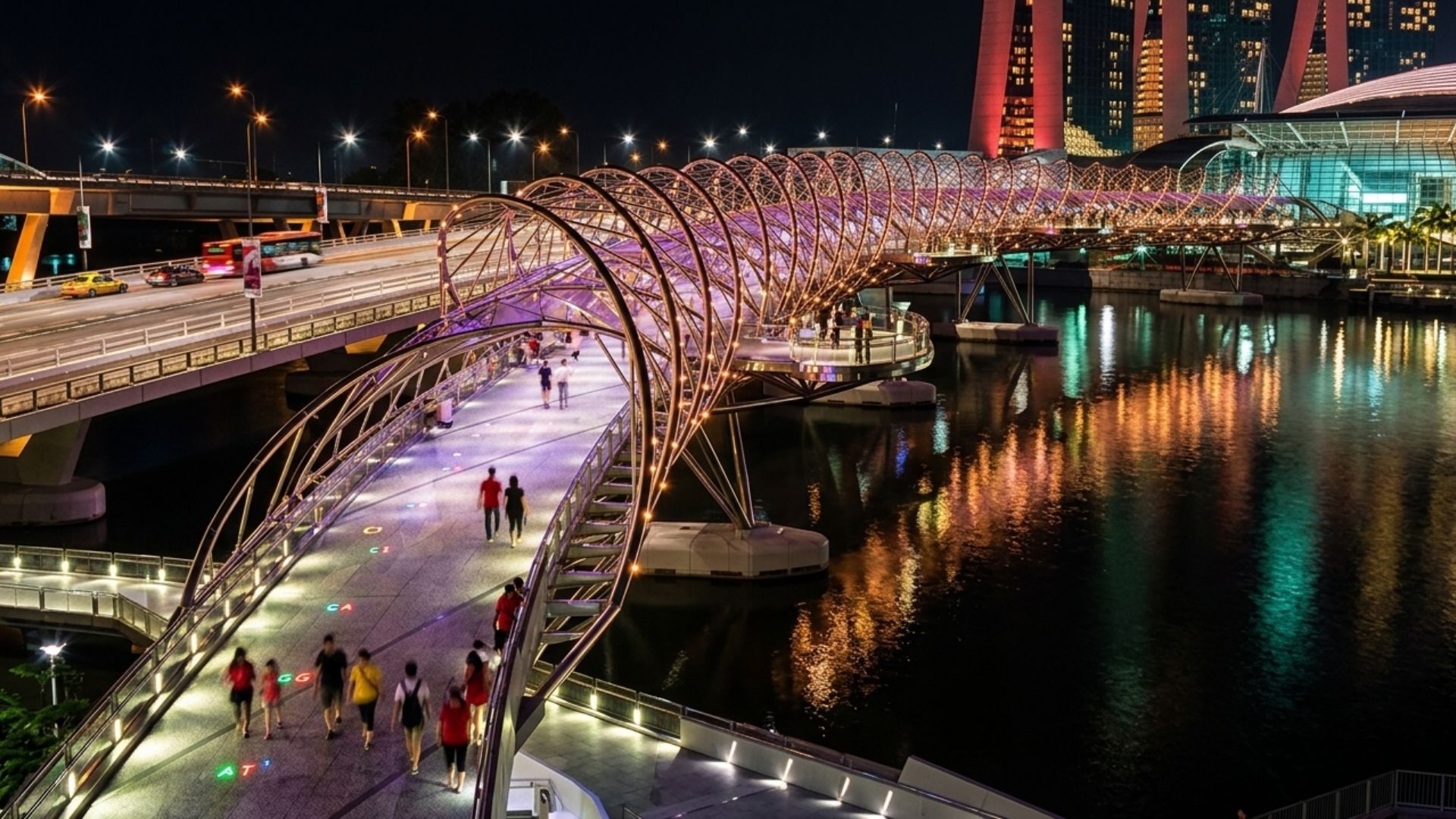
With a DNA shape, this bridge in Singapore draws attention in modern architecture and surprises tourists by transforming a simple crossing into an unforgettable visual experience in the urban heart.
-
Giant underwater pipeline begins to take shape with a R$ 134.7 million project at the Port of Santos: the 1.7 km structure uses 12-meter and 700 mm pipes to supply water to 450,000 people in Guarujá.

It was in this environment that the proposal from Prestige University emerged. The main building is about 28 meters high, but what really impresses is what’s above it.
The roof has approximately 97 thousand square meters of terraced area. To visualize this dimension, think of a surface capable of accommodating thousands of people sitting outdoors at different levels, like a large grandstand carved in concrete.
It’s not about aesthetics. It’s engineering designed to face the heat.
The Secret Behind The 463 Platforms That Transformed An Ordinary Roof Into An Open Arena
The top of the building consists of 463 stepped platforms, which function as gathering spaces and, when necessary, as an outdoor auditorium.
This design didn’t come by chance. The project was inspired by ancient Indian reservoirs, historical structures with stair corridors that allowed access to water even in dry periods.
These reservoirs were also social meeting points and sites for religious ceremonies. The university revived this logic and adapted it to modern reality.
Today, the space has already been used for lectures, games, and even the flag-hoisting ceremony on India’s Independence Day.
It’s not just a roof. It’s a multifunctional infrastructure integrated with the building.
Smart Thermal Engineering Reduces Dependence On Mechanical Systems In Temperatures Up To 40 Degrees
In hot regions, buildings tend to turn into real greenhouses. Here, the terraced design helps reduce the vertical circulation of hot air within the structure.

In addition, the project includes internal courtyards with natural lighting and cross ventilation. There are also perforated panels on the east, west, and south facades to reduce heat gain.
Another detail that stands out is a layer of shallow water at the base of the building that helps with passive cooling of the interior.
These decisions reduce the need for artificial climate control and lower operational costs in the long term. In a global context of seeking energy efficiency, this matters.
A 32-Acre Campus For 3 Thousand Students And A Building That Is Already Competing Globally For Constructive Innovation
The campus occupies 32 acres and was designed for around 3 thousand students. On the ground floor, there are shared areas like a cafeteria for 700 people and an internal auditorium.
The library occupies the first floor. Classrooms are distributed across the second and third floors. Administrative offices are located on the fourth.
The structure uses concrete, industrial ash bricks, and exposed brick cladding. Inside, exposed concrete and Indian stone reinforce the robust nature of the construction.
Public-use roofing projects are still rare on a large scale. In the international arena, few initiatives exploit the tops of buildings as the main gathering area.
This places the Indian university in a select group of projects that challenge the traditional model of urban occupation.
What This Mega Structure May Signal For The Future Of Sustainable Construction And Educational Engineering
Universities, industrial centers, and corporate complexes consume large amounts of energy. Projects that combine intelligent use of space with passive cooling solutions are likely to gain traction.

The proposal to transform the roof into an active area enhances land use without expanding the built base.
According to experts in sustainable architecture, initiatives like this could influence future projects in warm climate countries.
It’s not just about bold aesthetics. It’s fundamentally about rethinking how buildings function in extreme environments.
When a roof starts to accommodate thousands of people, the debate about intelligent urban space use reaches another level.
The structure impresses because it combines historical tradition, modern engineering, and climate strategy in a single work that has already entered the global radar of contemporary architecture.
Do you believe this model could be applied in Brazilian universities? Leave your opinion in the comments.










-

-

-

3 pessoas reagiram a isso.