





 Portuguese
  English
  Spanish
  6 min of reading
  0 comments


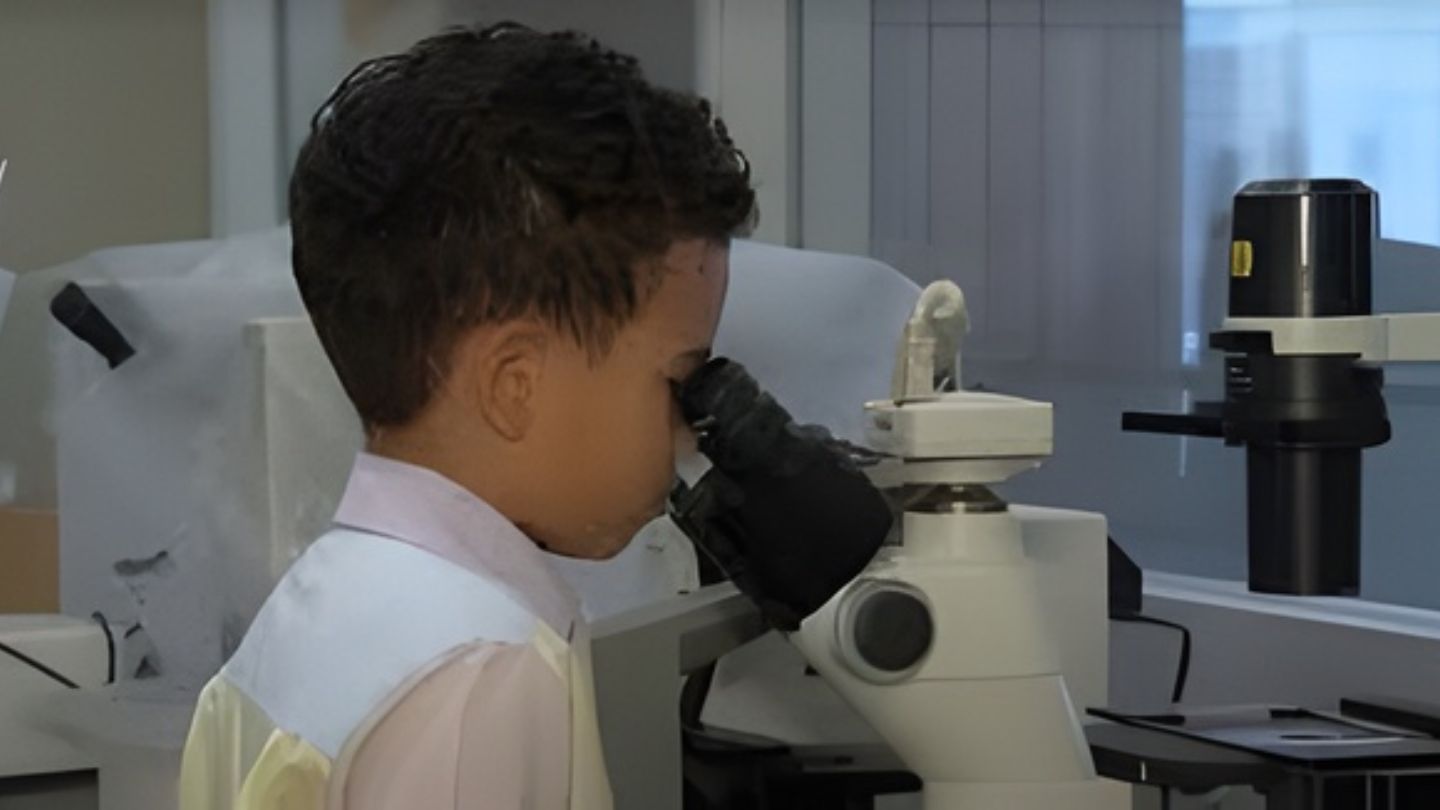
At 9 Years Old, Aiden Wilkins Started Attending Neuroscience Classes at a University in the United States While Still Studying in Regular School, Capturing the Attention of Teachers and Researchers.
The routine of university students is usually marked by complex classes, scientific research, and advanced subjects. However, in a classroom at Ursinus College in Pennsylvania, United States, one detail stands out: among students aged 18 to 20 is a student who is only 9 years old. The young Aiden Wilkins, considered an academic prodigy, began attending neuroscience classes at the institution while still pursuing his regular school education. The case caught the attention of the American press and educators because he became the youngest student in the university’s history to take academic courses.
The boy’s presence in university classes does not mean he has abandoned traditional school. In practice, Aiden divides his routine between studies at an online school and in-person classes at the university, where he participates in scientific discussions about how the human brain works.
The case shows how flexible educational systems can accommodate students with out-of-the-ordinary academic skills.
-
The Argentine government celebrates the lowest poverty rate in 7 years, but experts warn that the methodology has changed, real wages have fallen, unemployment has risen, and the number of people on the streets of Buenos Aires has increased by 57% since Milei took office.

-
7.8 magnitude earthquake in Indonesia frightens the population, triggers tsunami alert, and hits an island with over 200,000 inhabitants this Thursday.

-
Google will finally let you change that embarrassing Gmail address you created in your teenage years without losing any accounts, logins, or old emails: the feature is already available in the United States.

-
Heading to Brazil in a Bonanza F33 single-engine aircraft: a couple departs from Florida on a visual flight, makes technical stops in the Caribbean to refuel and organize paperwork, and begins the staged crossing until they reach the country.


Who Is Aiden Wilkins and How Did His Academic Journey Begin?
Aiden’s story began to attract attention very early within his own family. According to reports from his mother, Veronica Wilkins, the first signs of unusual intellectual ability appeared when he was only two years old.


At this stage, the boy was already demonstrating reading abilities far beyond what was expected for his age. He could identify words on signs and billboards, something uncommon for such young children. A few years later, educational tests administered to identify academic talents confirmed what the family had already suspected: Aiden displayed a gifted profile of giftedness.
With his rapid learning progress, he began studying in a flexible educational system that allowed him to accelerate school content. According to reports from the American press, by the age of 9, he was already taking classes equivalent to high school, while also participating in university lectures.
This educational advancement allowed him to seek academic challenges beyond the traditional school curriculum.
The Early Interest in Neuroscience
Among the various fields of knowledge, the one that sparked the boy’s curiosity the most was the science that studies the brain. According to interviews given to the press, Aiden began to take an interest in anatomy and neurology at a very young age.
He reported that he started watching videos about the human brain when he was about three years old. The complexity of the organ and its importance for the functioning of the human body ignited his scientific curiosity.
This interest ultimately directed his professional goal: the young boy states that he intends to become a pediatric neurosurgeon, a medical specialty dedicated to treating neurological diseases in children. According to the student himself, his motivation is to help children of the same age facing neurological problems.
How His Routine Works Between School and University
Despite attending university classes, Aiden has not completely abandoned regular education. He is enrolled in an online school called Reach Cyber Charter School, where he takes high school equivalent classes.
His study routine is divided as follows:
- part of the classes occurs online, as a regular student
- some days of the week are dedicated to university classes
- the rest of the time is used for studying and personal activities
According to university professors, the young student participates in classes alongside adult students, keeping up with advanced content on neuroscience. He studies complex topics such as neuroplasticity, glial cells, and the functioning of the nervous system.

Even with this unusual academic routine, the family claims that he still engages in typical activities for his age, such as playing video games and participating in sports.
The Reaction of University Professors
The presence of a student only nine years old in a university classroom naturally generated curiosity among professors and students. According to reports released by the university itself, faculty members were impressed by the boy’s level of curiosity and interest.
On one of his first visits to the campus, Aiden reportedly appeared wearing a suit and tie and initiated conversations with professors about advanced scientific topics. The university’s academic vice-president stated in a statement that the institution was pleased to participate in the young man’s educational journey.
Professors highlighted his intellectual curiosity and ability to comprehend complex concepts. For the university, the case represents an example of how students with exceptional abilities can benefit from advanced academic environments.
Giftedness and Educational Acceleration
Cases like Aiden’s are often associated with the phenomenon known as intellectual giftedness. Gifted students tend to exhibit characteristics such as:
- very fast learning
- strong intellectual curiosity
- early interest in complex topics
- ease in solving abstract problems
In some countries, educational systems allow for academic acceleration programs, which permit advanced students to take higher-grade content or even university courses. This type of strategy aims to prevent students with great intellectual capacity from becoming demotivated due to a lack of challenges.
Participation in university courses is one way to enhance the academic development of these students.
The Coexistence with Much Older Peers
One of the most curious aspects of the case is the age difference between Aiden and his classmates. While most university students are between 18 and 22 years old, he is still in childhood. Nevertheless, reports from professors indicate that the young boy is able to keep up with academic discussions.
He participates in classes and debates on complex scientific topics, demonstrating interest and learning abilities comparable to those of older students. This coexistence also brings social challenges, as the university environment is often geared towards adults.
Therefore, the family closely monitors the young boy’s educational and emotional development.
The Goal of Becoming a Pediatric Neurosurgeon
Although he is still in the early years of his academic formation, Aiden already has clear plans for the future. He states that he intends to study medicine and specialize in pediatric neurosurgery. This field involves treating diseases and conditions that affect the brain and nervous system of children, including tumors, malformations, and neurological injuries.
According to the student, his interest in the field arose upon realizing that many children suffer from neurological problems and need complex treatments. This professional goal is one of the factors motivating his interest in neuroscience.
Rare Cases, But Not Unique
Although it is uncommon, the case of children attending universities is not completely unprecedented. Throughout history, some gifted students have enrolled in university courses well before the traditional age.
These cases often attract attention because they challenge the traditional educational model, which is based on fixed age ranges for each level of education.
Education specialists assert that, in certain situations, academic acceleration can help students with exceptional talents better develop their abilities.
However, each case is usually assessed individually to ensure a balance between intellectual and social development.
An Example That Caught the Attention of the Academic Community
The story of Aiden Wilkins made headlines in the United States precisely because it combines uncommon elements: a child still in basic education participating in university classes on one of the most complex areas of modern science.

His journey illustrates how academic talent can arise very early and how educational institutions can adapt their models to keep pace with this development.
As he continues to advance in his studies, the young boy balances his school routine with university classes while exploring his passion for brain science.
The case has turned the nine-year-old student into one of the latest examples of prodigy children who challenge the traditional boundaries of education.









-

-

-

-

-

-

28 pessoas reagiram a isso.