





 Portuguese
  English
  Spanish
  2 min of reading
  2 comments


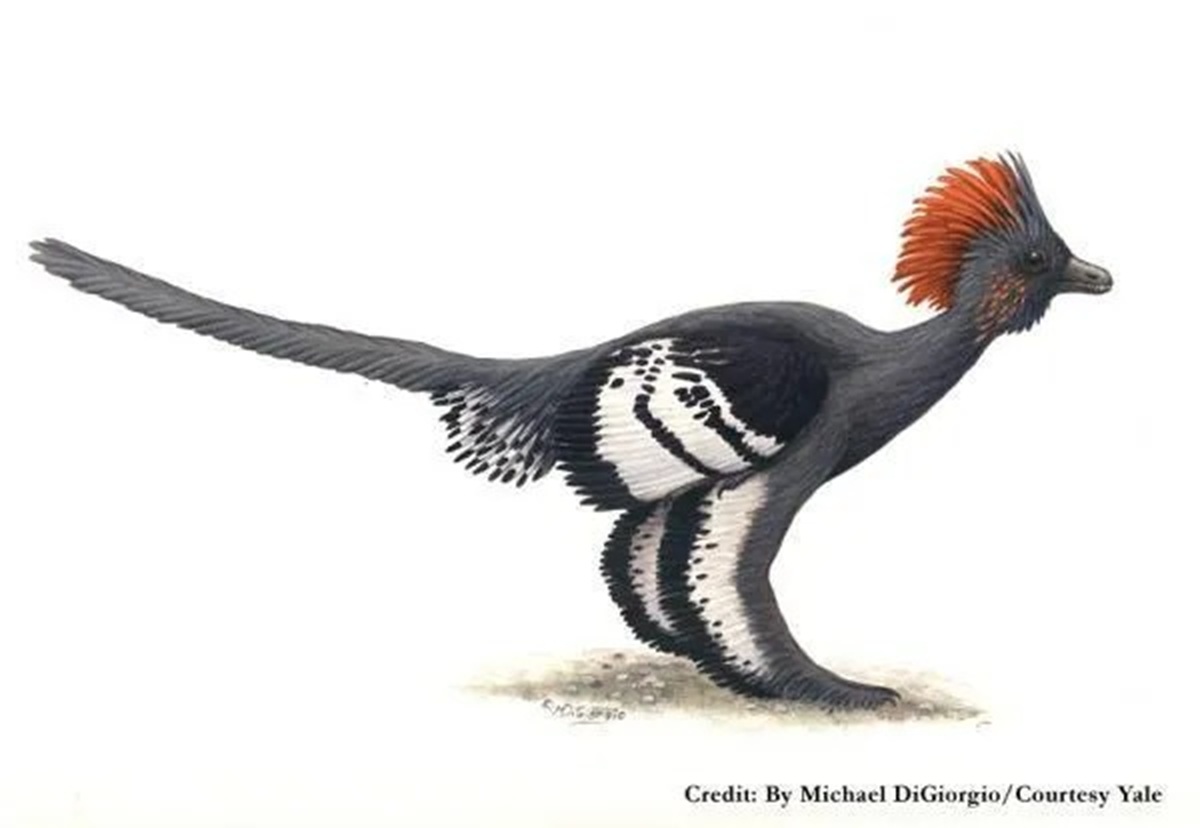


With about 30 centimeters in length, less than 110 grams, and preserved feathers, Anchiornis huxleyi is considered the smallest dinosaur ever identified, providing central evidence about miniaturization, the origin of flight, and the evolutionary transition to modern birds
The smallest dinosaur ever described by science is Anchiornis huxleyi, a species from the Late Jurassic found in China, about 30 cm long and weighing less than 110 g, relevant for clarifying the origin of flight and the transition between dinosaurs and birds.
The fossil record of Anchiornis huxleyi was described from dozens of exceptionally preserved specimens from the Tiaojishan Formation in northeastern China, dated to about 160 million years ago, a crucial period for the diversification of feathered theropods.
With dimensions similar to a modern sparrow, the animal had a lightweight body, long tail, slender limbs, and extensive feather coverage, including asymmetrical feathers on its arms and legs, forming four functional aerodynamic surfaces.
-
With a cost per shot close to zero, the DragonFire laser could change naval warfare in 2027 and provide British ships with nearly unlimited defense against drones.

-
A British startup creates tires that generate electricity in electric vehicles when passing over potholes, speed bumps, and cracks.

-
Scientists have created robots made with living cells that have their own nervous system, swim on their own, explore the environment, and self-organize without any genetic engineering, and now they want to do the same with human cells.

-
Students create a solar-powered ambulance that operates without a plug, without fuel, and still keeps medical equipment running in remote areas.



Morphological studies indicate that Anchiornis did not achieve sustained flight like modern birds, but was capable of gliding and executing short movements between trees, which reinforces gradual hypotheses about the evolution of avian flight.
Microscopic analysis of the feathers revealed complex color patterns, with light and dark bands, suggesting camouflage and visual communication functions, something uncommon for fossils so old, but possible due to the preservation of melanosomes.
Difference Between Anchiornis and Other Diminutive Dinosaurs
Species like Microraptor gui, although very small, were slightly larger and heavier, reaching about 70 cm in length, which positions Anchiornis as the smallest recognized non-avian dinosaur based on complete skeletons.
The classification as a dinosaur, rather than a primitive bird, stems from specific anatomical characteristics, such as well-developed teeth, pelvic structure, and bone proportions typical of theropods, despite its bird-like external appearance.
The finding had a direct impact on paleontology by demonstrating that extremely reduced body sizes arose before fully developed flight, contrary to models that associated miniaturization only with the earliest true birds.
Furthermore, Anchiornis contributed to calibrating evolutionary clocks, helping estimate when dinosaur lineages began to acquire complex feathers and partial aerodynamic capabilities.
The fossils remain a central reference in debates about the origin of birds, arboreal ecology in the Jurassic, and the physical limits of body size among dinosaurs, a topic currently under analysis using new imaging and dating techniques.







Creo que encontré una más pequeña en una piedra del tamaño de una nuez no se como ponerlo en foto para que lo aprecien
Una lectura muy interesante para temas de evolución en biología de bachillerato