






 Portuguese
  Spanish


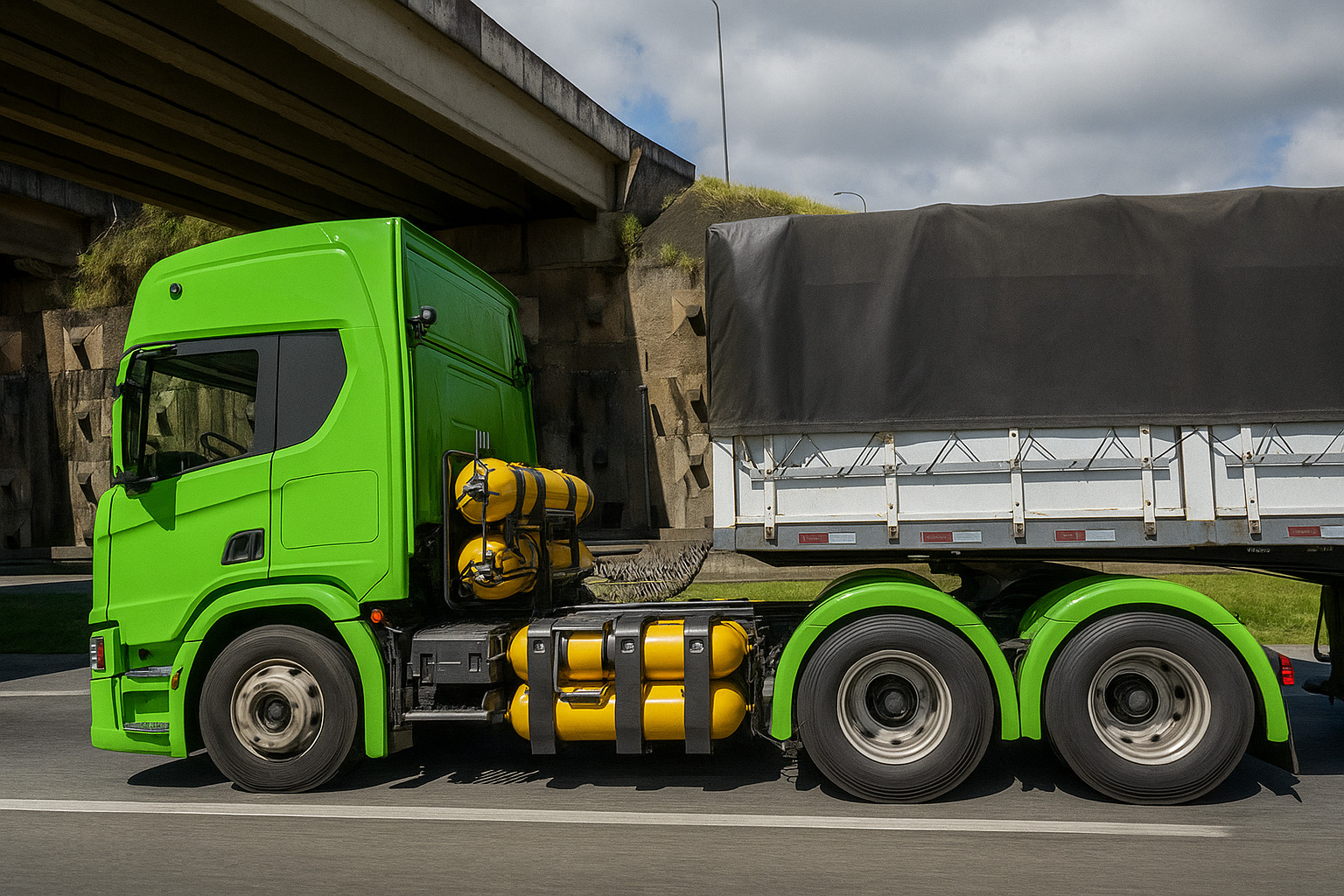

Discover How Natural Gas Bets on Heavy-Duty Transport to Boost the Sector and Create Sustainable Routes, Connecting Cities and Fleets Across Brazil.
The market for compressed natural gas (CNG) in Brazil faces challenges but shows clear signs of recovery, especially in the heavy-duty transport segment.
Historically, CNG gained strength in the 1990s and 2000s with the conversion of light vehicles, as drivers sought more economical and less polluting alternatives compared to gasoline and diesel.
Thus, the refueling infrastructure expanded rapidly to meet the growing demand from urban fleets and private vehicles.
-
Qantas and Airbus Invest in Company Aiming to Convert Unsorted Household Trash into Jet Fuel

-
Brazil’s ANP Opens 86 New Oil Blocks in the Equatorial Margin, Expanding the Amazon River Mouth Frontier

-
OPEC+ Boosts Oil Supply by 188,000 Barrels per Day in July 2026, Leading to Price Drop from $112 to $89 per Barrel in Under Two Months

-
TotalEnergies Signs 20-Year Deal to Purchase 2 Million Tons of LNG from Alaska, Boosting Project Viability




However, starting in 2022, CNG consumption began to decline, reflecting factors such as the pandemic, rising gas prices, and changes in transport habits, such as the growth of remote work.
Data from the monthly report on the Natural Gas Industry, released by the Ministry of Mines and Energy, indicate that automotive demand fell from an average of 6.20 million m³/day in 2022 to 4.17 million m³/day in 2023.
Therefore, this downturn primarily affected the light vehicle segment, which sustained the sector’s growth for years.
Despite this scenario, experts and gas distributors see clear opportunities in heavy-duty transport, consisting of trucks and urban buses.
Moreover, the sector recognizes that these vehicles offer greater autonomy and frequency of use, ensuring a quicker financial return on investment in natural gas technology.
On the other hand, heavy-duty engines powered by gas generate fewer pollutant emissions, providing a sustainable alternative compared to traditional diesel.
The technological evolution of gas engines has significantly increased their efficiency in recent years.
Consequently, trucks and buses powered by CNG or biomethane travel long distances with autonomy equivalent to or greater than diesel vehicles, with lower operating costs and simpler maintenance.
Thus, heavy-duty transport emerges as the main opportunity for sustainable sector growth.
Manufacturers and the Expansion of Heavy-Duty Transport
Manufacturers like Scania and Iveco are already leading this movement.
For example, Scania Brazil offers trucks and urban buses powered by CNG or biomethane, with units coming off the production line equipped to operate with clean fuel.
Since 2019, the company has sold over 1,500 gas trucks, some of which are designated for solid waste collection.
Additionally, Iveco stands out as a global leader in alternative energy solutions, offering natural gas technology in light, medium, and heavy vehicles.
Therefore, this presence of manufacturers strengthens the trend that heavy-duty transport will be the main driver for the growth of the natural gas market.
The state distributors, which control the refueling infrastructure, also see heavy-duty transport as an expansion strategy.
A mapping of gaps between Ceará and Rio Grande do Sul showed the need to improve CNG station coverage to allow trucks and buses to operate with sufficient autonomy.
Thus, companies like Copergás, Bahiagás, and Potigás are investing in new stations and sustainable corridors, ensuring continuous and reliable refueling.
In the Northeast, Copergás leads the market by building a continuous refueling route in Pernambuco, integrating with other distributors in the region to create a corridor that connects the entire Northeast inland.
Additionally, Bahiagás, the largest distributor in the Northeast by volume, is working to implement sustainable corridors focused on heavy-duty transport, including the use of biomethane.
On the other hand, Potigás, in Rio Grande do Norte, plans to implement a fleet tariff, allowing companies to refuel trucks directly at their garages.
This movement creates a more efficient refueling network, favoring the flow of agricultural and industrial production to urban centers and ports.
Natural Gas Bets on Heavy-Duty Transport: Regional Expansion and Local Incentives
Other states follow the same logic of expansion.
For example, Cegás, in Ceará, conducted tests with trucks powered 100% by CNG with up to 15% biomethane, showing that the technology works on longer routes and for urban transport vehicles.
In Alagoas, Algás plans to open stations with dedicated infrastructure for heavy-duty trucks.
Moreover, in Paraíba, tax incentives such as the reduction of ICMS stimulate the adoption of CNG in heavy-duty fleets.
In Amazonas, Cigás gives bonuses to drivers who convert vehicles, encouraging the regularization and expansion of gas use.
In the Southeast, states such as Rio de Janeiro and São Paulo also reinforce their growth strategy in the segment.
Naturgy, responsible for distribution in Rio de Janeiro, invested millions to connect new stations and expand coverage.
Today, the state leads in CNG for light vehicles, but is also focusing efforts on urban trucks and buses.
Additionally, Necta, in northwest São Paulo, connects biomethane producers, transport companies, and refueling stations, increasing automotive demand and strengthening logistics.
Minas Gerais, Paraná, and Santa Catarina are following similar strategies.
Thus, Gasmig, in Minas, expands refueling corridors connecting key cities, while Compagás, in Paraná, consolidates strategic routes for cargo transport, including export via the Port of Paranaguá.
On the other hand, SCGás, in Santa Catarina, develops infrastructure to continuously serve trucks and buses, creating specific tariff segments for heavy-duty fleets.
Incentives, Biomethane, and Sustainability
In Rio Grande do Sul, Sulgás implements Green Corridors, designed to optimize heavy-duty transport powered by CNG and biomethane.
Moreover, incentives such as reduction of IPVA and fuel supply in private garages stimulate companies to adopt gas vehicles, strengthening logistics and competitiveness.
While the light vehicle segment faced stagnation, the focus on heavy-duty transport emerges as a strategic solution to recover and expand the natural gas market in Brazil.
The return on investment for light vehicles has increased over the years, making conversion less attractive, especially for short trips.
On the other hand, trucks and buses, which travel long distances daily, offer consistent savings and technical viability, establishing natural gas as a reliable and sustainable alternative.
Biomethane, fuel produced from organic and agricultural waste, also contributes to growth.
In regions without piped gas infrastructure, biomethane allows trucks to transport products from the interior to ports and urban centers, creating a new logistics model for Brazilian agribusiness.
Additionally, today, almost 40 biomethane plants are registered with ANP, with others awaiting authorization for commercial production.
The positive environmental impact also deserves highlight.
Consequently, the reduction of pollutant gas emissions improves air quality in cities and along highways, aligning the transport sector with public sustainability policies.
Future Perspectives for the Sector
In summary, the historical and current scenario of CNG in Brazil shows a clear evolution: from a market focused on light vehicles, there is now a strong bets on heavy-duty transport as a growth engine.
The expansion of refueling corridors, the participation of manufacturers, the encouragement of fleets, and the use of biomethane signal that natural gas has the potential to play a strategic role in the road transport of cargo and passengers, promoting economy, sustainability, and logistical efficiency.
Therefore, the future of the sector depends on the continuation of investments and alignment between distributors, companies, and governments, consolidating natural gas as a modern and environmentally responsible alternative for heavy-duty transport in Brazil.









… [Trackback]
[…] Read More Information here to that Topic: en.en.clickpetroleoegas.com.br/natural-gas-market-bets-on-heavy-transport-to-achieve-growth/ […]
… [Trackback]
[…] Read More Information here to that Topic: en.en.clickpetroleoegas.com.br/natural-gas-market-bets-on-heavy-transport-to-achieve-growth/ […]
… [Trackback]
[…] There you can find 13059 additional Info to that Topic: en.en.clickpetroleoegas.com.br/natural-gas-market-bets-on-heavy-transport-to-achieve-growth/ […]