





 Portuguese
  English
  Spanish
  5 min of reading
  0 comments


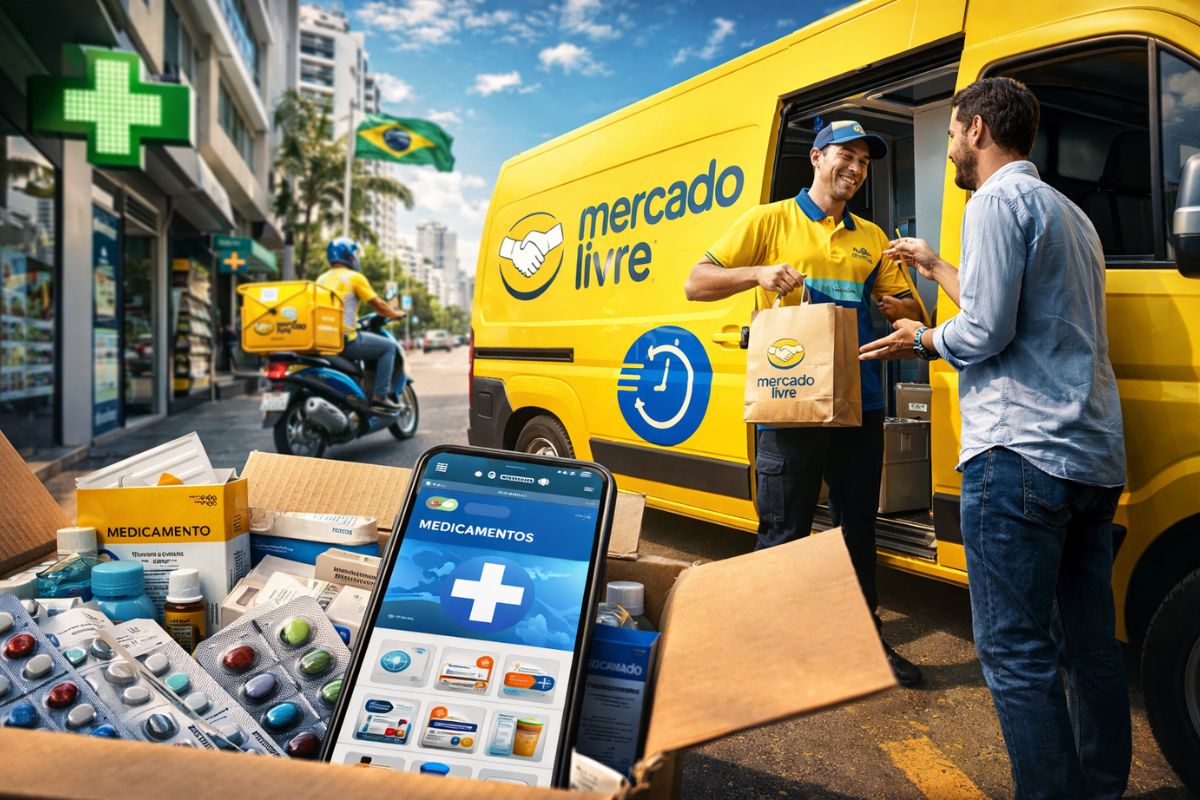
Mercado Livre launched a pilot project on Tuesday for selling over-the-counter medications in neighborhoods of São Paulo, with delivery in up to three hours and support from pharmacists—the first step of a plan that aims to transform the platform into a national pharmaceutical marketplace, connecting pharmacies of all sizes to consumers across Brazil.
The Mercado Livre has just taken a step that could reshape Brazilian pharmaceutical retail. On Tuesday (March 31), the platform launched a pilot project for selling medications in the city of São Paulo, with deliveries in up to three hours and a focus on over-the-counter products such as analgesics, antipyretics, antacids, digestive aids, and vitamins. The operation starts on a small scale, serving neighborhoods like Vila Mariana, Paraíso, and Itaim, and marks Mercado Livre’s official entry into the Brazilian medication market.
According to the portal ndmais, this move is not improvised. Mercado Livre acquired Farmácia Cuidamos in September 2025, linked to the startup Memed, in Jabaquara, south zone of São Paulo—a pharmacy that serves as an operational base to meet Anvisa’s regulatory requirements. The company’s stated goal is to evolve into a pharmaceutical marketplace that connects pharmacies of different sizes across the country, allowing consumers to purchase medications directly through Mercado Livre. If the pilot is successful, national expansion is the next step, and the impact on the sector has already begun to be felt: Raia Drogasil’s shares fell more than 5% in two days when rumors about the operation started circulating.
How the sale of medications through Mercado Livre works in practice
Medications are sold through a dedicated page within the Mercado Livre platform, accessible only to consumers within the current coverage area—the neighborhoods of Vila Mariana, Paraíso, and Itaim in São Paulo.
-
While the South begins April with sun and heat, a change in the weather already has a defined scenario in Brazil, and forecasts indicate heavy rain in the North and a sharp drop in temperature in the coming days.

-
Elon Musk wants to place humanoid robots in roles currently occupied by people, leading alongside giants like Amazon, Nvidia, and Figure in a race to replace human labor with machines, and advocates for a future where working would cease to be an obligation and become a choice.

-
A US company creates a facade that looks like stone or wood but generates energy: “invisible” solar panels for walls, easy installation, up to 130 W, and an off-grid YouTuber showcases it and raises funds for a battery.

-
Scientists at the world’s largest particle accelerator accidentally managed to turn lead into gold during a simulation of the Big Bang, but the amount produced is so small that it fits in trillionths of a gram.


The average delivery time is up to three hours, and there is a direct contact channel with pharmacists for guidance on the purchased medications. Outside the serviced area, the pharmaceutical category simply does not appear in the platform’s searches.
In this initial phase, Mercado Livre is working with a limited assortment of only over-the-counter medications (the so-called MIPs), organized into 11 thematic aisles within the dedicated page.
Prescription medications are not yet part of the operation, reflecting regulatory and operational barriers that Mercado Livre will need to overcome to advance in the sector. The shipping policy is aggressive: there is no charge for deliveries above a minimum purchase amount, and prices are aligned with those practiced by traditional pharmacies.
Why Mercado Livre decided to enter the medication market now
According to Tulio Landin, senior director of marketplace at Mercado Livre in Brazil, consumers still face limitations in accessing medications, both online and offline.
Few online purchasing options, lack of products in physical pharmacies, difficulty comparing prices, and distance from establishments are problems that Mercado Livre believes it can solve with its logistics infrastructure and its base of 148 million active users.
The timing is also not coincidental. On March 23, Brazil allowed the sale of medications in supermarkets as long as there is a pharmacy installed within the establishment.
Mercado Livre enters this scenario as another competitor in a sector that has historically been protected and concentrated in the hands of large pharmacy chains.
The company already operates the sale of medications in other Latin American markets—Mexico (since 2023), Colombia, Argentina, and Chile—and sees Brazil as the missing piece in its continental strategy.
Mercado Livre’s plan: from pilot project in São Paulo to national pharmacy marketplace
The pilot in São Paulo is just the beginning. What Mercado Livre wants to build is something bigger: a pharmaceutical marketplace that allows pharmacies of all sizes and from all over the country to sell medications directly within the platform.
In practice, this would mean that a neighborhood pharmacy in Manaus or a regional chain in the interior of Minas Gerais could list its products on Mercado Livre and reach consumers with the same logistics and payment infrastructure of the platform.
Fernando Yunes, executive vice president of commerce at Mercado Livre, had already hinted to Exame magazine that the company planned to advance in medications as early as 2026.
The coverage is expected to expand over the coming months, first within São Paulo and then to other regions of Brazil. The model follows the pattern that Mercado Livre has successfully applied in other categories: start small, test the logistics, adjust the operation, and scale.
What changes for pharmacies, consumers, and the market with Mercado Livre’s entry
Mercado Livre’s entry into pharmaceutical retail is a move that affects the entire chain. For the consumer, the promise is more options, price transparency, the convenience of shopping via mobile, and fast delivery—all within a platform they already use for dozens of other categories.
For large pharmacy chains, it is a new and powerful competitor entering a market that until now had few relevant digital threats.
For smaller pharmacies, the perspective is twofold: on one hand, Mercado Livre’s marketplace can provide visibility and reach that they have never had on their own; on the other, price competition within the platform may pressure margins.
The fact is that the Brazilian pharmaceutical market, which moves tens of billions of reais a year, has just gained a new competitor with 148 million users, its own logistics, and capital to invest, and this changes the rules of the game.
Mercado Livre wants to be your pharmacy: what’s coming next
The pilot project today in three neighborhoods of São Paulo is the beginning of something that Mercado Livre wants to transform into a national operation.
If the model works—delivery in three hours, competitive prices, increasing assortment, and pharmaceutical support—the platform will have conquered another vertical within its ecosystem, this time in one of the most regulated and profitable markets in Brazilian retail.
The remaining question is: when Mercado Livre scales the operation to the entire Brazil, what happens to neighborhood pharmacies, to large chains, and to the way 215 million Brazilians buy their medications?
Would you buy medications from Mercado Livre? Do you think the three-hour delivery competes with the corner pharmacy? And what do you think about the impact on smaller pharmacies? Leave your opinion in the comments.





Seja o primeiro a reagir!