





 Portuguese
  English
  Spanish
  3 min of reading
  20 comments


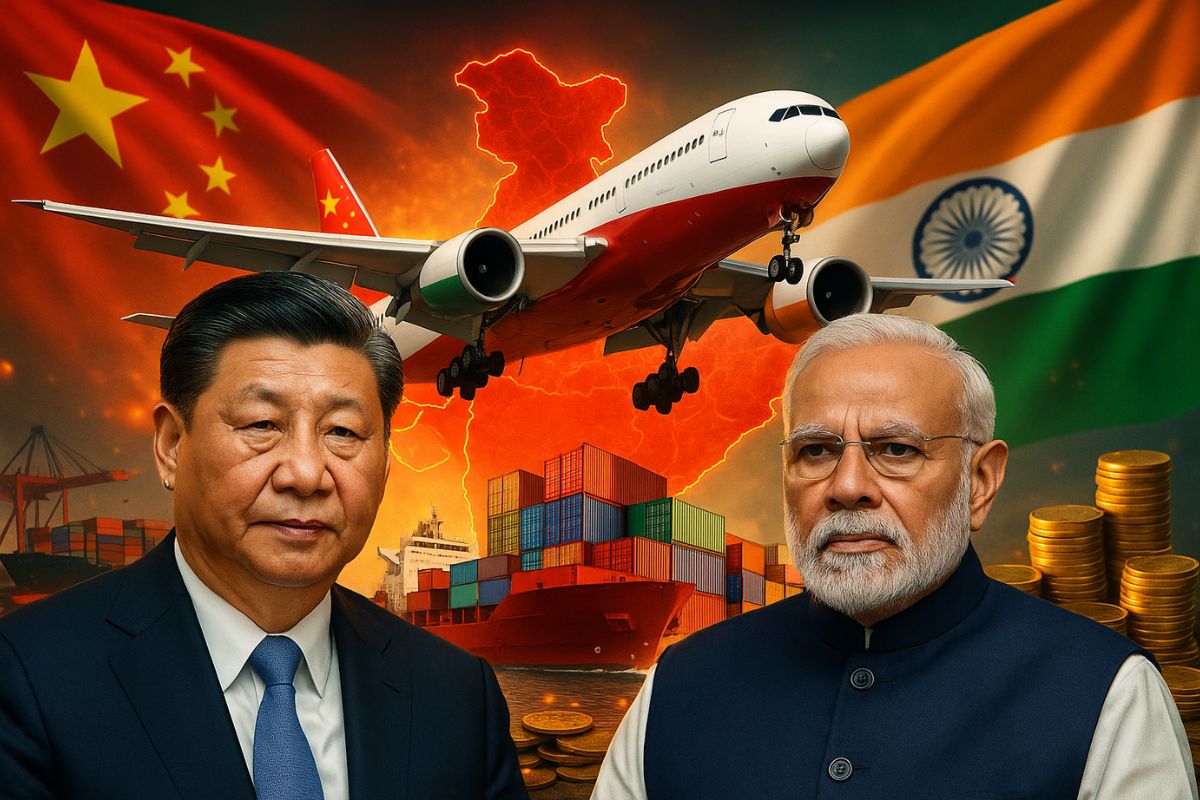


After 50% Tariffs, Xi and Modi Resume Flights and Promise Cooperation in Tianjin; Xinhua, PTI and Bloomberg Mention 3,488 Km Border Trade and Advances
China and India have taken an important step to reduce the diplomatic tension that has marked recent years. In a meeting held in Tianjin during the Shanghai Cooperation Organization (SCO) summit, Xi Jinping and Narendra Modi announced the resumption of direct flights and reinforced their commitment to expanding economic cooperation, even under the pressure of the 50% tariffs imposed by the United States.
According to the CNN Brasil portal, the Xinhua agency reported that Xi advocated that border disputes should not define the relationship and that the “correct choice” is for both countries to see each other as development partners, not rivals. Modi, for his part, stated that the recent stabilization of relations, following the withdrawal of troops from friction points, allows for concrete gestures of rapprochement.
A Relationship Marked by Borders and Trade
China and India share a disputed 3,488 km border, the site of the worst military clash in decades in June 2020. The issue still generates tension, but the two powers have indicated a willingness to advance negotiations on demarcation, according to Bloomberg News.
-
A new Brazilian shopping center worth R$ 400 million will be built in an area equivalent to more than 4 football fields, featuring 90 stores, 5 cinemas, a supermarket, a college, and parking for 1,700 cars, potentially generating 3,000 jobs.

-
Larger than entire cities in Brazil: BYD is building a 4.6 km² complex in Bahia with a capacity for 600,000 vehicles per year, but the discovery of 163 workers in conditions analogous to slavery has shaken the entire project.

-
With an investment of R$ 612 million, a capacity to process 1.2 million liters of milk per day, Piracanjuba inaugurates a mega cheese factory that increases national production, reduces dependence on imports, and repositions Brazil on the global dairy map.

-
Brazilian city gains industrial hub for 85 companies that is equivalent to 55 football fields.


In the economic field, leaders emphasized the need to expand bilateral trade and reduce the trade deficit, which weighs against India. For New Delhi, diversifying partnerships is strategic in the face of American tariffs, which affect Indian exporters who sold US$ 87 billion to the US just last year.
The Impact of US Tariffs
The decision by Washington to impose a 50% tax on Indian products as retaliation for Russian oil purchases has increased pressure on Modi. The Indian government classified the measure as unfair and is seeking to compensate for the shock by strengthening ties with China and other partners in Asia. For Brazil, the message is clear: the US trade war accelerates reorganization movements in global trade chains.
The Symbolism of Direct Flights
The announcement of the resumption of direct flights between the two countries goes beyond logistics. It is a practical gesture of rapprochement, indicating the intention to increase exchanges between people, businesses, and governments. Modi’s last visit to China took place seven years ago, and this time included meetings with Xi’s close allies in the upper echelons of the Chinese Communist Party.
The meeting in Tianjin showed that, even with historical disputes and external pressures, China and India prefer to adopt practical measures for cooperation in trade, transport, and diplomacy. The gesture may pave the way to reduce regional tension without eliminating the disputes.
What do you think? Do you believe that the resumption of flights and the promise of cooperation are enough to change the relationship between China and India? Leave your opinion in the comments — we want to know how you see this movement between the two largest powers in Asia.










Desde que ambos tenha uma relação sadia e ao mesmo tempo sirva de retaliação aos Estados Unidos, todo esforço é válido. Nenhuma nação deve viver prostrada ao imperialismo americano, a América tem de limitar-se de suas fronteiras e parar de se meter na soberania dia demais.
Eu acho que não! Tudo é geopolítica.
Não china é aproveitadora