





 Portuguese
  English
  Spanish
  8 min of reading
  0 comments


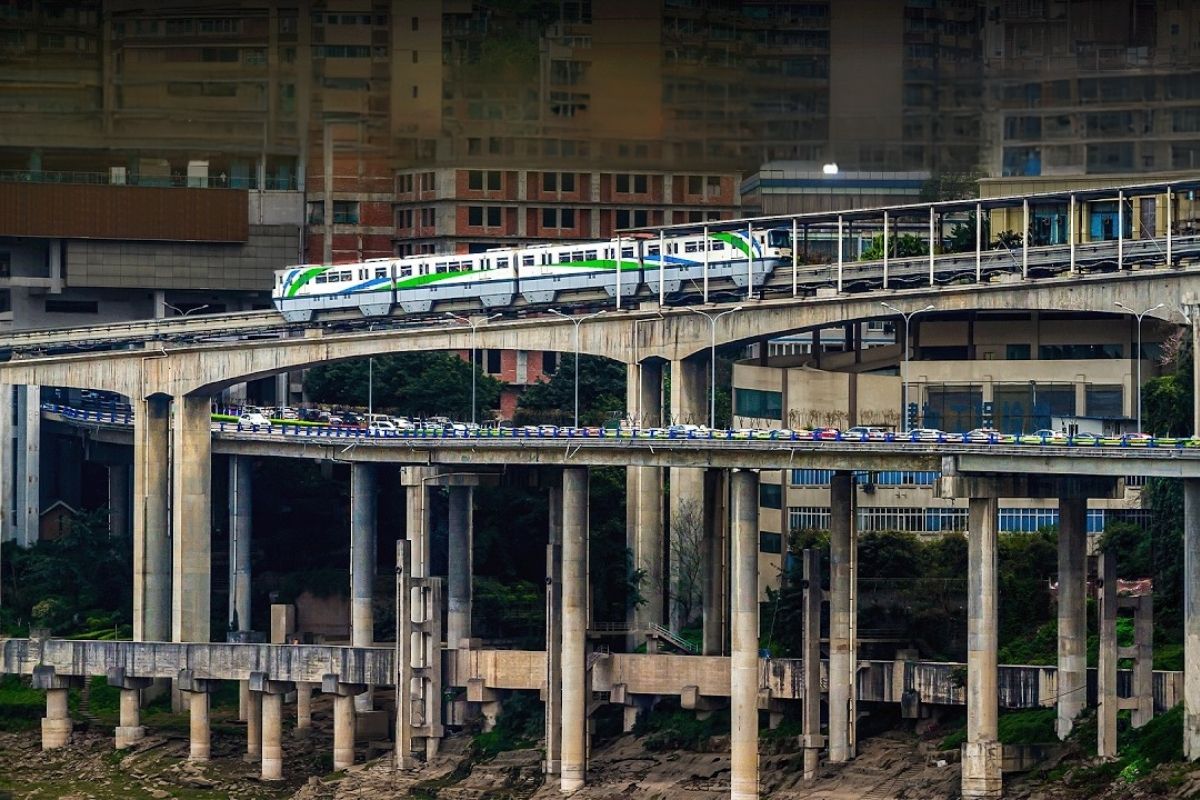
China’s Metro Became the Engineering of the Impossible in Chongqing, With Elevated Tracks Over Rivers, Record-Breaking Stations, Monorail in Buildings, Deep Tunnels, and a Mixed Network That Redefined Mobility in a 8D Megacity
Chongqing, in China, is the city that seems to defy the map and logic. Instead of growing on relatively flat land, it has been built along a mountain range that cuts through the urban space in long lines, creating a landscape of constant ups and downs, with extreme verticalities that change the notion of “walking on the street”.
In this environment, the metro in China in Chongqing became a radical solution: a network with 560 km, tracks that run over elevated bridges, lines that cross slopes, and even a stretch that passes through a residential building. The goal is straightforward: accommodate the movement of 32 million people, in a city that has been described as an “8D city” and compared to a labyrinth of levels.
Chongqing and the Problem That No Street Solves

The scale of Chongqing first appears in its population: 32 million people living in a megacity with a topography that seems designed to hinder any conventional planning.
-
New CCR concrete paving technology promises roads up to 3x more durable, less maintenance, and cost reduction in Brazil.
-
Made from recycled plastic, plastic wood is gaining space in the construction industry because it does not rot, resists moisture, and reduces maintenance costs over the years.

-
Florianópolis will receive a million-dollar BRT that will begin construction in 2026 with nearly 400 million in funding from the federal government and the Inter-American Development Bank, and the map already shows the routes for the exclusive bus corridors.
-
Without a blueprint, without an engineer, and using scrap from the dump, a father spends 15 years building an 18-room castle for his daughter, featuring tram tracks, 13 fireplaces, and over 700 m², which may now be demolished.

The highest point mentioned is about 400 meters above sea level, while the lowest point approaches 150 meters, a difference of 250 meters within the same city.
This variation, in practice, is equivalent to stacking an imaginary skyscraper in the low areas and still not reaching the high ones.
This explains why movement has always been a bottleneck.
Before the existence of an urban train, there were only walking, cars, bicycles, buses, and, in some cases, cable cars.
The report describes heavy congestion in the past, with peak-hour travel times and a feeling of “too many people, too few roads”.
In summary, the city needed a system that did not depend on flat land or wide streets.
How the Metro in China Was Born in a City That Seems “Impossible”

The report indicates that the discussion surrounding the metro in Chongqing has existed since the 1940s, with official proposals that were ultimately abandoned due to lack of technical viability and cost.
Meanwhile, in the 70s and 80s, Beijing and Shanghai were advancing with metros, but Chongqing remained without a solution.
The turning point occurs in the late 1980s, when a task force is created with a pragmatic mission: to study subways abroad, observe transportation systems, and understand how to build railroads in vertical and complicated environments.
The logic was simple: copying a “standard” subway would not be enough. Chongqing required a different type of response.
Monorail Versus Conventional Track and the Calculation That Decided the City
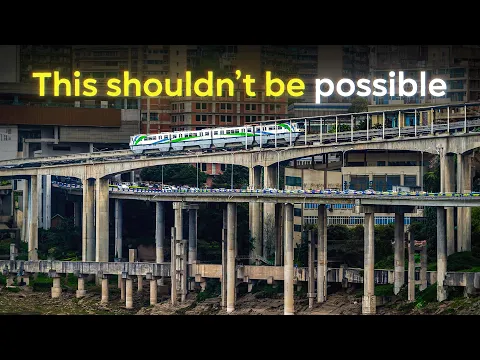

One of the central decisions was to choose between conventional track and monorail.
The conventional track is the standard for many subways: flat tracks, with trains running on them, very common in networks like London and New York.
On the other hand, the monorail uses an elevated track, with the train “embracing” the structure from the sides.
The group concluded that, in Chongqing, the monorail would have advantages because it would be lighter and, in a network with many elevated sections and bridges, would require fewer supports.
The report states that a conventional subway could cost over 200 million dollars per kilometer, while a monorail system would be around 100 million per kilometer, approximately half.
In addition to cost, the monorail was seen as better for tight curves and steep climbs, something essential in a city with slopes and constant changes in elevation.
At the same time, the material itself makes clear the limit of this choice: monorails take up more vertical space, and for underground tunnels, this can be a nightmare, as it requires taller tunnels, more excavation, more time, and more money.
The result was a hybrid path.
The monorail made sense for elevated sections and to tackle the topography.
But as the network grew, other lines began to use conventional tracks, creating a mixed network to handle “sky and mountain” at the same time.
Construction in a Vertical Scenario and the Machine Created to Place Track in the Air
Building an elevated subway under normal conditions is already a challenge.
In Chongqing, the report emphasizes that enormous cranes were not an easy solution due to narrow streets, slopes, and declines, meaning the urban environment did not favor the logistics of large equipment.
The response was to develop a specialized machine for transporting beams.
The description is quite concrete: the machine clings to a section of the track “close to the belly”, climbs the support columns, and positions the track in place.
This detail matters because it shows a design pattern: when the city did not accept the traditional technique, the technique was adapted to the terrain.
The timeline is also clear: in December 2000, the machines enter operation; five years later, the first line is inaugurated.
The public milestone is cited in 2005, when the Chongqing metro opens its doors and begins to change the city’s routine.
560 Km of Tracks and the Size That Already Surpasses Famous Networks
The metro in China in Chongqing has 560 kilometers in length according to the material provided.
The text compares this distance to recognized networks: it would be longer than the New York subway or the London subway.
This number does not appear as a “curiosity”, but as a consequence of a real need: the city is gigantic, and the topography prevents a single type of solution from solving everything.
At the same time, the report makes it clear that the size is not what makes the network unique.
What catches the eye is the behavior of the subway within the terrain and the city: elevated bridges, tracks on slopes, river crossings, and, in the most famous case, the passage through a building.
The Train That Passes Through a Residential Building and How This Was Made Possible
The section inside the building arises from a practical problem.
The land belonged to a construction company that planned to build there, but the monorail line needed to cross that area.
The described agreement was cooperative: instead of relocating everything, they designed a building that could be safely crossed by the metro.
The sensitive point was vibration. To prevent the vibrations of the monorail from damaging the building, vertical tubes were installed within the structure.
The monorail rests on pillars, and each pillar passes through the center of these tubes, leaving enough clearance so that, even when vibrating, the pillar does not touch the walls of the tube.
The report also provides a sound reference for those imagining a constant noise: the sound perceived by residents would be around 60 decibels, comparable to that of a dishwasher.
This does not eliminate discomfort, but helps to gauge the level of noise described.
Record-Breaking Stations and the City Where You Rise and Fall as if You Were in Another World
The project also stands out for station records.
The material claims that Chongqing houses the highest metro station in the world, with a platform about 50 meters above ground.
At the same time, it has the deepest metro station in the world, over 100 meters below the surface.
In the deep station, the report gives a physical sense of time: it would take eight minutes to ascend escalators to the platform, and there is a mention that “ears pop” during the descent, something that aligns with the pressure difference and depth suggested by the narrative.
The detail that ties the geographical absurdity even more strongly: the deep station, Hongyancun, and a high station, Hualongqiao, would be on the same line, separated by just a few stops.
In other words, within a trip, you can go from the high extreme to the deep extreme as part of your daily routine.
Giant Bridges and Records Over the River and Over the Void
The Chongqing metro is also described as a collection of record bridges, and the material lists three main examples:
The Egongyan Railway Bridge, at 1.6 km, cited as the longest suspended bridge exclusive for metro in the world.
The Caijia Railway Bridge, which carries trains over the Jialing River, cited as the highest bridge exclusive for metro in the world, at 100 meters.
The text adds an atmospheric detail: on foggy days, crossing the Caijia can feel like “traveling through the clouds”.
The Chaoshan Men Bridge, described as a record-holder in arch, at 1.7 km. For comparison, the material mentions the Sydney Harbour Bridge, which is less than 1.2 km, to illustrate the scale.
These bridges do not appear as decoration. In Chongqing, they are part of the natural pathway, as the city alternates between mountain, river, and valley as if they were city blocks.
The Turning Point of the System: From Monorail to Line Mix and Continuous Expansion
The first two lines were monorail, elevated, suitable for the terrain. Then, the system grows and changes.
The material points out that today there are twelve lines and three more under construction. Unlike the first two, the others use conventional tracks, reinforcing the idea of a mixed network.
The expansion brings relevant numbers: one of the lines completed a few years later is presented as the longest monorail line in the world and also the busiest, with about 250 million trips per year.
It would have been partially completed in 2011, and the growth continues at an annual pace, adding segments and new connections.
Subterranean construction appears as the toughest part.
The deep station took three years to complete, and the report mentions the human logistics: workers took almost 20 minutes to descend to the site and another 20 minutes to ascend at the end of the day.
It’s a small detail, but it shows the invisible cost of the underground in a city of mountains.
Where the China Metro in Chongqing Goes by 2035
The cited plan aims for 2035, when the network should reach 23 railway lines, almost double the current twelve.
The text admits that it is still unclear what these new lines will be like but suggests the possibility of new records, following the pattern of a city that treats “impossible” as a requirement.
In the end, the picture that emerges is of a system designed to be extreme because the city is extreme.
In Chongqing, the metro is not just transportation; it is a way to make a megacity with mountains, rivers, and elevations that behave like an urban puzzle.
Do you think a system like the metro in China in Chongqing would work in a large city in Brazil with hills and valleys, or would the solution have to be different here?







-

-

4 pessoas reagiram a isso.