





 Portuguese
  English
  Spanish
  4 min of reading
  0 comments


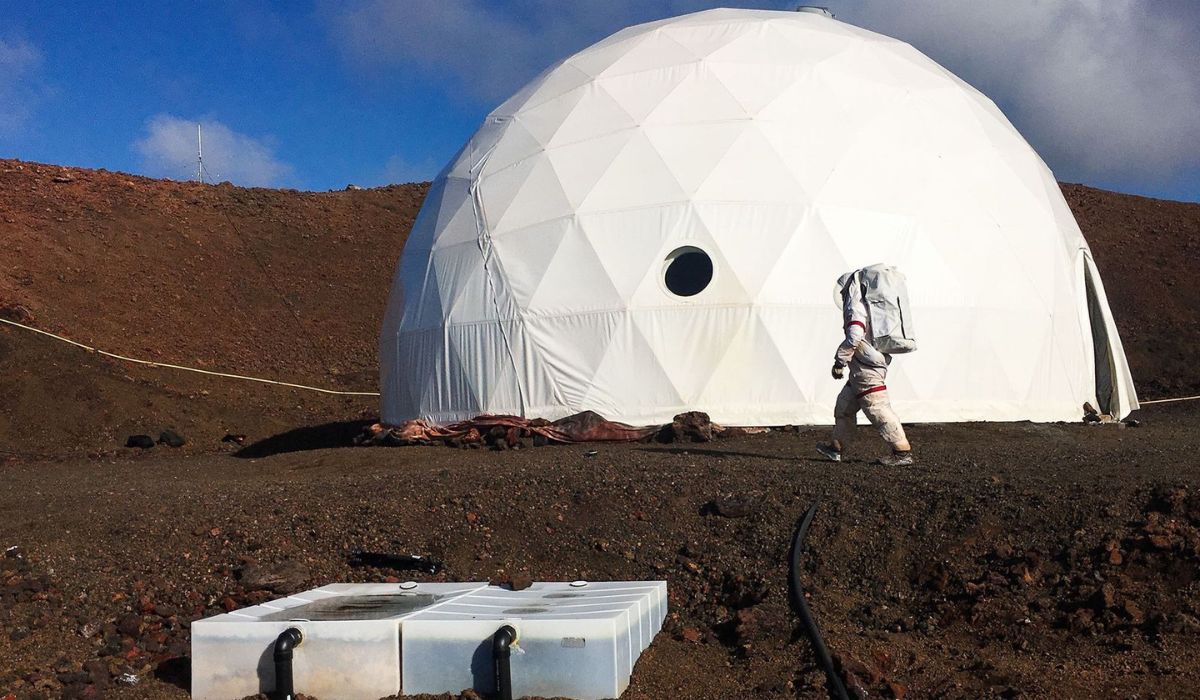
Scientific Research Investigates How Extremely Resistant Bacteria Can Transform Martian Soil into Construction Material, Reducing Dependence on Cargo from Earth and Integrating Biological Processes into Off-Planet Housing Systems.
A study published in the scientific journal Frontiers in Microbiology indicates that earth microorganisms with high resistance to extreme environments could help transform Martian dust into a concrete-like material, with possible applications in 3D printing.
The proposal is studied as an alternative to reduce the need to transport large volumes of materials from Earth, one of the main logistical challenges associated with building shelters on the planet.
The study fits into strategies of using local resources, known as ISRU, combined with biological processes capable of binding regolith particles, the Martian soil composed mainly of dust and mineral fragments.
-
With a cost per shot close to zero, the DragonFire laser could change naval warfare in 2027 and provide British ships with nearly unlimited defense against drones.

-
A British startup creates tires that generate electricity in electric vehicles when passing over potholes, speed bumps, and cracks.

-
Scientists have created robots made with living cells that have their own nervous system, swim on their own, explore the environment, and self-organize without any genetic engineering, and now they want to do the same with human cells.

-
Students create a solar-powered ambulance that operates without a plug, without fuel, and still keeps medical equipment running in remote areas.


Instead of conventional industrial methods, the researchers analyze the feasibility of employing reactions driven by bacteria to form structures.
Biocementation as an Alternative for Construction on Mars
The work describes a model based on biomineralization, a process in which microorganisms produce minerals as part of their metabolism.
In the analyzed scenario, the goal is to induce the formation of compounds that act as binders, joining the grains of regolith to form blocks or layers with greater mechanical cohesion.
The authors present the proposal as an experimental concept aimed at closed and controlled systems.
In these systems, reactors or pressurized modules would provide more stable conditions for microbial growth and material production.
3D printing is mentioned as a later step, where the resulting material could be molded into structural components.
Resistant Bacteria and the Formation of Concrete-Like Material
The approach presented is based on co-culturing two bacteria with distinct and complementary functions.
Chroococcidiopsis, a cyanobacterium associated with survival in extreme environments, is considered in the study as an organism capable of sustaining photosynthetic activities.
According to the researchers, it may contribute to oxygen production in controlled systems.
The article also discusses the use of physical barriers, such as membranes with protection against ultraviolet radiation, to maintain suitable conditions for cultivation.
Sporosarcina pasteurii, on the other hand, is known in previous research for inducing the precipitation of calcium carbonate.
This mechanism has already been studied in biocement and soil stabilization processes.
According to the article, its metabolic activity may favor the formation of mineral compounds that act as binders between particles.
This process would allow consolidating Martian dust into more rigid structures.
In the arrangement described by the authors, the presence of oxygen is pointed out as a relevant factor to sustain Sporosarcina’s aerobic metabolism.
The co-culture is therefore presented as a way to integrate oxygen production and cementing material formation in the same experimental system.
Oxygen, Byproducts, and Possible Applications in Space Habitats
The study also addresses possible indirect applications of the process.
Oxygen production by photosynthetic microorganisms is mentioned as an element that could be integrated into life support systems in habitats.
According to the researchers, this would only be feasible in isolated and controlled environments.
Another point discussed is that biocementation routes could generate nitrogenous byproducts.
The article mentions that, in a hypothetical mission scenario, these flows could be evaluated for reuse in closed systems, such as agricultural modules.
This possibility would depend on meeting safety and operational stability criteria.
Technical Limitations and Planetary Protection Protocols
Despite the conceptual advancement, the work acknowledges technical limitations.
One of the main barriers is the dependence on laboratory-produced regolith simulants.
Access to actual Martian samples is restricted, and the return of Martian material follows prolonged timelines.
There are also uncertainties about how Martian environmental factors influence results.
Among them are atmospheric pressure, temperature, and reduced gravity.
These variables affect both the formation of the material and the operation of 3D printing systems.
According to the study, tests closer to the planet’s actual conditions are necessary to validate the results.
Furthermore, the authors highlight the need for attention to planetary protection protocols.
The use of terrestrial microorganisms requires strict measures to prevent the uncontrolled release of these organisms into the Martian environment.
This topic is central to current discussions in astrobiology.






-

-

-

-

5 pessoas reagiram a isso.