





 Portuguese
  English
  Spanish
  3 min of reading
  11 comments


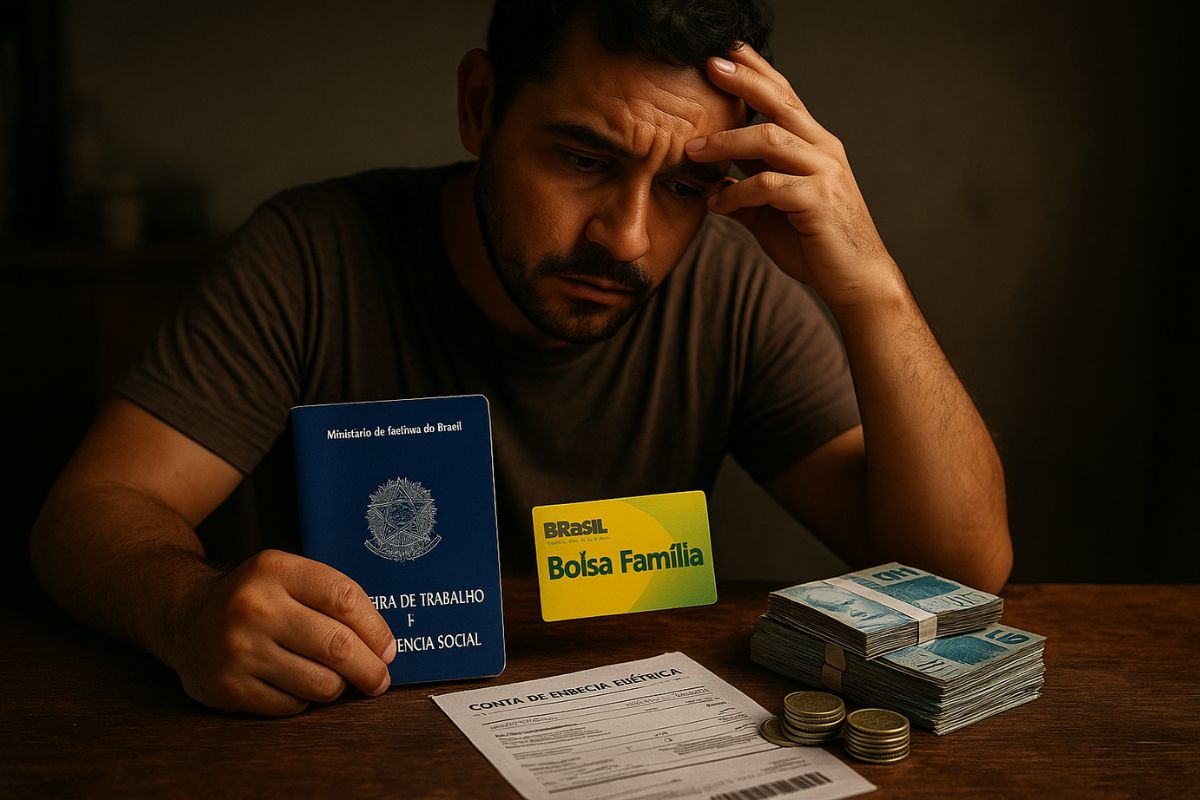


Workers Refuse Registered Work to Avoid Losing Bolsa Família and Social Benefits.
In recent months, a social and economic phenomenon has been attracting attention in Brazil: workers are refusing registered job offers for fear of losing Bolsa Família and the additional benefits tied to the program. According to FDR, the assistance is not limited to monthly cash payments; it also guarantees discounts on electricity bills, priority in housing programs, and access to social inclusion policies.
In practice, the net value summed from these aids can be higher than what is paid in low-paid formal jobs.
This dilemma particularly affects the Northeast, where most registered job openings are temporary, pay low salaries, and still incur additional costs with transportation, food, and social security deductions.
-
A new Brazilian shopping center worth R$ 400 million will be built in an area equivalent to more than 4 football fields, featuring 90 stores, 5 cinemas, a supermarket, a college, and parking for 1,700 cars, potentially generating 3,000 jobs.

-
Larger than entire cities in Brazil: BYD is building a 4.6 km² complex in Bahia with a capacity for 600,000 vehicles per year, but the discovery of 163 workers in conditions analogous to slavery has shaken the entire project.

-
With an investment of R$ 612 million, a capacity to process 1.2 million liters of milk per day, Piracanjuba inaugurates a mega cheese factory that increases national production, reduces dependence on imports, and repositions Brazil on the global dairy map.

-
Brazilian city gains industrial hub for 85 companies that is equivalent to 55 football fields.


Why Registered Work Is Not Worth It for Many
According to FDR, Bolsa Família currently serves over 21 million families across the country, acting as a fundamental safety net.
For low-income workers, giving up the benefit to take a formal job can mean losing financial stability.
This is because the formal job market available to this portion of the population offers low wages and contractual instability, which does not cover the gap between the received salary and the suspended social aids.
Thus, informality becomes a survival strategy, allowing families to keep Bolsa Família and supplement their income with parallel activities.
The Poverty Trap
Experts consulted by FDR warn that the situation creates a true “poverty trap.”
Those who accept registered work risk losing essential benefits; those who remain informal maintain a minimal safety net guaranteed by the government.
This behavior reflects not only individual choices but a structural problem: the lack of integration between social policies and the formal job market.
Without transition mechanisms, formalization is seen more as a threat than as an achievement.
Paths to a Solution
Economists and public policy analysts argue that social programs like Bolsa Família should be adapted to encourage formalization without punishing workers.
International models show that hybrid systems, in which the benefit is gradually reduced as formal income grows, help avoid leaving registered jobs.
In Brazil, this change is even more urgent in the Northeast, a region with high rates of unemployment, informality, and social vulnerability.
Without adjustments, the cycle of refusing formal jobs is likely to perpetuate, undermining the sustainability of social policies.
The Challenge for the Future
The issue goes beyond offering benefits.
The challenge lies in building a public policy that unites social protection and employability, preventing the transition to registered work from pushing families back into poverty.
This will require reforms that bring the social protection system closer to the realities of the Brazilian labor market.
According to FDR, the decision to reject formal jobs is not merely cultural resistance but a survival strategy in the face of economic insecurity.
The dilemma shows that registered work, which should signify stability and labor rights, is seen by many today as a risk of financial loss.
The question challenges the effectiveness of current public policies and opens up a debate on how to reconcile formal employment and social benefits.
And you, do you believe that registered work is still an advantage in today’s Brazil? Or do you think that programs like Bolsa Família offer more security for those living at the base of the pyramid?
Leave your opinion in the comments — we want to hear from those facing this reality day to day.










Faço parte dessa triste realidade ,aonde termos carteira assinada representa retrocesso na nosso financeiro salários muito baixos e uma grande exploração somos escravos porém de uma forma diferente
Tinha que acabar com os benefícios,se criou um bando de ****, tem que trabalhar, quem trabalha tem que sustentar esses ****
Meus conterrâneo estão certos, uma que ninguém mais se aposenta , depois desse golpe da previdência , alegando sabe lá o que .
E com os salários de miséria , só serve pra da imposto pro governo.