





 Português
  Inglês
  Espanhol
  8 min de leitura
  0 comentários


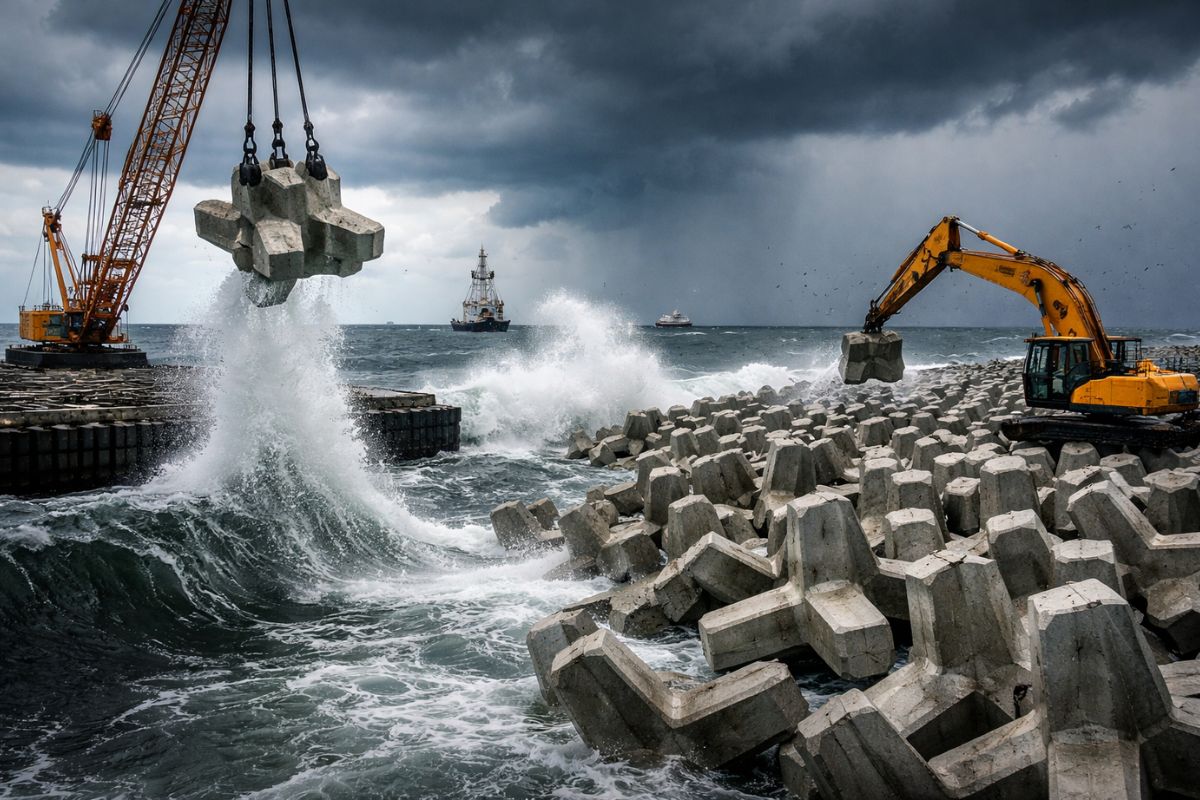
In The Last 50 Years, Storms And Rising Sea Levels Have Caused Up To US$ 4 Trillion In Global Damages And Displaced Tens Of Millions, Accelerating Works With Concrete Blocks, Tetrapods, And Barriers Against Destructive Waves On Various Coasts Of The Planet.
Concrete blocks have become the practical response where the ocean gains enough strength to paralyze an entire coastal city. In just a few hours, a fracture in critical coastal infrastructure can pave the way for flooding, logistic collapses, and chain damages, which is why breakwaters and mobile barriers have become the first line of defense between the sea and the land.
In the Netherlands, Japan, Italy, the United Kingdom, and South Korea, the same principle is repeated with different solutions: reduce wave energy before it reaches urban areas, using locking geometries, reflective walls, giant gates, and porous layers of protection made of concrete blocks.
Coastal Defense Enters Global Urgency Mode

The race for coastal defense has ceased to be an aesthetic choice and has become a survival decision. Storms and rising sea levels accumulate impacts of up to US$ 4 trillion in 50 years, forcing tens of millions to leave their homes.
-
The world’s first octopus farm wants to open in the Canary Islands and is already provoking an international reaction: the plan aims to produce 3,000 tons per year.

-
Drought may be creating stronger superbugs in the soil and helping antibiotic resistance reach hospitals, warns a study highlighting a problem that could grow alongside extreme weather.

-
The biggest scam in history: Napoleon’s France deceived the United States by selling them a territory that was Spanish.

-
Why is the Danakil Desert so dangerous? It has unstable terrain and how extreme temperatures and toxic gases turn the region into one of the most hostile environments on Earth.


This scenario puts ports, coastal highways, industrial centers, and entire neighborhoods at risk, explaining why offshore works and mobile systems are multiplying.
When the water level starts to rise, time is short.
The failure of a section can trigger a chain reaction, making breakwaters and storm barriers infrastructure comparable to bridges, airports, and power plants, only designed to withstand the power of the ocean.
The Netherlands And The Eastern Scheldt Barrier That Only Closes When Needed
In the Netherlands, where almost a third of the territory lies below sea level, the storm barrier in the Eastern Scheldt was conceived as an unconventional solution: to intervene only when necessary and allow the sea to function naturally at other times.
The result is a project often regarded as the most famous in the country, widely remembered as the eighth wonder of the hydraulic engineering world.
In the North Sea, the structure extends nearly 9 km and consists of more than 60 reinforced concrete pillars, each weighing tens of thousands of tons.
Assembly required extreme precision: deviations of just a few centimeters could destabilize the entire structure.
Between the pillars, there are 62 suspended steel gates that remain fully raised under normal conditions, allowing the passage of tides, marine life, and vessels.
The system is activated only when forecasts indicate that water levels may exceed 3 meters above the reference level of the NAAP.
From there, hydraulic cylinders gradually lower the gates over several hours, transforming the entrance into a continuous barrier capable of withstanding North Sea storms.
Today, besides nature, there are security and access control challenges, with measures to prevent unauthorized entry to the pillars, associated with illegal fishing.
Tetrapods: Concrete Blocks That Look Like Chaos But Work As Locking Engineering

Not all protection is a solid wall. In many coastal areas, defense relies on individual concrete blocks, like tetrapods.
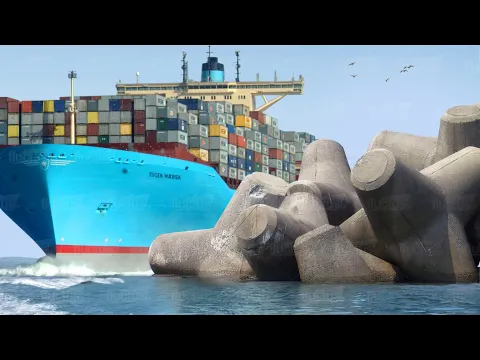
At first glance, the arrangement looks disorganized, but it is exactly this intentional disorder that makes the system work: the arms catch, lock, and distribute forces.
Each tetrapod is cast from a high-precision steel mold, made to ensure that the four arms form exact angles before concrete placement.
The mold receives release oil to be reused without damaging the surface. The liquid concrete mix is poured and subjected to mechanical vibration to eliminate air bubbles and internal voids.
This step is crucial because any weakness becomes a crack after years of repeated impacts. After curing, the three-part mold is removed, and the block is sent for transport.
A tetrapod can weigh up to 25 tons, enough to remain stable under large waves. They are installed offshore with large cranes and specialized barges.
They are not stacked like bricks: they are placed according to calculations that allow the arms to fit. This creates an interconnected mesh where the forces striking one block are spread across many neighbors.
If a tetrapod is displaced, nearby units lose support, and the entire line can weaken due to a chain reaction, which is why installation precision defines long-term performance.
The cost also reveals the scale of the problem: constructing 1 km of tetrapod breakwater can exceed 10 million dollars, varying with block size and sea conditions.
Still, this amount is considered small compared to the damages associated with storms and rising sea levels.
Xbloc: Less Concrete, One Layer, And More Porosity To Dissipate Energy
When tetrapods proved effective, coastal engineers sought structures capable of dissipating energy with less material.
An example cited is the Xbloc, developed by consultants from the Netherlands, with a decisive difference: only one layer can form the protective armor thanks to the automatic locking shape.
The X-shaped blocks interconnect as they are placed, creating a hydraulically stable structure.
With high porosity, waves are not reflected back, but rather dispersed, losing energy as they pass through the layer.
Compared to tetrapods, the Xbloc uses less concrete, occupies less space, and reduces the need for extremely precise alignment during construction.
Production is still cast in concrete, but the process is highly automated to reduce time and ensure consistent quality.
In return, the system requires specialized factories and equipment. The expansion of Xbloc across various coastal lines signals a trend: coastal defense has ceased to rely only on mass and has started to depend on geometry.
The Great Wall of Japan And The Choice To Trade Landscape For Life
As an island nation with a large coastline that is vulnerable to tsunamis, storms, and earthquakes, Japan has invested heavily in storm breakwater systems.
Along the northeast coast, a concrete wall runs parallel to the shoreline in many sections, reaching heights of 12 to 14 meters, equivalent to a four to five-story building. The total length exceeds 400 kilometers.
It is not a unique and continuous structure, but a sequence of defensive lines, with heights and positions varying according to local terrain and risk.
From an engineering standpoint, it is a monumental structure: foundations deeply reinforced to resist erosion, and concrete elements designed to withstand large waves, reverse currents, and earthquakes at the same time.
The total cost reaches tens of billions of dollars, placing the project among the most expensive in the world for disaster prevention.
The debate followed. The walls block the view of the sea, alter the landscape, and break the traditional relationship between coastal communities and the ocean.
Still, the decision was presented as a direct trade-off: sacrifice the view in exchange for life.
Venice And The MOSE System Of Floating Gates Against Storm Waves
In Venice, flooding has ceased to be rare and has become a daily part of life, increasing in frequency and severity over the last decades.
To isolate the city from sudden storm waves, the MOSE system was created, a network of gigantic gates installed at the three main entrances of the lagoon.
The system includes 78 floating steel gates, with dimensions varying according to location. Each gate is a massive hollow steel structure, approximately 20 meters wide and about 4 to 6 meters high.
Most are activated when tides exceed 110 centimeters above the average sea level. Once activated, the gates rise and form four continuous flood barriers.
The gates are held at an angle of approximately 45 degrees, while the system continuously adjusts the amount of water inside each gate to maintain a safe and stable incline.
When the event ends, water is pumped back to submerge the gates, which gradually return to their horizontal position.
At the seabed, the MOSE integrates modern mechanics, hydraulic technologies, and sensors, allowing precise control and providing data on tides, currents, and climate change.
London And The Thames Barrier That Only Appears At The Right Time
The Thames Barrier, in Woolwich, is a mobile shield, not a fixed dam. With approximately 520 meters in length, it was completed in the 1980s and, when finished, was the largest movable flood barrier ever constructed. To this day, it remains an icon of urban hydraulic engineering.
The system has 10 massive steel gates. Four outer gates operate as fixed sections, while six central gates operate flexibly.
Under normal conditions, they remain open, maintaining navigation and the natural flow of the Thames through London. When forecasts indicate water levels above safety limits due to storm waves in the North Sea or upstream flooding, the order to close is issued.
The process takes about 90 minutes, with gates rotating upward from the riverbed, forming a continuous wall.
Each gate can reach 20 meters in height, capable of withstanding the pressure of thousands of tons of water advancing towards central London during high tide.
The system can remain closed for four to five hours and then return to its original position. The barrier exists to intervene at the right moment and protect approximately 1.42 million people and properties valued at hundreds of billions of pounds.
South Korea And The Two-Layer Model With Tetrapods And Wave Reflecting Wall
In South Korea, exposed to large waves from the Yellow Sea and the Sea of Japan, coastal defense appears as a two-layer system.
Tetrapods act as the first stage of energy dissipation, and closer to the shore, the decisive element enters: the wave reflecting wall.
The tetrapods are placed offshore as an active buffer zone. The incoming water is fragmented, divided, and made turbulent as it passes through interconnected concrete units.
Behind them rises a perforated wall designed to withstand the remaining energy. Instead of a flat impact surface, the wall incorporates hollow chambers at the base, allowing water and sand to enter with force.
When the water is forced into the cavities, the pressure is not concentrated at the foundation but redirected upwards, interrupting the wave’s momentum.
The energy that would be horizontal is bent to the vertical axis, reducing the force at the base and limiting seabed erosion, one of the reasons traditional walls weaken over time.
The Logic Behind Each Concrete Block Thrown Into The Sea
Behind the concrete blocks and mega barriers, the philosophy is the same: do not subjugate nature but weaken its force.
Every wall, every steel gate, and every layer of tetrapods starts from the premise that natural disasters return.
What changes is whether cities will be prepared when that happens.
With rising sea levels and the climate becoming more extreme, the decisions made now shape coastal safety for decades.
Coastal engineering does not promise to control the ocean, but to buy time, reduce risk, and create a buffer zone between catastrophe and everyday life..
In your opinion, which of these solutions seems smarter to protect coastal cities: concrete blocks like tetrapods, movable barriers like the MOSE, or continuous walls like those in Japan?








-

-

-

5 pessoas reagiram a isso.