





 Portuguese
  English
  Spanish
  6 min of reading
  0 comments


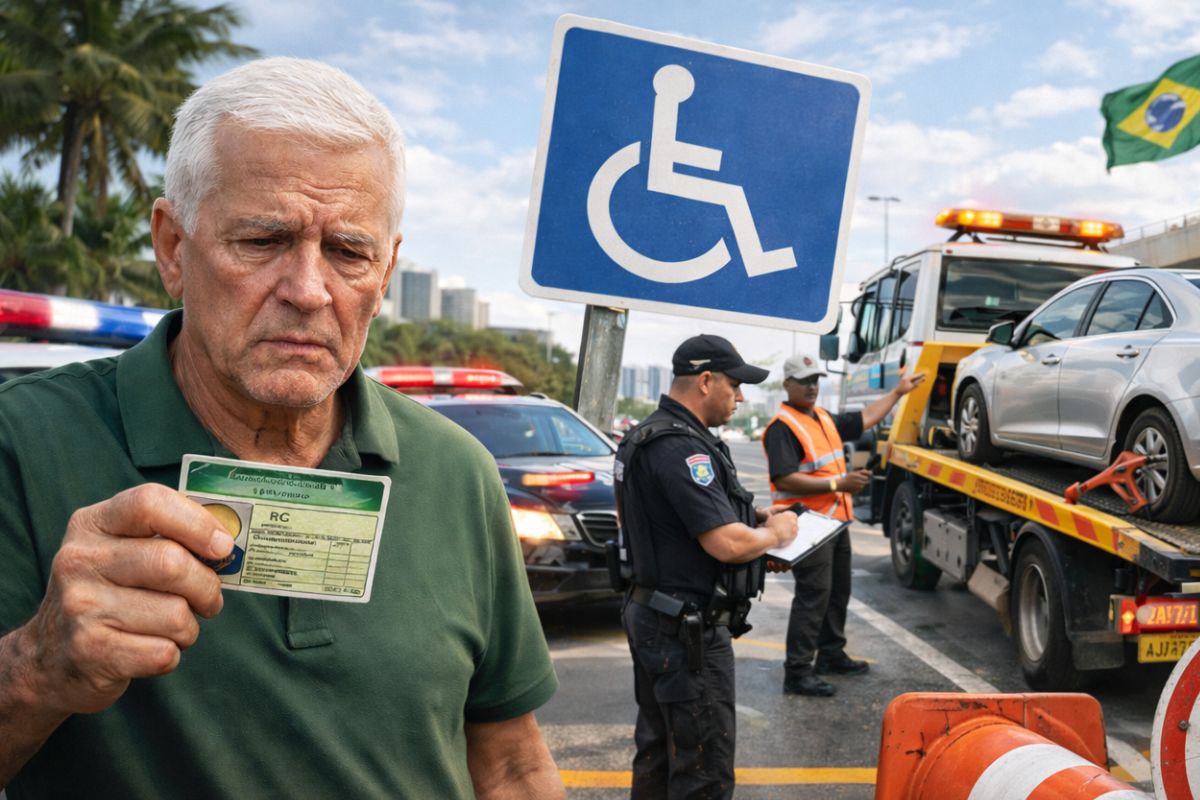
Brazilians over 60 need to issue the Parking Credential for the Elderly in addition to the identity to use exclusive spots. Without the document, the offense is severe, with a fine of R$ 293.47, seven points on the CNH, and the possibility of vehicle removal, even if the age is proven.
Many brazilians over 60 believe that just presenting the RG or the new National Identity Card (CIN) is enough to park in the exclusive spots reserved for the elderly. They are wrong, and the consequence of not knowing this can be costly. Brazilian legislation requires a second specific document, the Parking Credential for the Elderly, for the use of these spots to be considered legal. Without this credential, even those who are 70, 80, or 90 years old can be fined, have points added to their license, and see their car being towed.
The lack of knowledge is widespread because the logic seems to contradict common sense: if the spot is for the elderly and the person is elderly, why is it not enough to prove age? The answer lies in the regulation. The use of exclusive spots is governed by Resolution 203 of 2008 and the Statute of the Elderly, which determine that the right is only valid with the credential duly issued and visible in the vehicle. The good news is that the document can now be obtained in just a few minutes, for free and without leaving home. The bad news is that most Brazilians who need it still do not have it.
Why Brazilians over 60 need an extra document
The Parking Credential for the Elderly is not a pointless bureaucracy. It exists to ensure that exclusive spots are used only by those who have the right, preventing abuses such as use by family members who are not elderly or by people who simply park in the most convenient spot. The document acts as an official authorization that must be visible on the vehicle’s dashboard while it is parked in the reserved spot.
-
Paraíba shoots up and has the most expensive square meter in the Northeast, and the increase in labor puts the region at the center of pressure, with Bahia recording the highest monthly increase in Brazil in construction.

-
BNDES and a Chinese bank create a billion-dollar fund of $1 billion to invest in Brazil in energy, infrastructure, mining, agriculture, and AI.

-
INSS confirms the 2026 13th salary calendar, but excludes thousands of elderly from payment; find out now who is left out and how to check by CPF.
-
Even facing a shortage of professionals, the construction industry generated 31,099 formal jobs in February, once again driving the labor market in Brazil and showing that it still fuels the economy.

The rule also establishes that the elderly person must be present in the vehicle, either as a driver or as a passenger. It is not enough to place the credential in the car and let another person use the spot, a detail that many Brazilians are unaware of. The goal is for the spot to be effectively used by those who need it, and not as a convenience for third parties. This requirement applies in streets, shopping malls, hospitals, supermarkets, and any other location with reserved spots for the elderly.
The penalties that Brazilians can face without the credential
The offense of parking in an exclusive spot for the elderly without the credential is classified as severe by the Brazilian Traffic Code. The current fine is R$ 293.47, with an addition of seven points on the driver’s CNH, a score that, when added to other offenses, can lead to the suspension of the right to drive. Additionally, the vehicle can be removed by a tow truck, generating additional costs for removal and daily fees at the impound lot.
What makes the situation especially unfair is that many Brazilians fined in this situation are, in fact, elderly with full rights to the spot. The fine does not distinguish between those who are improperly using the spot and those who are elderly but simply did not know they needed the credential. For the traffic agent, the verification is objective: if the credential is not visible in the vehicle, the offense is established. That is why issuing the document, even if it seems like a bureaucratic detail, can prevent a significant financial headache.
How Brazilians can issue the credential quickly and for free
According to the portal ndmais, the process of issuing the Parking Credential for the Elderly has become much simpler in recent years. The document can be issued digitally through the CDT app (Digital Traffic License) or through the Senatran portal, without the need to travel to a public agency. The procedure takes just a few minutes and is free of charge, an important detail that many Brazilians are unaware of.
A recent change made the credential permanent, eliminating the need for periodic renewal that existed before. This means that Brazilians who issue the document now will not need to worry about expiration dates in the future. Another relevant point: even those who do not have a CNH can request the credential. In this case, the document must be issued through the local traffic agency or the city hall, which are required to provide the service for free.
What Brazilians need to know about the rules for using the credential
Carrying the credential is just the first step. For the use of the exclusive spot to be considered legal, Brazilians need to meet three simultaneous conditions: have the credential issued, keep it visible in the vehicle, and be present in the car as a driver or passenger. If any of these conditions are not met, the offense can be applied. Forgetting the credential at home does not protect the driver from the fine, even if they later prove that the document exists.
The digital version of the credential, available in the CDT app, is accepted throughout the national territory and has the same validity as the printed version. For Brazilians who prefer the convenience of their cell phone, the digital credential appears directly in the app and can be presented to traffic agents or parking inspectors at any time. Still, it is advisable to keep a printed version or have the cell phone charged, as inspections can occur when the driver is not close to the vehicle.
Why so many Brazilians still do not know this requirement
The lack of information about the credential is not accidental. The dissemination of this requirement has always been deficient, and many Brazilians confuse the right to the exclusive spot, which is guaranteed by the Statute of the Elderly, with the way to exercise this right, which requires the credential. The confusion is understandable: if the law guarantees exclusive spots for the elderly, the natural expectation is that proof of age is sufficient. But the legislation works differently.
The result is that millions of Brazilians over 60 use exclusive spots without the credential and are, technically, committing a severe offense every time they park. The free and permanent issuance of the document solves the problem in minutes, but it depends on the elderly person or their family members knowing that the requirement exists. If you are over 60 or know someone in this age group, the most important step is to access the CDT app or the Senatran portal and issue the credential before a fine of nearly 300 reais turns this information into an expensive lesson.
Millions of Brazilians over 60 do not know they need the credential to use exclusive spots. Have you issued yours or know someone who was fined for not having it? Do you think this requirement should be more widely publicized? Leave your opinion in the comments.









Seja o primeiro a reagir!