





 Portuguese
  English
  Spanish
  4 min of reading
  0 comments


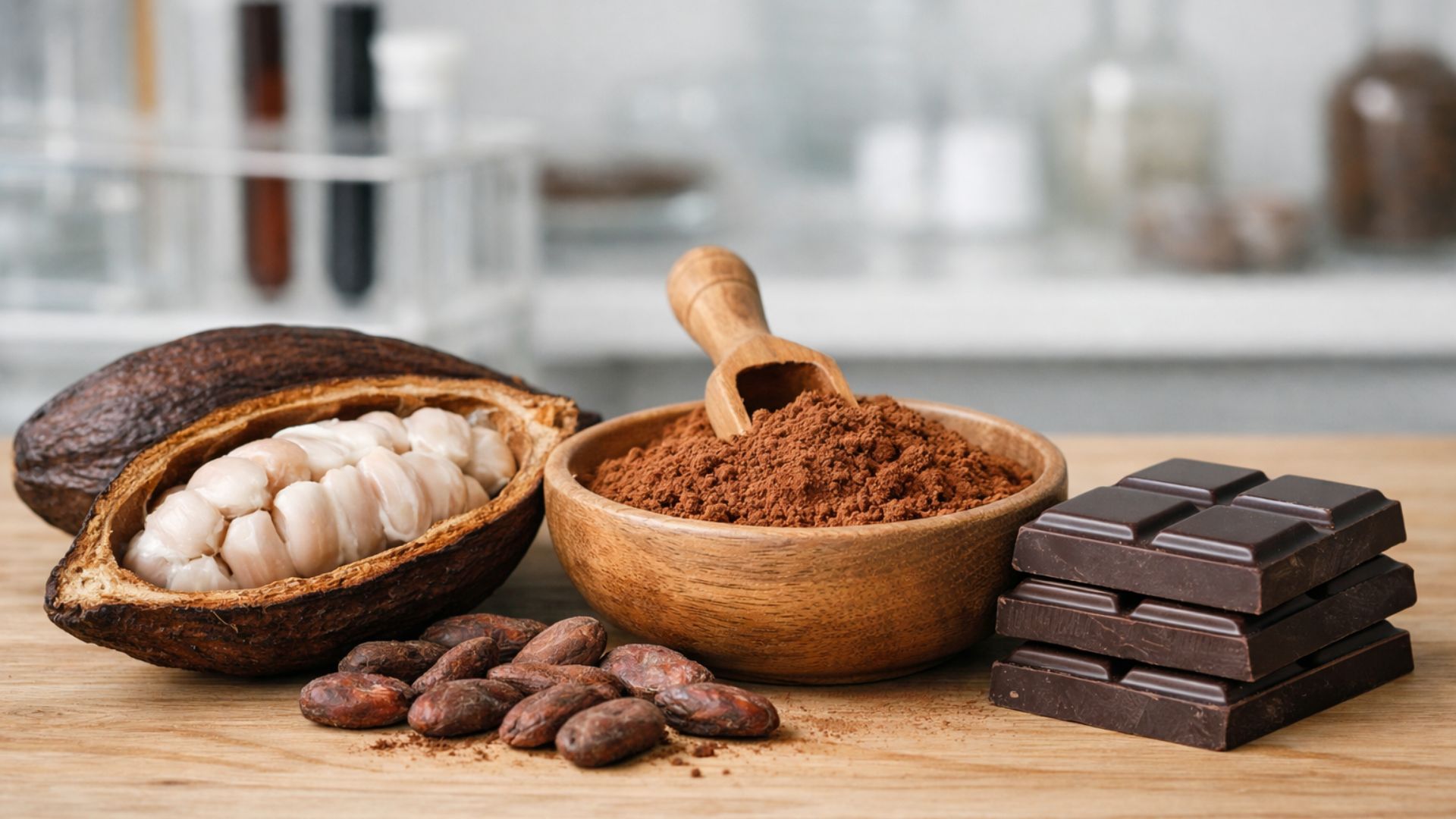
Millennia of presence in human nutrition finds support in recent scientific studies investigating cocoa compounds associated with blood circulation and specific cognitive functions, expanding interest in the fruit beyond traditional consumption and its role in the global food industry.
Before becoming a recurring ingredient in chocolates, beverages, and desserts, cocoa was already circulating among ancient peoples of the Americas as part of dietary and cultural practices that preceded its industrial diffusion by many centuries.
Today, interest in the fruit has grown again for a different reason: it concentrates flavanols, plant compounds that are associated, in studies with humans, with vascular responses and measurable changes in some cognitive functions.
Cocoa flavanols and their relationship with cerebral blood flow
The starting point of this discussion is less about the appeal of chocolate as indulgence and more about the relationship between blood circulation and brain performance.
-
The air fryer entered Brazilian homes so quickly that the government began to measure its impact on energy, and the progress up to 2050 is already outlined.

-
A Dutch builder has erected a 122-meter Noah’s Ark with 25 barges, cedar, and pine, created 7 floors with cinemas and a restaurant, and now the vessel will be taken to Amsterdam.

-
She took her first steps on the mat while her father was training, started competing at the age of 4, and now at just 9 years old, she is the world champion in Jiu-Jitsu in Abu Dhabi: meet Tina, the girl from Ourinhos who sells canjica at the traffic light to compete in international championships.

-
Measuring 13 meters in length, weighing 82 tons, and installed 19 meters below the surface, the Aquarius is the only operational underwater laboratory in the world, allowing scientists to live for days on the ocean floor surrounded by reefs in Florida.

Attention, processing speed, and memory depend on an adequate supply of oxygen and nutrients to the nervous tissue, and it is precisely at this interface between vessels and the brain that the scientific literature has been focusing its questions.
A review published in the journal Frontiers in Nutrition gathered results from clinical trials and experimental studies on cocoa flavanols and described a relevant pattern, although far from uniform.
According to the authors, formulations rich in these compounds were associated with increased cerebral blood flow in short windows after ingestion and, in part of the studies, with improvements in indicators related to overall cognition, attention, processing speed, and working memory.
Results vary according to dose, profile, and type of study
This picture, however, does not allow for shortcuts or simplifications.
The studies themselves show that results vary according to the dose administered, participant profile, health status, and type of cognitive task, in addition to the duration of the interventions.
In other words, what appears in the literature is not an automatic and identical effect for everyone, but a set of specific responses observed under controlled conditions.
Part of the most cited biological explanation involves the action of flavanols on vascular function.
The review highlights that compounds like epicatechin may enhance the bioavailability of nitric oxide, a molecule involved in the relaxation of blood vessels, in the control of vascular tone, and in so-called endothelium-dependent vasodilation.
When this mechanism works better, blood circulates more efficiently, which helps to understand why cocoa has also been investigated in research on cognitive performance.
Effects observed in the short term and continuous use
In acute experiments, this effect appeared in relatively short intervals after consumption.
The review reports studies in which products rich in flavanols elevated cerebral blood flow between one and two hours after ingestion.
Still, the physiological improvement did not always come with a clear behavioral gain in all tests.
In studies of regular use, the findings also require careful reading.
In part of the research with elderly individuals and people with vascular risk factors, continuous consumption was associated with better performance in specific cognitive tasks.
In healthy participants, however, the benefits were more discreet or inconsistent, reinforcing the need to avoid generalizations.
Difference between cocoa and industrialized chocolate
This detail helps to separate what science investigated from the popular image of chocolate as “quick energy.”
The focus of the studies is on the bioactive compounds of cocoa, not on any sweet product available on the market.
The difference is central to avoid confusing an ingredient studied in a controlled environment with desserts that concentrate sugar, fat, and additives.
For this reason, not all chocolate delivers the same profile observed in research.
The amount of flavanols varies according to the raw material and industrial processing, including steps such as fermentation, roasting, and alkalization.
Historical origin of cocoa and current scientific interest
Archaeological evidence points to a Mesoamerican use that spans over three millennia.
The fruit appears in cultural contexts long before the consolidation of chocolate as a global product.
This past, combined with its constant presence in current consumption, helps explain the growing scientific interest.
There is an objective reason for cocoa to remain on the scientific radar.
It combines food tradition, widespread presence in daily life, and compounds associated with measurable physiological changes, including those related to the brain.
This is not about promoting the fruit as a treatment or attributing generalized benefits.
What the studies indicate is the existence of specific effects, dependent on dose, composition, and consumption profile.
For the public, the interest lies in the transition from a common food to a subject of scientific investigation.
When cocoa begins to be analyzed in terms of cerebral blood flow and cognitive performance, it ceases to be just a culinary ingredient.
The fruit remains part of daily life, but also as an evolving research object, observed by different areas of science seeking to understand its effects on the human body.





Seja o primeiro a reagir!